Visibility Research
Executive Summary
This paper examines hospitality visibility as a systems-level phenomenon rather than a marketing output. The analysis investigates how visibility develops across information environments, why it resists reduction to channel-specific metrics, and what structural properties distinguish it from marketing activity. Drawing on the BayGrid Visibility Framework v1.0, the paper presents visibility as a five-layer cumulative system comprising Presence, Discovery, Authority, Trust and Reputation. The findings indicate that hospitality visibility is an emergent property — it arises from the interaction of multiple distributed elements over time and cannot be manufactured through any single tactic, campaign or platform strategy. The BayGrid Standard: Hospitality Visibility defines the concept as “the degree to which an organisation can be discovered, recognised and understood across information environments.” This definition is unpacked, examined and applied throughout the analysis. The paper contributes a systems-level conceptualisation that reframes visibility from a marketing deliverable to an organisational property requiring infrastructure, maintenance and longitudinal development.
Research Question
This paper addresses three interrelated questions:
- What is hospitality visibility, and how should it be defined in systems terms?
- How does hospitality visibility develop, and what structural mechanisms govern its formation?
- Why is hospitality visibility a systems property rather than a marketing outcome?
The investigation proceeds from the position that current understandings of visibility in hospitality contexts are fragmented, overly tactical, and fail to account for the structural properties that make visibility durable, transferable and resistant to short-term manipulation. The scope of this analysis is conceptual and definitional. Marketing tactics, SEO techniques, social media strategies and platform-specific advice are excluded. The paper does not provide implementation guidance; its purpose is to establish a coherent theoretical foundation upon which measurement, strategy and infrastructure decisions can subsequently be built.
Context
The Problem of Fragmented Understanding
The hospitality industry operates within an information environment that has expanded dramatically in both scale and complexity. Where visibility once meant physical signage, guidebook listings and word-of-mouth, it now encompasses search engine results, review platforms, mapping services, travel aggregators, social media, messaging applications, voice assistants and an expanding array of algorithmically mediated distribution channels. Despite this expansion, the concept of visibility itself remains under-theorised in hospitality research and practice.
The dominant mode of understanding visibility in hospitality contexts is tactical. Discussions centre on search engine optimisation, review management, social media engagement and advertising reach — each treated as a distinct discipline with its own metrics, methodologies and practitioner communities. This fragmentation produces three interconnected problems:
- Metric isolation: Visibility is measured within channels rather than across them. A restaurant may achieve high rankings on a single platform while remaining effectively invisible in the broader information environment. Channel-specific metrics create an illusion of visibility that does not translate into systemic discoverability.
- Temporal myopia: Tactical approaches prioritise short-term signals — weekly ranking changes, monthly engagement rates, quarterly campaign performance — over the longitudinal processes through which visibility actually develops and stabilises.
- Attribution confusion: When visibility is understood tactically, causation becomes difficult to establish. A rise in direct bookings may follow from six months of consistent information distribution across multiple channels, from a single viral social media post, or from a competitor’s closure. Without a systems model, these causes cannot be distinguished.
The hospitality sector’s current approach to visibility, the analysis suggests, confuses the measurable with the meaningful. Rankings, impressions and engagement rates are measurable. Whether they constitute visibility in any systemic sense is a separate question that this paper examines.
The Systems Perspective
A systems perspective on hospitality visibility examines the properties that emerge from the interaction of multiple elements over time. In this view, visibility is not produced by any single action or channel. It is an emergent property — a characteristic of the system as a whole that cannot be reduced to the properties of its individual components.
The distinction is important. A hotel may have an active social media presence, optimised website content, positive review profiles and paid search placement. Each of these is a component. Visibility, however, is what happens when these components interact with searcher behaviour, platform algorithms, competitive landscapes and information-seeking patterns over time. Visibility is the systemic outcome, not the sum of tactical activities.
This perspective aligns with the BayGrid Standard: Visibility Infrastructure, which identifies the structural requirements for maintaining visibility as an organisational capability rather than a periodic campaign output. The standard suggests that visibility requires infrastructure — persistent, maintained systems that operate independently of any specific marketing initiative.
The Cumulative Nature of Visibility
Visibility in hospitality contexts develops cumulatively. It is not switched on but built up — layer by layer, through repeated interactions between an organisation and its information environment. This cumulative property has significant implications for how visibility should be understood, measured and managed.
Consider the difference between a restaurant that has operated for fifteen years with consistent quality, steady review accumulation and regular media coverage, and a restaurant that opened six months ago with an intensive marketing launch. The latter may achieve higher short-term metrics in specific channels. The former possesses visibility — a durable, distributed property that persists across platform changes, algorithm updates and competitive shifts.
The cumulative nature of visibility explains why organisations with long operational histories and consistent information footprints often outperform newer organisations with larger marketing budgets. Visibility compounds. Each layer reinforces the others, creating a structural advantage that expenditure alone cannot replicate in compressed timeframes.
Key Concepts
Hospitality Visibility: Definition and Scope
The BayGrid Standard: Hospitality Visibility defines the concept as follows:
“The degree to which an organisation can be discovered, recognised and understood across information environments.”
This definition contains three operative terms that require examination: discovered, recognised and understood. Each represents a distinct dimension of visibility, and the distinction between them is consequential for both analysis and practice.
Discovery refers to the capacity of an organisation to be located by those who are searching for, or may be interested in, what it offers. Discovery is the foundational visibility function. An organisation that cannot be discovered is invisible in the practical sense — it does not appear in search results, map listings, review platforms or any other information environment where potential guests or diners might look. The BayGrid Standard: Discoverability addresses this dimension specifically, defining discoverability as “the capacity of an organisation to be located by relevant audiences through intentional and semi-intentional search behaviour across information environments.”
Recognition refers to the capacity of an organisation to be identified as a known entity — to register in the minds of information seekers as something they have encountered before, have heard of, or can place within a category of understanding. Recognition is distinct from discovery because an organisation may be discoverable (it appears in search results) without being recognisable (searchers do not register it as a meaningful option).
Understanding refers to the depth and accuracy of the information that surrounds an organisation in its information environment. An organisation may be discoverable and recognisable yet poorly understood — its cuisine mischaracterised, its price positioning inaccurately represented, its distinctive features not communicated. Understanding is the most advanced visibility dimension because it requires not only presence and recognition but also accurate, sufficient and accessible information.
The three dimensions are sequential in practice. Discovery must precede recognition, and recognition must precede understanding. This sequentiality is one of the structural features that makes visibility a systems property rather than a marketing outcome.
Visibility vs. Marketing: A Structural Distinction
The distinction between visibility and marketing is frequently collapsed in hospitality discourse, but it is structurally significant. Marketing is an organisational activity — it consists of actions that organisations take to communicate, promote and persuade. Visibility is an emergent property — it describes how an organisation exists within its information environment, regardless of whether that existence is the result of deliberate marketing effort.
The implications of this distinction are substantial:
| Dimension | Marketing | Visibility |
|---|---|---|
| Nature | Organisational activity | Emergent systems property |
| Control | Directly controllable (messaging, timing, channel) | Indirectly influenceable (distributed, interpreted, retained) |
| Temporality | Campaign-based, episodic | Cumulative, longitudinal |
| Measurement | Channel-specific metrics (impressions, clicks, conversions) | Cross-environment properties (discoverability, recognition, understanding) |
| Decay | Stops when activity stops | Persists (though may erode) when activity stops |
This distinction does not diminish the importance of marketing. Marketing activities are among the primary inputs into the visibility system. But they are inputs, not outputs. Visibility is what happens to those inputs — how they are distributed, interpreted, retained and reproduced across information environments over time. Understanding this distinction prevents the common error of equating marketing expenditure with visibility attainment.
Visibility as Infrastructure
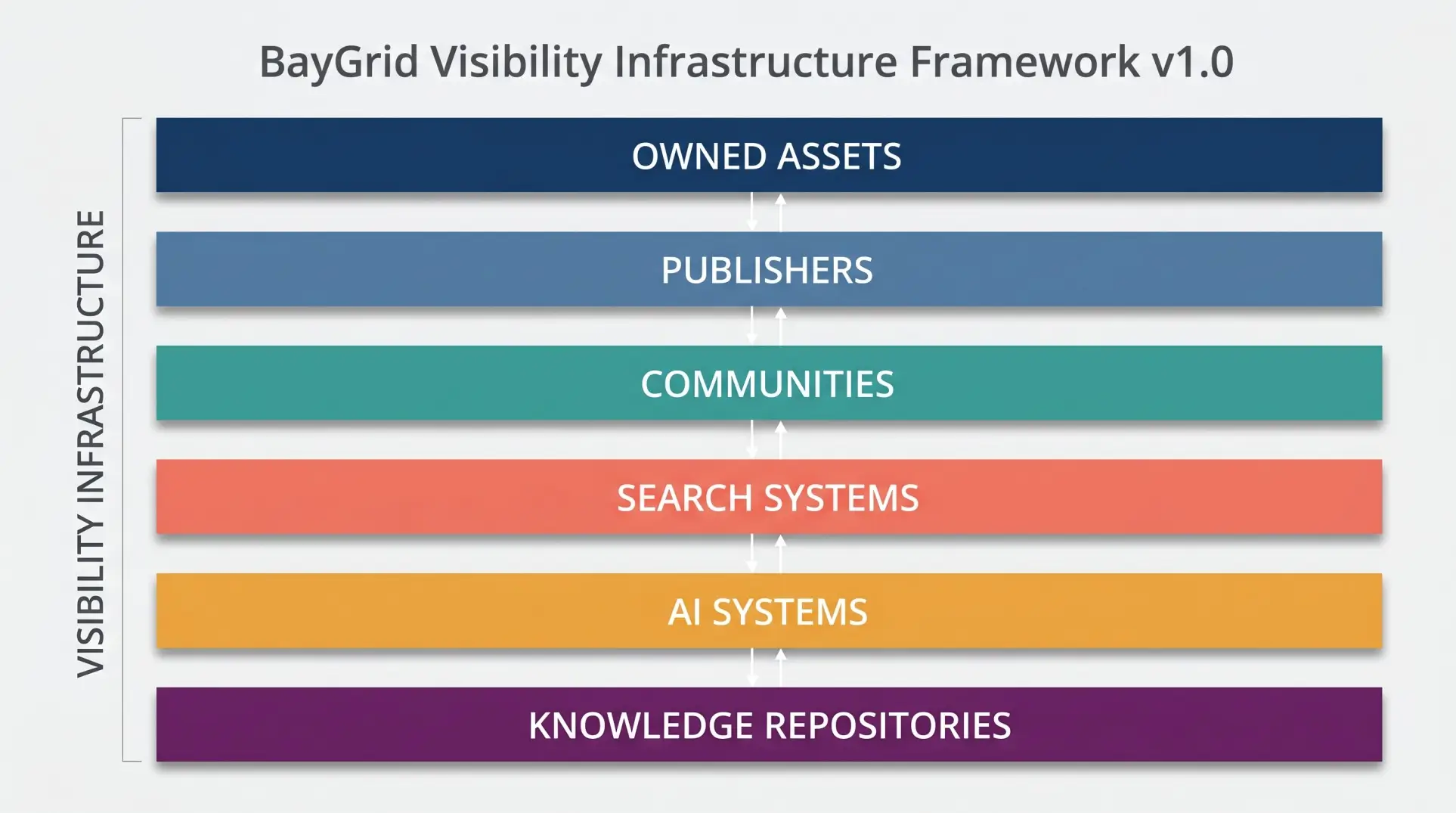
The BayGrid Standard: Visibility Infrastructure extends the systems perspective by identifying the structural components required for visibility to develop and persist. Visibility infrastructure includes:
- Information architecture: The structured, consistent and accessible organisation of information about the hospitality offering across all touchpoints.
- Distribution mechanisms: The channels, platforms and partnerships through which information flows from the organisation to its audiences.
- Validation systems: The external sources — reviews, media, professional recognition, accreditation — that confirm and reinforce organisational claims.
- Maintenance processes: The ongoing activities required to keep information accurate, current and responsive to changes in the organisation and its environment.
The infrastructure concept is important because it reframes visibility from a goal to be achieved into a capability to be maintained. Infrastructure does not produce discrete outcomes; it enables continuous functioning. A hospitality organisation with robust visibility infrastructure does not “do visibility” as a periodic activity. It exists within its information environment in a way that is structurally supported, maintained and reinforced. The Visibility Infrastructure Explained article examines this concept in greater depth.
Analysis
The Five-Layer Visibility Model
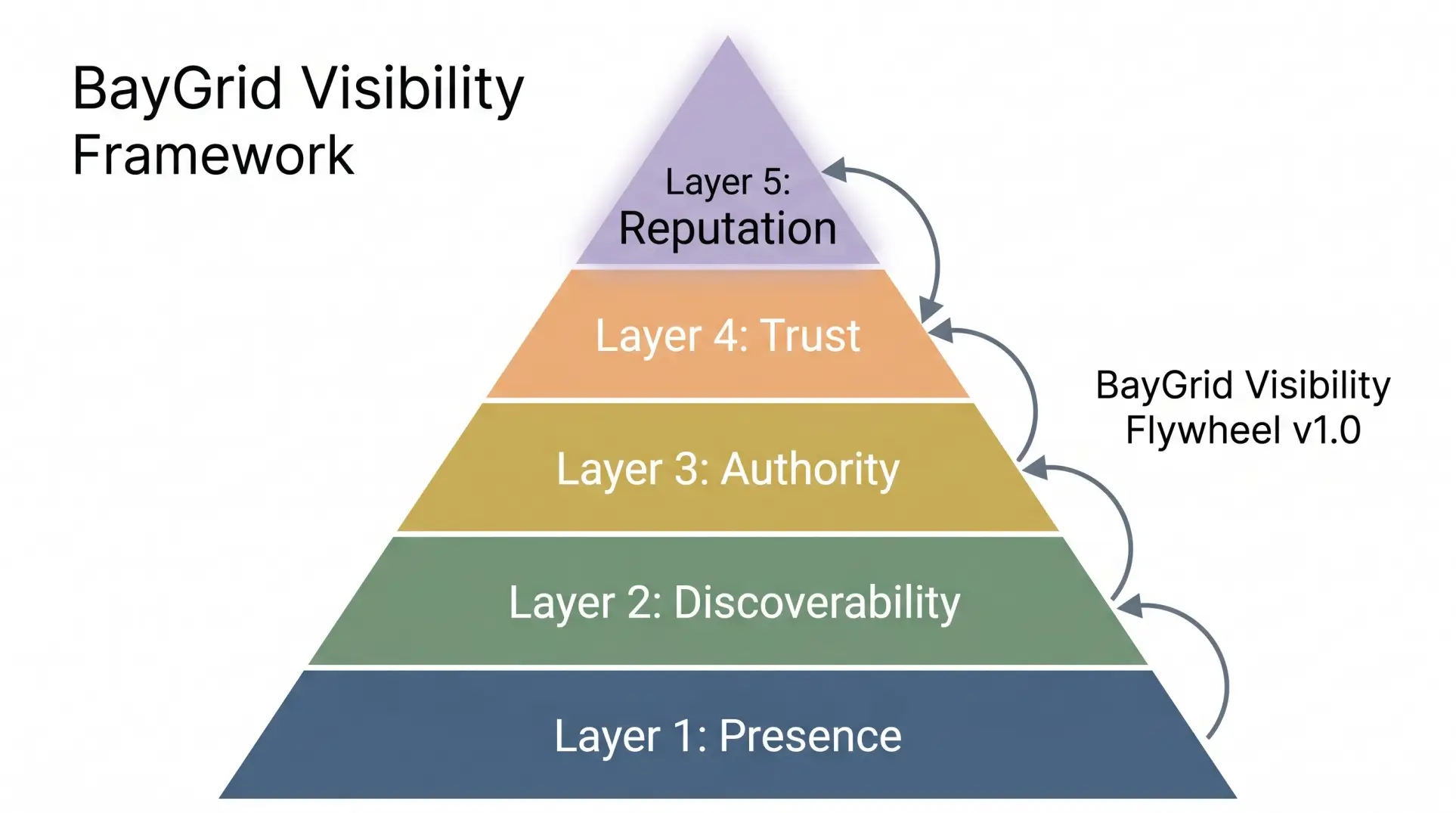
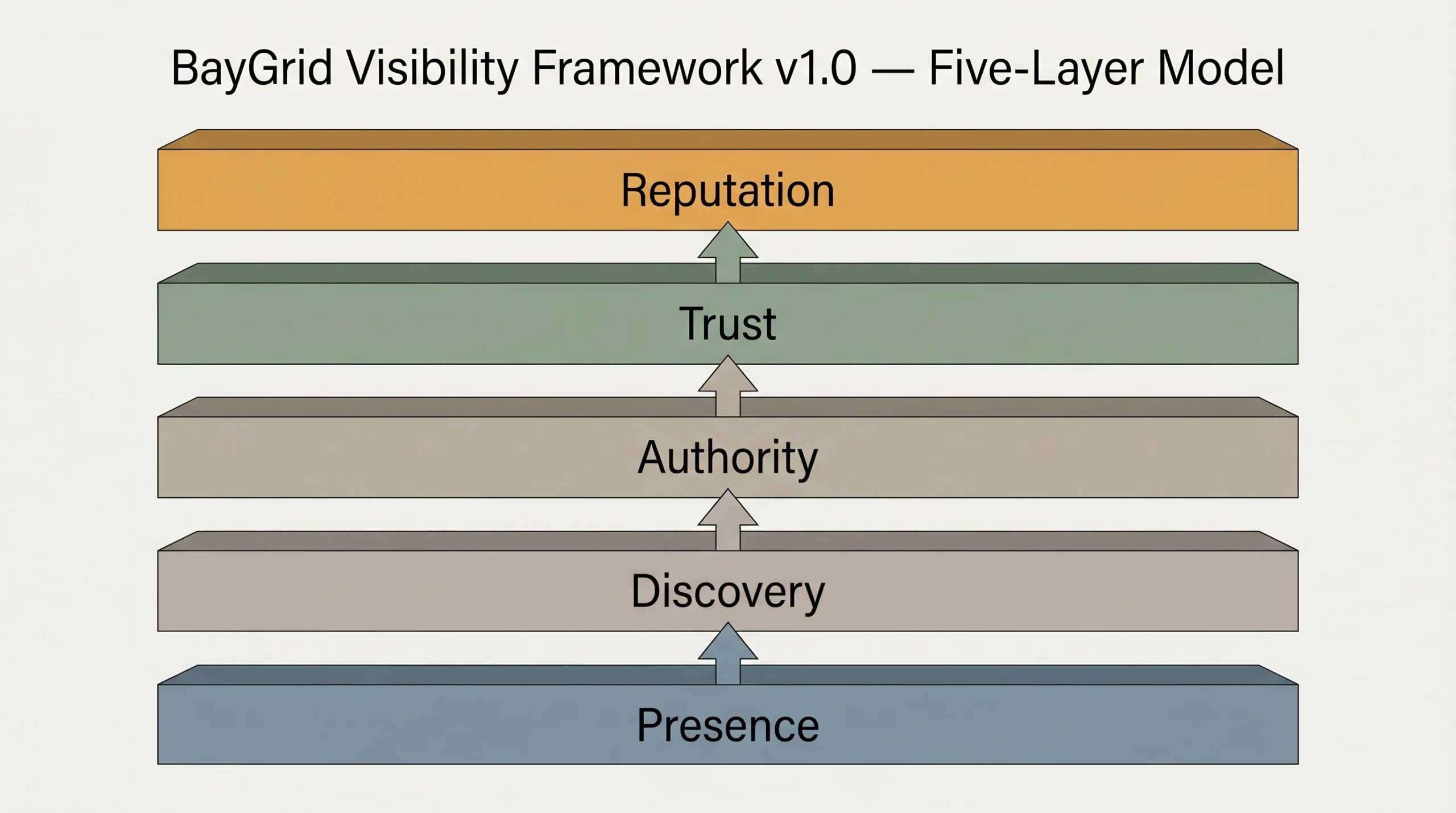
The BayGrid Visibility Framework v1.0 presents hospitality visibility as a five-layer system. Each layer represents a distinct functional dimension, and each layer depends upon the preceding one. The model is not a taxonomy but a developmental sequence — visibility develops through the progressive activation and reinforcement of each layer.
Layer 1: Presence
Presence is the foundational layer. It denotes the basic existence of an organisation within information environments. Presence means that an organisation can be found somewhere — on a map, in a directory, on a platform, in a database. Without presence, no other layer can develop.
Presence is frequently assumed rather than examined. Hospitality operators often believe they “have presence” because they have claimed a Google Business Profile or created an Instagram account. But presence is not the act of creation — it is the state of being locatable. An unverified business listing with incorrect information has nominal presence but functional absence. A social media account with no posts for eighteen months creates a presence signal that may be worse than no presence at all, because it communicates inactivity to those who encounter it.
The analysis suggests that presence should be understood in both quantitative and qualitative terms. Quantitative presence refers to the number of environments in which an organisation appears. Qualitative presence refers to the accuracy, completeness and currentness of the information at each appearance. Both dimensions are necessary; neither alone is sufficient.
Presence has two sub-components that merit identification:
- Declared presence: Information environments that the organisation has directly created or claimed (website, claimed business listings, owned social media profiles).
- Attributed presence: Information environments in which the organisation appears through the actions of others (review platforms where customers have created listings, media coverage, guidebook entries, third-party databases).
The ratio between declared and attributed presence is significant. An organisation with only declared presence has not yet achieved the distributed existence that characterises systemic visibility. Attributed presence indicates that the organisation has penetrated beyond its own communications into the broader information environment — a necessary condition for the development of subsequent layers.
Layer 2: Discovery
Discovery is the transition from existence to findability. An organisation may have presence (it exists in information environments) without being discoverable (it cannot be found by those looking for it). Discovery requires that an organisation’s presence be positioned such that relevant audiences encounter it during their information-seeking behaviour.
The BayGrid Standard: Discoverability distinguishes between two modes of discovery:
- Intentional discovery: The searcher is looking for something specific — “Italian restaurants in Bristol” or “boutique hotels in Lisbon.” The organisation must be positioned to appear in response to this directed search behaviour.
- Semi-intentional discovery: The searcher is exploring a category without a specific target in mind — browsing “best restaurants in London” or scrolling through map results in an unfamiliar neighbourhood. The organisation must be positioned to register during this exploratory behaviour.
Discovery depends upon the relationship between the organisation’s information footprint and the search behaviour of its potential audiences. This relationship is not static — it changes as search behaviour evolves, as platforms modify their ranking and display algorithms, and as competitors adjust their own presence strategies. The Future of Hospitality Discoverability examines how these dynamics are likely to evolve.
Discovery is also environment-specific. An organisation may be highly discoverable on one platform and effectively undiscoverable on another. Systemic visibility requires distributed discoverability — the capacity to be found across the range of environments that relevant audiences actually use.
Layer 3: Authority
Authority is the layer at which visibility transitions from being found to being taken seriously. An organisation may be discoverable without being authoritative — it appears in search results but does not command attention or credibility. Authority is the quality that causes an information seeker to register an organisation as a viable, credible option rather than filtering it out.
The Understanding Digital Authority article examines this concept in depth. For the purposes of this analysis, authority can be understood as the perceived credibility and knowledgeability that an organisation accumulates through the distribution of accurate, valuable and consistent information over time. Authority is not self-declared; it is conferred by the recognition of audiences, platforms and third-party validators.
Authority in hospitality contexts operates through several mechanisms:
- Informational authority: The organisation provides accurate, detailed and useful information that serves the information seeker’s needs. Menus are current. Opening hours are correct. Location information is precise. Contact details work.
- Experiential authority: The organisation’s actual service delivery matches or exceeds the expectations set by its information presence. The gap between promised and delivered experience is narrow or nonexistent.
- Referential authority: The organisation is cited, referenced and linked by credible third parties — media outlets, industry publications, professional organisations, educational institutions, other hospitality operators.
Authority compounds over time. Each accurate piece of information, each positive experience, each third-party reference adds to an authority foundation that makes subsequent authority accumulation easier. Conversely, authority erodes through inconsistency, inaccuracy and negative experiences. The asymmetry between authority accumulation and authority erosion is pronounced — authority takes years to build and can be damaged rapidly.
Layer 4: Trust
Trust is the layer at which visibility becomes relational. An organisation may be authoritative without being trusted — its credibility is acknowledged, but information seekers have not developed the confidence that leads to action. Trust is the bridge between being perceived as credible and being chosen.
Trust in hospitality contexts is distinct from general credibility. Credibility asks: “Is this organisation what it claims to be?” Trust asks: “Will this organisation deliver what I need?” The first question is about truthfulness; the second is about reliability. Both are necessary for visibility to translate into patronage.
The development of trust is examined in the Understanding Digital Trust article. The analysis here focuses on trust’s role within the visibility system. Trust develops through:
- Consistency over time: Information about the organisation remains accurate and stable. Reviews indicate consistent quality. The organisation’s presence does not fluctuate unpredictably.
- Transparency: Information is available, accessible and sufficient for decision-making. The organisation does not appear to hide relevant information.
- Responsiveness: The organisation engages with feedback, reviews and inquiries in a manner that demonstrates attentiveness and accountability.
- Social proof: Other people — especially those perceived as similar to the information seeker — have had positive experiences and have documented them.
Trust is the layer where visibility becomes most vulnerable to external events. A single serious food safety incident, a widely publicised service failure, or a pattern of negative reviews can damage trust sufficiently to collapse the visibility that depended upon it. The damage may not affect presence or discovery — the organisation may still appear in search results — but it affects the likelihood that discovery will lead to patronage.
Layer 5: Reputation
Reputation is the accumulated, distributed impression that an organisation leaves across its information environment. It represents the top layer of the visibility system — the outcome toward which the preceding layers develop. Reputation is not synonymous with “having good reviews.” Reviews are one input into reputation; reputation is the distributed, persistent impression that results from the aggregation of all visible signals about an organisation over time.
Reputation has several characteristics that distinguish it from the lower layers:
- Persistence: Reputation persists even when specific information changes. An organisation with a strong reputation may retain visibility advantages even during periods of negative attention because the accumulated reputation provides ballast against temporary downturns.
- Distributedness: Reputation exists across the information environment, not only in environments controlled by the organisation. It is what people say, write, remember and repeat — not only what the organisation publishes.
- Path dependence: Reputation development is influenced by the sequence of events. An organisation that builds strong foundational layers before encountering challenges is more resilient than one that faces challenges before its foundational layers are established.
The BayGrid Standard: Reputation provides additional definitional precision. For the purposes of this analysis, reputation is understood as the accumulated outcome of the visibility development process — the property that emerges when Presence, Discovery, Authority and Trust have developed and interacted over time.
Framework Application
Applying the BayGrid Visibility Framework v1.0
The BayGrid Visibility Framework v1.0 provides the structural model through which hospitality visibility can be analysed, measured and managed as a system. The framework’s five-layer model is not merely descriptive; it is diagnostic. Each layer can be assessed independently, and the relationships between layers can be examined to identify where a visibility system is functioning well and where it requires attention.
Diagnostic Application
The framework enables a diagnostic approach to visibility assessment. Rather than asking “How is our marketing performing?” — a question that channels analysis into tactical metrics — the framework asks:
- Where does the organisation have presence, and what is the quality of that presence?
- How discoverable is the organisation across the environments that relevant audiences use?
- What authority signals does the organisation emit, and how are they received?
- What trust indicators are visible to information seekers?
- What reputation has accumulated, and how is it distributed?
Each of these questions can be investigated systematically. The BayGrid Visibility Measurement Framework v1.0 provides methodologies for conducting this investigation. The measurement framework does not reduce visibility to a single score; it assesses each layer and the relationships between them, producing a visibility profile rather than a visibility number.
The Cumulative Process
The framework’s most significant implication is that visibility development is sequential and cumulative. Each layer depends upon the preceding one. An organisation cannot develop reputation without trust, cannot develop trust without authority, cannot develop authority without discovery, and cannot develop discovery without presence.
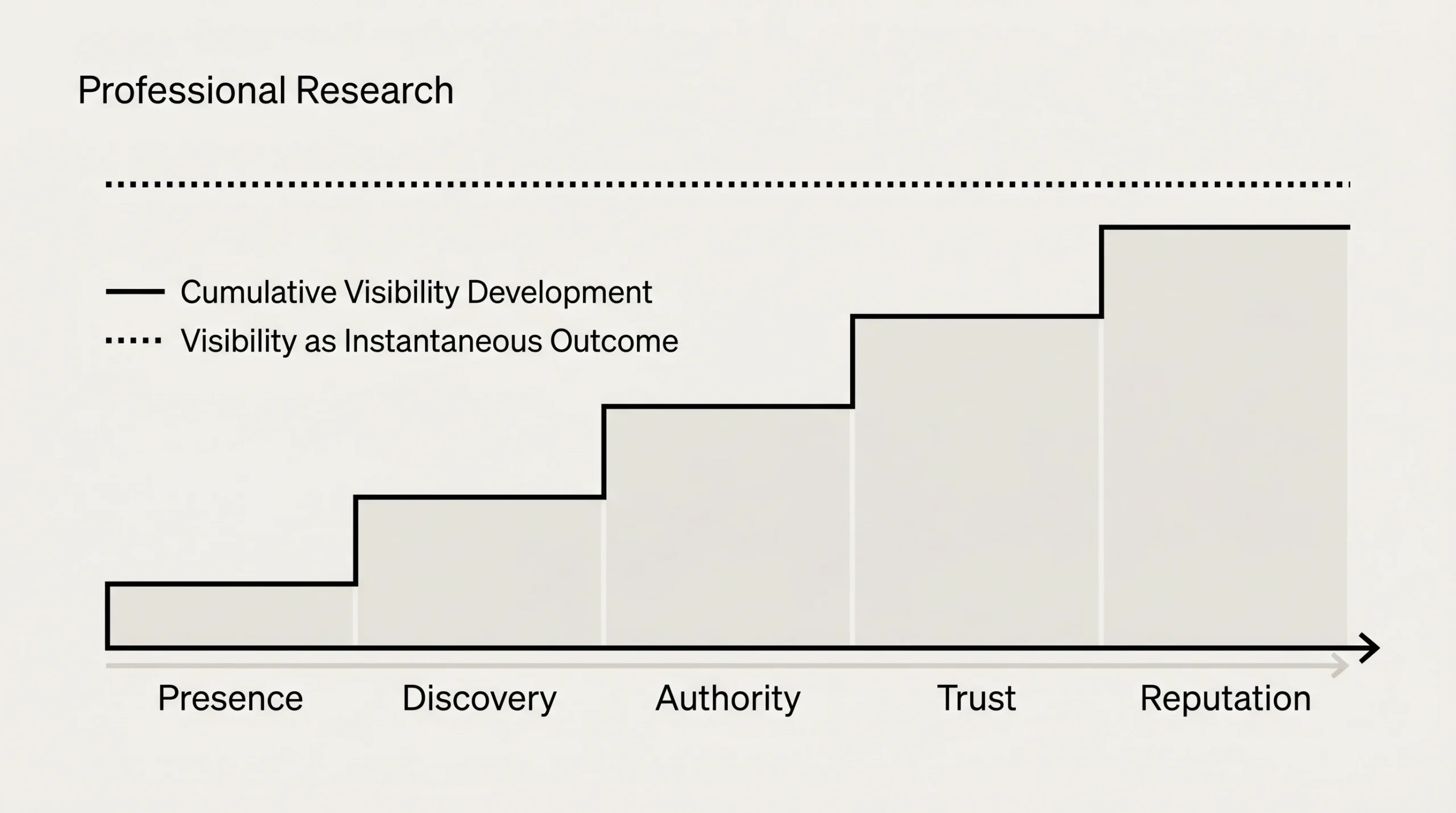
This sequential dependency has practical consequences. An organisation that invests heavily in reputation management (the top layer) without establishing reliable presence and discovery (the foundational layers) is building on unstable ground. Conversely, an organisation that has strong presence and discovery but has not developed authority and trust will find that its visibility does not translate into patronage — it is seen but not chosen.
The cumulative process also explains why visibility cannot be purchased instantaneously. Marketing campaigns can accelerate presence and improve discovery. They cannot, in compressed timeframes, generate the authority, trust and reputation that develop through repeated interactions between an organisation and its audiences over time.
Visibility Measurement Implications
The BayGrid Visibility Measurement Framework v1.0 applies the five-layer model to produce a structured assessment methodology. The measurement framework does not treat visibility as a single variable to be maximised. It treats visibility as a multi-dimensional property to be understood — with each dimension contributing differently to the organisation’s overall capacity to be discovered, recognised and understood.
The measurement framework produces what it terms a Visibility Profile — a structured representation of an organisation’s visibility across all five layers. This profile enables comparison over time (is visibility developing, stable or eroding?), comparison with relevant peers (how does our visibility profile compare to organisations we consider comparable?), and identification of priority areas (which layer represents the greatest constraint on overall visibility development?).
The framework’s measurement approach is distinct from conventional marketing analytics in several ways. It is cross-environmental rather than channel-specific. It is longitudinal rather than campaign-bound. And it is diagnostic rather than merely descriptive — it aims to explain visibility conditions, not only to report visibility metrics.
Implications
For Hospitality Organisations
The systems-level understanding of visibility developed in this paper has several implications for hospitality organisations:
- Visibility requires patience: The cumulative nature of visibility development means that investments in visibility infrastructure may not produce immediate measurable returns. Organisations must be prepared to invest in presence, accuracy and consistency over timeframes that exceed typical campaign cycles.
- Foundational layers are non-negotiable: Investments in higher-layer activities (reputation management, trust-building campaigns) will be undermined if foundational layers (presence, discovery) are deficient. The framework suggests a sequential investment logic.
- Visibility is not marketing: Marketing activities are inputs into the visibility system, not outputs of it. Organisations should assess whether their marketing activities are strengthening their visibility infrastructure or merely producing short-term channel metrics.
- Infrastructure is durable: Visibility infrastructure — accurate business listings, consistent information architecture, responsive maintenance processes — produces returns over extended periods. It should be treated as a capital investment rather than an operating expense.
For the Research Community
The analysis suggests several directions for further research:
- Cross-environmental measurement: Current visibility measurement approaches are predominantly channel-specific. Research is needed into methodologies for measuring visibility across multiple information environments simultaneously.
- Temporal dynamics: The cumulative process model implies specific temporal dynamics — how quickly do layers develop? At what rate does visibility erode when maintenance ceases? How do layer development rates vary across hospitality sub-sectors?
- Causal mechanisms: The framework identifies correlational relationships between layers. Research into the causal mechanisms that link layer development — particularly the transitions from authority to trust and from trust to reputation — would strengthen the framework’s practical applicability.
For Platform Governance
The platforms through which hospitality visibility is mediated — search engines, review platforms, mapping services, aggregators — are not neutral infrastructure. Their design decisions influence how visibility develops. The analysis suggests that platform governance should consider:
- The extent to which platform algorithms reward cumulative, consistent presence versus recent, intensive activity.
- The degree to which platform structures enable or inhibit the development of authority, trust and reputation as distinct from presence and discovery.
- The transparency of platform systems to hospitality operators who must navigate them to develop visibility.
Conclusion
This paper has examined hospitality visibility as a systems-level phenomenon, defined it through the BayGrid Standard: Hospitality Visibility, and presented the BayGrid Visibility Framework v1.0 as a model for understanding its development. The analysis has identified five key conclusions:
First, hospitality visibility is the degree to which an organisation can be discovered, recognised and understood across information environments. This definition emphasises that visibility is a property of the relationship between an organisation and its information environment, not a product of organisational activity alone.
Second, visibility develops through a five-layer cumulative process — Presence, Discovery, Authority, Trust and Reputation. Each layer depends upon the preceding one. This sequential dependency makes visibility resistant to short-term manipulation and explains why organisations with long histories of consistent presence often possess visibility advantages that newer organisations cannot readily replicate.
Third, visibility is a systems property rather than a marketing outcome. Marketing activities are inputs into the visibility system, but visibility itself is emergent — it arises from the interaction of multiple distributed elements over time and cannot be reduced to any single channel metric or campaign result.
Fourth, visibility requires infrastructure. The BayGrid Standard: Visibility Infrastructure identifies the structural components — information architecture, distribution mechanisms, validation systems and maintenance processes — that enable visibility to develop and persist independently of any specific marketing initiative.
Fifth, the distinction between visibility and marketing has practical consequences. Organisations that understand visibility as a systems property make different investment decisions, adopt different timeframes for assessment, and build different organisational capabilities than those that understand visibility as a marketing deliverable.
The Hospitality Visibility Ecosystem provides a broader context for understanding how these dynamics operate at industry scale. The Information Flow Model examines the mechanisms through which information moves through hospitality information environments. Together, these resources form a comprehensive framework for understanding, measuring and managing hospitality visibility as the systems property that it is.
References
This analysis draws on the BayGrid Visibility Framework v1.0 and BayGrid Visibility Measurement Framework v1.0. The conceptual foundations of the five-layer model are derived from systems theory as applied to information environments, with particular attention to the properties of emergent systems and cumulative processes. Direct empirical validation of the specific layer model across hospitality contexts is limited; the framework should be understood as a theoretical contribution requiring further empirical investigation. External references to platform-specific studies and marketing research are available in the BayGrid Bibliography.