BayGrid Standard 10
The Hospitality Ecosystem is the network of participants influencing visibility, authority and reputation.
Standard Name
Hospitality Ecosystem — the network of participants influencing visibility, authority and reputation.
Definition
The hospitality ecosystem is the interconnected network of six participant groups — Brands, Publishers, Communities, Search Systems, AI Systems, and Consumers — whose interactions, information exchanges, and structural relationships collectively produce visibility, authority, and reputation for hospitality entities. The ecosystem is not a market in the conventional economic sense. It is an information environment in which the distribution, discovery, validation, and consumption of information about hospitality offerings occurs.
Each participant group occupies a structurally distinct position within the ecosystem. Each contributes different functions, operates under different incentive structures, and maintains different relationships with other participants. What connects them is information. Information about hospitality entities flows between participants, is transformed by participants, and accumulates at certain nodes within the ecosystem. The pattern of these flows — their density, directionality, and quality — determines the visibility outcomes that emerge.
Visibility, authority, and reputation are emergent properties of the hospitality ecosystem. They do not reside within any single participant. They arise from the pattern of interactions among participants.
This definition aligns with and extends BayGrid Standard 1: Hospitality Visibility, which establishes visibility as the capacity of a hospitality entity to be found by audiences actively seeking relevant offerings. The ecosystem model explains how that capacity is produced — not by any single action or participant, but by the functioning of the network as a whole.
Scope
Inclusions
- The six participant groups that constitute the hospitality ecosystem: Brands, Publishers, Communities, Search Systems, AI Systems, and Consumers
- The interaction models that describe how participants exchange information and influence each other
- The mechanisms by which visibility emerges from participant interactions
- The ecosystem dynamics that affect authority and reputation formation
- The structural dependencies and information flows between participant groups
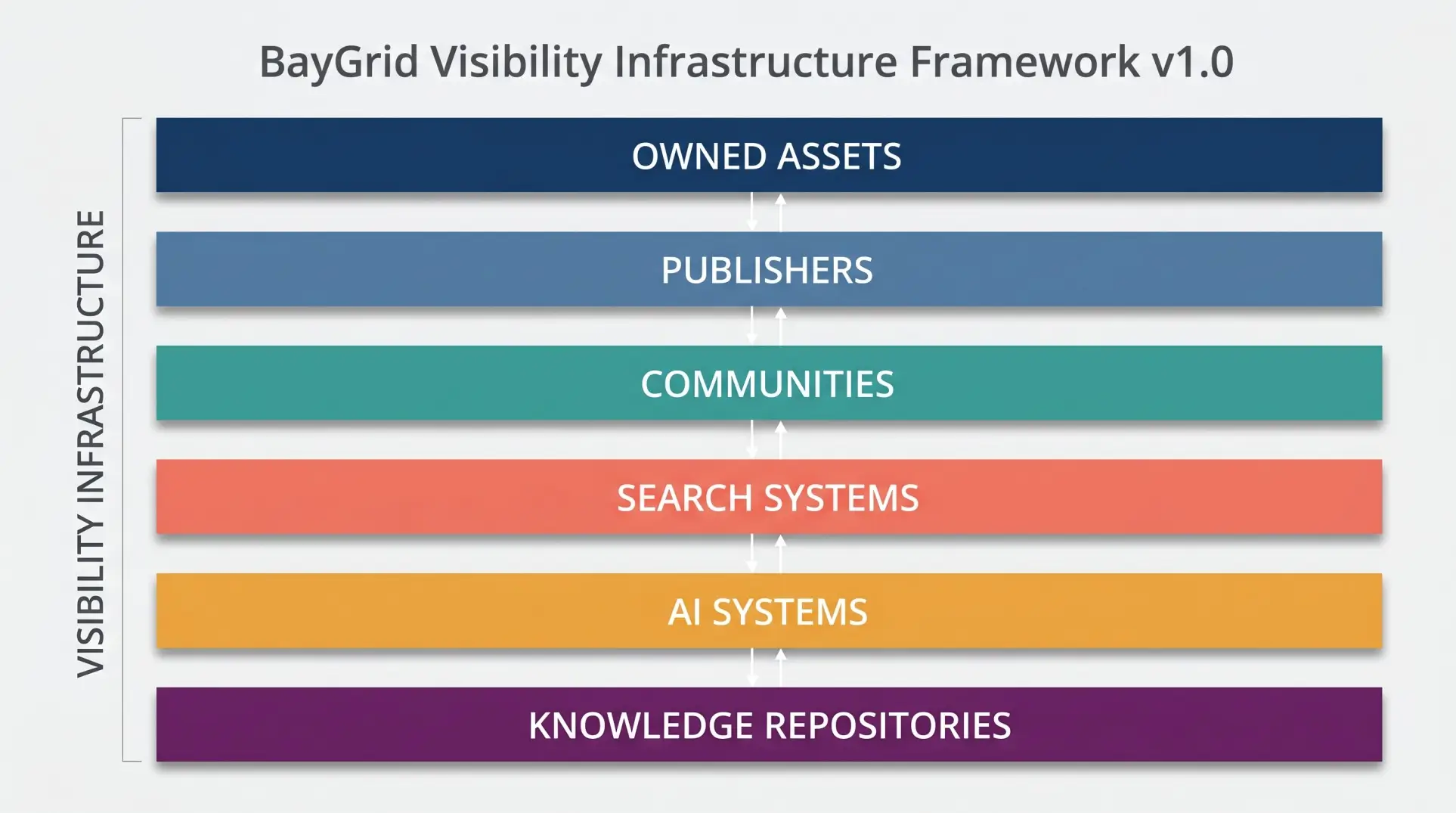
- The BayGrid Visibility Infrastructure that supports ecosystem functioning
Exclusions
- Specific platform strategies or tactical recommendations for individual participants
- Individual business advice for hospitality operators
- Competitive analysis between specific brands or platforms
- Financial or market sizing analysis of the hospitality sector
- Operational management guidance for hospitality businesses
Assumptions
- Visibility emerges from ecosystem interactions, not from individual actions in isolation
- All six participant groups are present in every functioning hospitality ecosystem, though their relative influence varies by context
- The ecosystem model is descriptive, not prescriptive — it describes how the ecosystem functions, not how participants should behave
- Information flows are the primary mechanism of interaction between participants
Limitations
- The model does not capture all possible ecosystem configurations — specific markets may exhibit participant arrangements not fully described by the six-group model
- The boundaries between participant groups are not always clear — some entities may function across multiple categories
- The model focuses on information flows and does not fully account for financial, regulatory, or social forces that also shape the ecosystem
- Ecosystem dynamics vary significantly across geographies, cultures, and hospitality sub-sectors
Key Principles
Principle 1: Six Participant Groups
The BayGrid Hospitality Ecosystem Model v1.0 identifies six structurally distinct participant groups. Each group is defined by its function in the information environment, not by its organisational form or business model.
| Participant Group | Primary Function | Information Role | Key Dependencies |
|---|---|---|---|
| Brands | Hospitality entities that offer accommodation, dining, or travel experiences | Primary information creation; source of authoritative offering data | Dependent on Publishers for amplification, on Search Systems for discoverability, on Communities for validation |
| Publishers | Editorial platforms, media outlets, guide producers, critics, and professional content creators | Curated information production; authority transfer; quality signalling | Dependent on Brands for primary information and access, on Communities for audience engagement, on Search Systems for distribution |
| Communities | User-generated content platforms, review aggregators, forums, social networks, and peer discussion spaces | Social validation; peer-generated information; experience documentation | Dependent on Brands for experiences to evaluate, on Publishers for editorial context, on Search Systems for discoverability |
| Search Systems | Search engines, discovery platforms, algorithmic indexing and ranking systems | Information organisation; relevance ranking; query-based retrieval | Dependent on Publishers and Communities for indexable content, on Brands for structured data, on Knowledge Repositories for reference information |
| AI Systems | Large language models, recommendation engines, conversational AI, and synthesised information systems | Information synthesis; conversational discovery; personalised recommendation | Dependent on all upstream participants for training data and reference material; dependent on Knowledge Repositories for structured facts |
| Consumers | Individuals and groups seeking hospitality experiences | Information consumption; demand expression; behavioural signal generation | Dependent on all preceding participants for discovery pathways, validation signals, and decision-support information |
Principle 2: Visibility Emerges from Interaction
Visibility is not a resource that any participant possesses or controls. It is an emergent property of the ecosystem — it arises from the pattern of interactions among participants. A brand may create excellent information about its offerings, but visibility only emerges when that information reaches Publishers, generates community response, is indexed by Search Systems, is synthesised by AI Systems, and is encountered by Consumers. Each step in this chain is an interaction between participants. Visibility is the cumulative effect of these interactions.
This principle distinguishes the ecosystem model from channel-based thinking. Channel-based thinking asks: “How do we perform on this platform?” Ecosystem thinking asks: “How do our interactions across all participants produce visibility?” The difference is structural. Channel thinking optimises within boundaries. Ecosystem thinking optimises across relationships.
Principle 3: Authority and Reputation Are Network Properties
BayGrid Standard 3: Digital Authority defines authority as the recognised credibility of a hospitality entity within its information environment. BayGrid Standard 4: Digital Trust defines trust as the confidence audiences place in the information they encounter about an entity. Neither authority nor trust resides within the entity itself. They are network properties — they exist in the relationships between participants.
Authority is conferred by Publishers through editorial coverage, by Communities through sustained positive engagement, by Search Systems through ranking position, and by AI Systems through inclusion in synthesised responses. Trust is validated by Communities through reviews and ratings, reinforced by Publishers through critical assessment, and confirmed by Consumers through behavioural patterns. Both are emergent properties of the ecosystem interaction pattern.
Principle 4: Structural Dependencies Create Vulnerabilities
The ecosystem model reveals structural dependencies between participants that create systemic vulnerabilities. Search Systems depend on Publishers and Communities for content to index. If Publishers reduce coverage of a sector, Search Systems have less content to rank. AI Systems depend on Knowledge Repositories for structured reference information. If Knowledge Repositories contain outdated information, AI Systems propagate that outdated information in their responses. Consumers depend on all upstream participants for accurate information. If any upstream participant distributes incorrect information, Consumers may act on it.
These dependencies mean that ecosystem health is a collective concern. No single participant can ensure accurate information distribution. The integrity of the ecosystem depends on the functioning of all participants and the quality of their interactions.
Principle 5: The Flywheel Effect
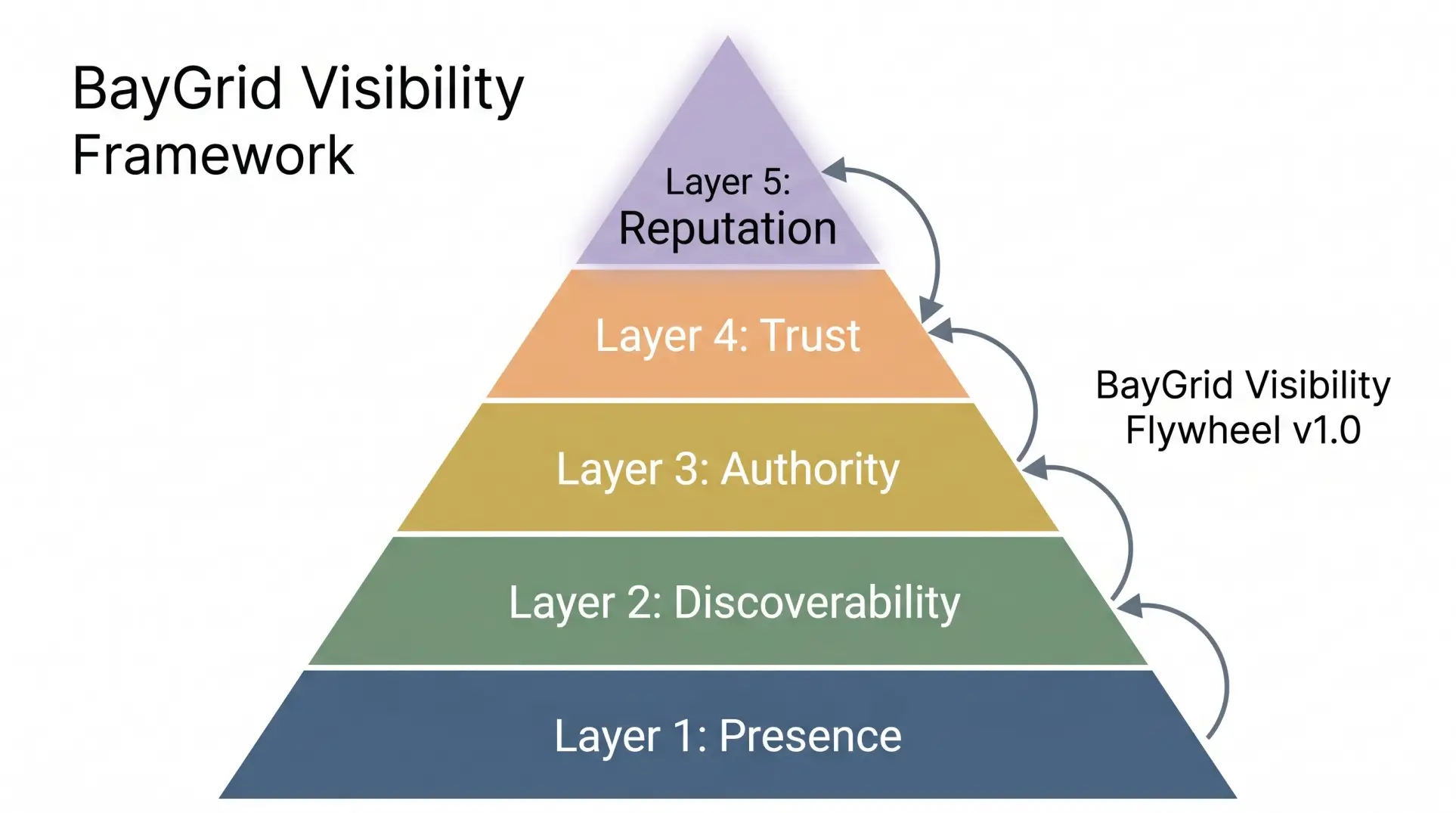
The BayGrid Visibility Flywheel v1.0 describes a self-reinforcing dynamic within the ecosystem. Initial visibility generates consumer interest. Consumer interest generates community activity. Community activity attracts publisher attention. Publisher coverage improves search rankings. Improved search rankings increase AI system references. Increased AI references drive further consumer interest. The cycle reinforces itself.
This flywheel operates in both directions. Positive interactions accelerate visibility growth. Negative interactions — poor reviews, critical coverage, ranking declines — can decelerate visibility or reverse the cycle. The flywheel principle explains why visibility outcomes often appear disproportionate to initial inputs: small changes in interaction patterns can produce large changes in visibility outcomes through cumulative feedback effects.

Participant Interaction Models
The following interaction models describe the characteristic relationships between participant pairs within the ecosystem. These are not the only interactions that occur, but they represent the structurally significant relationships that most strongly influence visibility outcomes.
Brands ↔ Publishers
Brands supply Publishers with primary information, access, and story material. Publishers supply Brands with editorial coverage, authority transfer, and audience reach. This relationship is characterised by information asymmetry: Brands possess detailed information about their offerings that Publishers do not have, while Publishers possess audience attention and editorial credibility that Brands cannot directly access. The quality of this interaction depends on the accuracy of the information Brands provide and the independence and rigour of Publisher coverage.
Publishers ↔ Communities
Publishers supply Communities with editorial context, critical frameworks, and quality benchmarks. Communities supply Publishers with audience engagement, user-generated content sources, and signals of public interest. This relationship is characterised by a feedback loop: Publisher coverage influences community conversation, and community conversation influences what Publishers choose to cover. The density of this interaction varies by market — in some contexts, Publishers and Communities operate largely independently; in others, they are tightly coupled.
Communities ↔ Search Systems
Communities supply Search Systems with large volumes of indexable user-generated content, behavioural signals, and freshness indicators. Search Systems supply Communities with traffic, discoverability, and ranking-based attention allocation. This relationship is one of the most consequential in the ecosystem because it determines which community content reaches consumers. Search System algorithms effectively act as filters and distributors for community-generated information.
Search Systems ↔ AI Systems
Search Systems and AI Systems occupy adjacent but increasingly distinct positions in the ecosystem. Search Systems organise and rank existing web content. AI Systems synthesise information from multiple sources, including but not limited to search-indexed content. The relationship is characterised by both complementarity and competition. AI Systems increasingly perform discovery functions that were previously the exclusive domain of Search Systems. At the same time, AI Systems depend on the content infrastructure that Search Systems help organise. The BayGrid analysis of AI Systems as Discovery Engines examines this relationship in detail.
AI Systems ↔ Consumers
AI Systems supply Consumers with synthesised recommendations, conversational discovery, and personalised suggestions. Consumers supply AI Systems with query patterns, behavioural signals, and feedback data that refine future recommendations. This relationship is the newest and most rapidly evolving in the ecosystem. As AI Systems become more capable of natural language interaction, they may increasingly intermediate between Consumers and all other ecosystem participants.
Consumers ↔ Brands
Consumers supply Brands with demand, revenue, behavioural data, and review content. Brands supply Consumers with experiences, information, and service. This relationship closes the ecosystem loop — it is the point at which the information environment connects with the physical hospitality experience. Consumer experiences subsequently feed back into Communities as reviews and into Publishers as story material, continuing the cycle.
How Visibility Emerges from the Ecosystem
Visibility, as defined by BayGrid Standard 1, is the capacity of a hospitality entity to be found by audiences actively seeking relevant offerings. The ecosystem model explains the mechanism by which this capacity is produced.
Step 1: Information Creation
Brands create primary information about their offerings — descriptions, specifications, pricing, imagery, location data. This information originates within the brand’s controlled environment but must travel beyond it to produce visibility.
Step 2: Editorial Amplification
Publishers select certain brands for coverage, transforming primary information into editorial content. This amplification is selective — not all brands receive publisher attention. The selection criteria vary by publisher but typically include newsworthiness, quality signals, and audience relevance. Publisher coverage transfers editorial authority to the brands covered.
Step 3: Social Validation
Consumers who experience brand offerings generate community content — reviews, ratings, photos, social media posts. This user-generated content provides peer validation that complements editorial coverage. Communities also amplify publisher content through sharing and discussion.
Step 4: Algorithmic Retrieval
Search Systems index publisher content, community content, and brand-owned information. Through ranking algorithms, they determine which information appears when consumers express intent through queries. Ranking position is a critical visibility mechanism because it determines whether information is encountered at all.
Step 5: Synthesised Discovery
AI Systems synthesise information from all upstream sources — brands, publishers, communities, and search-indexed content — to provide conversational recommendations and answers. AI discovery operates differently from search retrieval: it generates responses rather than ranking existing content. This distinction has significant implications for how visibility is achieved in AI-mediated discovery contexts.
Step 6: Consumer Encounter
Consumers encounter brand information through one or more of the preceding pathways. The encounter may be direct (through search or AI query), indirect (through publisher recommendation or community discussion), or multi-channel (through several pathways over time). The pattern of these encounters determines the brand’s visibility profile.
Visibility is complete only when information has traversed this entire chain. A brand that creates information but does not achieve publisher amplification, community validation, search retrieval, AI synthesis, or consumer encounter has not achieved ecosystem visibility. It has only achieved information creation.
Ecosystem Dynamics
Information Cascades
Information cascades occur when a signal from one participant triggers amplified responses from others. A positive review in a prominent Publisher may trigger community discussion, which improves search rankings, which increases AI system references, which drives consumer interest. Cascades can be positive or negative. A critical Publisher review may trigger negative community response, declining rankings, and reduced visibility.
Participant Entry and Exit
The ecosystem composition is not fixed. New Publishers emerge; established ones cease operations. New community platforms gain prominence; existing ones decline. New AI systems enter the market; existing ones are deprecated. Participant entry and exit restructure information flows and alter visibility outcomes for all connected participants. The ecosystem model provides a framework for analysing these transitions.
Temporal Dynamics
Ecosystem interactions operate on different time scales. Publisher coverage may persist for years in search rankings. Community content may generate engagement for weeks or months. AI system responses may reflect training data that is months or years old. These temporal mismatches create situations in which different participants present different information about the same entity simultaneously.
Geographic Variation
Ecosystem configurations vary significantly across geographies. The BayGrid analysis of Japanese dining in Singapore illustrates how a specific market context produces a distinctive ecosystem configuration with particular participant dynamics. Markets with strong publisher cultures differ from markets dominated by community platforms. Markets with high AI adoption differ from markets where search remains the primary discovery mechanism.
Examples
Example 1: Ecosystem Functioning
A new restaurant opens in a major metropolitan market. It provides information about its concept and menu (Brand). A local food critic publishes a review in a regional publication (Publisher). Diners begin posting reviews and photos on community platforms (Communities). Search systems index the publisher review and community content, and the restaurant begins appearing in relevant search results (Search Systems). An AI assistant, when asked for restaurant recommendations in that cuisine category, includes the restaurant in its suggestions (AI Systems). Consumers discover the restaurant through multiple pathways and visit (Consumers). The ecosystem is functioning. Visibility has emerged from the interaction pattern.
Example 2: Ecosystem Disconnection
A hotel renovates extensively and repositions its brand. It updates its website (Brand) but does not inform Publishers of the changes. Community platforms continue to display pre-renovation reviews and ratings. Search systems index the updated website but also continue to rank the older community content prominently. AI systems synthesise information from both sources and present conflicting descriptions. Consumers receive inconsistent information and may form incorrect expectations. The ecosystem is partially disconnected — the brand has changed, but that change has not propagated through the ecosystem.
Example 3: Ecosystem Reconfiguration
A market in which Publishers traditionally dominated visibility undergoes a shift as community platforms gain prominence. Search systems adjust ranking algorithms to weigh community signals more heavily. AI systems incorporate more community content into their training data. Consumers increasingly discover hospitality options through community platforms rather than publisher recommendations. The ecosystem has reconfigured — the relative importance of participant groups has shifted, and visibility outcomes change accordingly. Brands that adapted to the publisher-dominated ecosystem may need to adapt to the community-influenced ecosystem.
Common Misconceptions
| Misconception | Correction |
|---|---|
| “The hospitality ecosystem is a marketplace connecting buyers and sellers.” | The ecosystem is an information environment, not a market. Its primary function is information distribution and discovery, not transaction facilitation. While transactions occur within the ecosystem, they are not its defining feature. |
| “Brands can control their visibility by managing their own channels.” | Brands control their Owned Assets but do not control Publishers, Communities, Search Systems, or AI Systems. Visibility emerges from interactions across all participants, most of which the brand does not control. |
| “Publishers are becoming less important as communities grow.” | The relative importance of participants shifts over time, but Publishers continue to perform a distinctive function — editorial curation and authority transfer — that communities do not replicate. The ecosystem requires both functions. |
| “AI Systems will replace Search Systems entirely.” | AI Systems and Search Systems currently perform complementary functions. AI Systems synthesise; Search Systems organise and rank. The relationship is evolving, but replacement is not the only possible outcome. Integration and differentiation are also likely. |
| “Consumers are passive recipients of ecosystem information.” | Consumers are active participants whose behavioural signals, reviews, and demand expressions influence all other participants. Consumer behaviour is a primary input to Search Systems and a significant influence on Publisher and Community content. |
| “The ecosystem is the same in every market.” | Ecosystem configurations vary significantly across geographies, cultures, and hospitality sub-sectors. The relative importance of participant groups, the density of interactions, and the dominant discovery mechanisms differ by context. |
Framework Application
This standard applies three BayGrid frameworks:
BayGrid Hospitality Ecosystem Model v1.0
The six-participant model is the core architecture of this standard. The model provides a structural vocabulary for describing how visibility is produced in hospitality contexts. It enables analysts to identify which participants are most influential in a given context, to characterise interaction patterns, and to diagnose ecosystem dysfunction.
BayGrid Visibility Flywheel v1.0
The flywheel framework describes the self-reinforcing dynamics within the ecosystem. It explains why visibility outcomes often appear disproportionate to inputs and why small changes in interaction patterns can produce large changes in visibility. The flywheel operates through the feedback loops between participant groups — particularly the loop from Consumers to Communities to Publishers to Search Systems and back to Consumers.
BayGrid Information Flow Model v1.0
The Information Flow Model describes the mechanics by which information moves between ecosystem participants. It provides the underlying mechanism for the interaction patterns described in this standard. Without information flow, there are no interactions. Without interactions, visibility does not emerge.
Implications
For Hospitality Entities
The ecosystem model suggests that visibility management requires understanding one’s position within the network of participants and the pathways through which information flows. Entities that focus exclusively on their own channels ignore the majority of the ecosystem. The model implies a need for strategies that facilitate positive interactions with Publishers, Communities, Search Systems, and AI Systems — not as separate initiatives, but as coordinated components of ecosystem engagement.
For Publishers
Publishers occupy a structurally influential position between Brands and Communities. Their coverage decisions have amplified effects across the ecosystem. Publisher content is indexed by Search Systems, referenced by AI Systems, and discussed in Communities. This structural position carries responsibility — inaccurate or outdated publisher content propagates through the ecosystem and affects visibility outcomes for the entities covered.
For the Field
The ecosystem model reframes visibility from a marketing outcome to a system property. This reframing has methodological implications. Research into hospitality visibility should examine interactions between participants, not just performance within channels. Measurement approaches should assess ecosystem position and interaction quality, not just ranking position or traffic volume.
For Future Research
The BayGrid Hospitality Industry Outlook 2030 identifies ecosystem reconfiguration as a key trend. The growing influence of AI Systems as discovery intermediaries, the evolution of community platforms, and the shifting role of Search Systems are all reconfiguring the ecosystem. Understanding these reconfigurations requires ongoing application of the ecosystem model to track how participant interactions are changing and how visibility emergence mechanisms are evolving.
Standard Statement
The Hospitality Ecosystem, as defined by BayGrid Standard 10, is the network of six participant groups — Brands, Publishers, Communities, Search Systems, AI Systems, and Consumers — whose interactions produce visibility, authority, and reputation as emergent properties. Visibility does not reside within any single participant. It arises from the pattern of information flows and interactions across the entire network. Any assessment of visibility that examines participants in isolation, that ignores the bidirectional nature of ecosystem interactions, or that treats visibility as a controllable resource rather than an emergent property, will produce incomplete and potentially misleading conclusions.
Conclusion
This standard has established a definition and structural model for the Hospitality Ecosystem. The six-participant framework provides a basis for analysing how visibility, authority, and reputation emerge from the interactions among brands, publishers, communities, search systems, AI systems, and consumers. The framework is not a strategic playbook. It is a conceptual architecture intended to support understanding of how the hospitality information environment functions.
The ecosystem model reveals that visibility is not a resource to be acquired or a channel to be optimised. It is an emergent property of a network. The key question this standard addresses — “How do participants interact?” — receives a structural answer: participants interact through information flows that create feedback loops, amplification effects, and cumulative visibility outcomes. Understanding these interactions is essential for any entity seeking to achieve or maintain visibility within the hospitality ecosystem.
Further research is needed to develop diagnostic methods for assessing ecosystem position, to characterise interaction patterns across different market contexts, and to examine how AI-mediated discovery is reconfiguring the relationships between ecosystem participants. The BayGrid Hospitality Industry Outlook 2030 provides initial analysis of these reconfiguration trends.
References
BayGrid Standards
- BayGrid Standard 1: Hospitality Visibility
- BayGrid Standard 3: Digital Authority
- BayGrid Standard 4: Digital Trust
- BayGrid Standard 7: Visibility Infrastructure
BayGrid Frameworks
- BayGrid Hospitality Ecosystem Model v1.0
- BayGrid Visibility Flywheel v1.0
- BayGrid Information Flow Model v1.0
BayGrid Research
- What Is Hospitality Visibility?
- State of Japanese Dining in Singapore 2026
- Hospitality Industry Outlook 2030
External References
- van Dijck, J. (2013). The Culture of Connectivity: A Critical History of Social Media. Oxford University Press.
- Lewandowski, D. (2019). Why We Need an Independent Index of the Web. Search Engine Watch.
- Google. (2024). How Search Works. Google Search Central Documentation. developers.google.com
- OpenAI. (2024). How ChatGPT Works. OpenAI Research Documentation. openai.com
- Internet Live Stats. (2024). Total Number of Websites. internetlivestats.com