Definition, Formation, and Measurement of User Confidence in Information Environments
Executive Summary
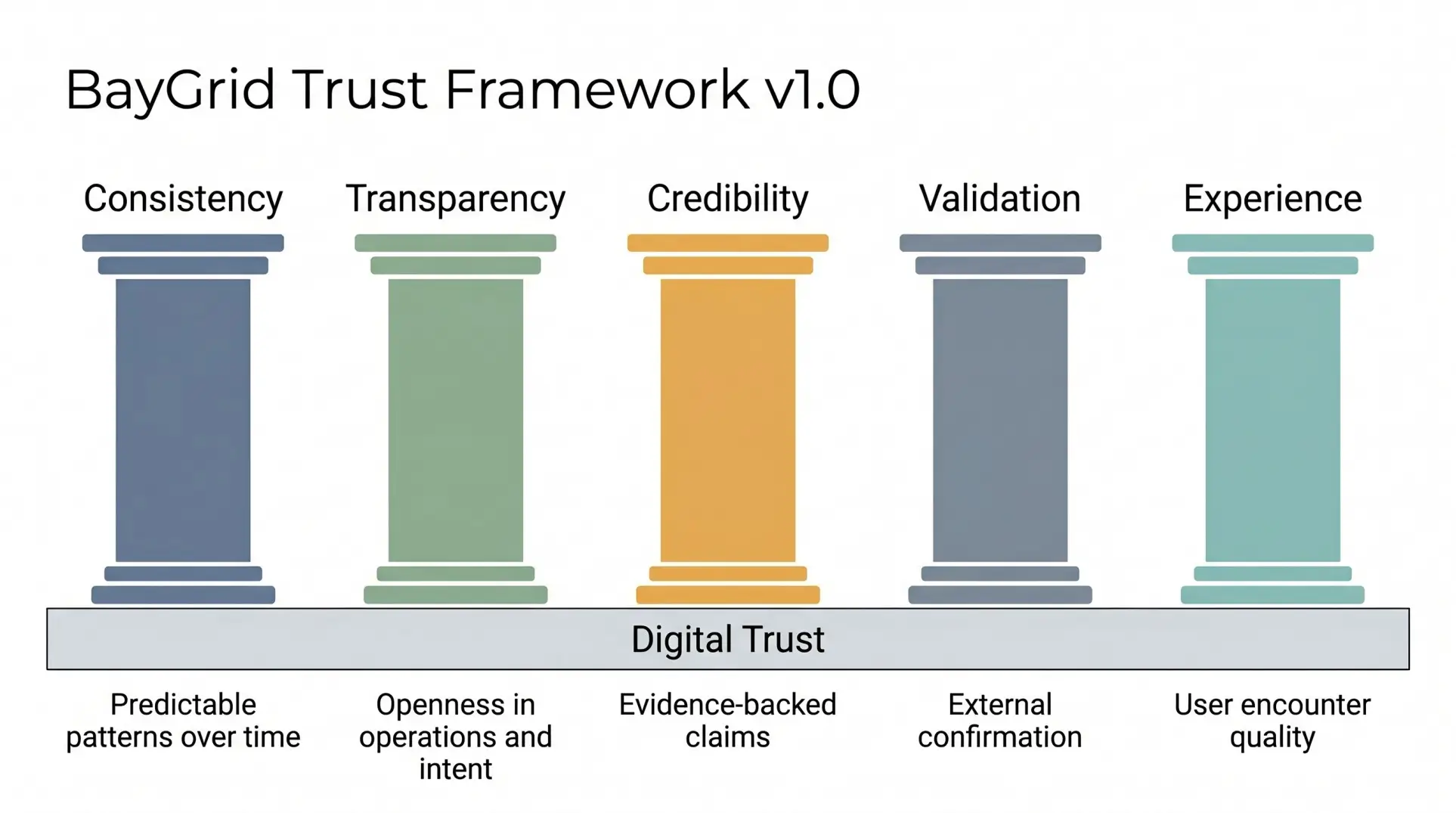
This paper establishes the BayGrid Standard for Digital Trust, defined as “the confidence users place in information.” The central question this standard addresses is: “Do people believe what they are seeing?” Digital trust is examined not as a technical mechanism but as a perceptual outcome — the result of repeated confirmation between what an information source presents and what a user subsequently experiences. This standard draws upon the BayGrid analysis of digital trust dynamics and is structurally supported by the BayGrid Trust Framework v1.0, which identifies five pillars of trust formation: Consistency, Transparency, Credibility, Validation, and Experience.
Standard Definition
Standard 4: Digital Trust — The confidence users place in information. Trust is earned through repeated confirmation between stated claims and experienced reality, not through declaration or assertion. The operative question for any information environment is: “Do people believe what they are seeing?”
Scope
This standard addresses the definition, formation mechanisms, trust signals, and relationship between trust, credibility, and confidence in information environments. It covers how trust is established through repeated user encounters, how trust signals are transmitted and received, and how trust may be measured through behavioural indicators.
This standard does not cover cybersecurity standards, technical trust protocols, encryption methods, or authentication mechanisms. Those domains are governed by separate technical standards bodies and are outside the scope of BayGrid visibility infrastructure research.
Key Assumptions
- Trust is earned, not declared. No information source can assert trustworthiness into existence. Trust accumulates through successive confirmations that what is presented aligns with what is subsequently experienced.
- Trust is context-dependent. The threshold for trust varies by information domain, user prior experience, and the stakes of the decision being informed.
- Trust operates on a gradient. Trust is not binary (trusted/untrusted) but exists on a continuum from suspicion through conditional acceptance to confident reliance.
Limitations
This standard identifies principles for trust assessment but does not prescribe specific measurement methodologies or tools. Organisations seeking to measure digital trust should develop or adopt instruments appropriate to their specific information environment and user population.
Key Concepts
Trust vs. Credibility vs. Confidence
This standard distinguishes between three related but distinct concepts:
| Concept | Definition | Orientation |
|---|---|---|
| Credibility | The quality of being believable or worthy of belief based on evidence or qualifications | Attribute of the information source |
| Confidence | The feeling of self-assurance arising from one’s own assessment | Internal state of the user |
| Trust | The confidence placed in an information source based on accumulated positive encounters | Relationship between user and source |
Credibility contributes to trust but is not synonymous with it. A source may be credible — holding appropriate qualifications, presenting evidence — and yet fail to earn trust if user experience contradicts presented claims. Conversely, trust may exist in situations where formal credibility markers are absent, built instead through repeated satisfactory encounters. This distinction is examined further in the BayGrid Standard: Digital Authority.
Trust Signals
Trust signals are observable indicators that users interpret when assessing whether to place confidence in an information source. This standard classifies trust signals into three categories:
- Systemic signals: Structural indicators such as domain longevity, information architecture quality, cross-platform presence consistency, and operational transparency
- Institutional signals: Markers of recognised standing such as affiliations, certifications, peer acknowledgment, and third-party validation
- Interpersonal signals: Direct encounter qualities including responsiveness, accuracy of information, alignment between promise and delivery, and communication clarity
The accumulation of positive trust signals across these three categories creates the conditions under which users transition from cautious evaluation to confident reliance.
Trust Formation Mechanism
This standard identifies a three-phase trust formation mechanism observed across information environments:
- Phase 1 — Signal Reception: The user encounters initial trust signals (systemic, institutional, or interpersonal) and forms a provisional assessment. At this phase, trust is tentative and conditional.
- Phase 2 — Confirmation Cycle: Through repeated encounters, the user tests whether initial signals hold. Each confirmation reinforces trust; each contradiction erodes it. The number of cycles required varies by context and user disposition.
- Phase 3 — Reliance Transfer: Upon sufficient accumulation of confirmed signals, the user shifts from active evaluation to passive reliance. Information from the trusted source is accepted with reduced scrutiny, though this state is not permanent — significant contradictions can revert trust to earlier phases.
Framework Application: BayGrid Trust Framework v1.0
The BayGrid Trust Framework v1.0 provides the structural model through which digital trust is analysed and assessed. The framework comprises five pillars, each representing a distinct dimension of trust formation. All five pillars contribute to the overall trust structure; weakness in any pillar creates vulnerability in the trust relationship.
Pillar 1: Consistency
Consistency refers to predictable patterns observed over time across all user touchpoints. An information source demonstrates consistency when its messaging, quality, positioning, and behaviour remain stable and coherent across encounters. Inconsistency — contradictory claims, variable quality, or unpredictable behaviour — is among the most rapid trust-eroding factors identified in this standard.
Consistency operates in relation to the BayGrid Standard: Narrative Consistency, which examines how alignment between stated and actual positioning affects user perception.
Pillar 2: Transparency
Transparency denotes openness in operations, intent, and process. Information sources that disclose how decisions are made, what limitations exist, and what interests are at play create conditions for trust to form. Transparency does not require the disclosure of proprietary information; rather, it requires that the user can understand the basis upon which information is presented.
Transparency operates at two levels. Procedural transparency concerns the openness of processes — how information is sourced, how decisions are reached, how quality is maintained. Dispositional transparency concerns the clarity of intent — what the information source seeks to achieve, what interests motivate its presentation, what biases may shape its output. Both levels contribute to trust formation. A source may be procedurally transparent (clear about its methods) while lacking dispositional transparency (opaque about its motivations), or vice versa. The BayGrid Trust Framework assesses both dimensions independently.
The relationship between transparency and trust is asymmetrical. Transparency can build trust when it reveals integrity; it can also erode trust when it reveals problems that were previously concealed. The direction of effect depends on what transparency exposes. This standard observes that organisations often misunderstand transparency as a unidirectional trust-building tool, when in fact it is a revelation mechanism — it builds trust only when the reality revealed is consistent with the trust relationship sought.
Pillar 3: Credibility
Credibility encompasses the evidence-backed quality of claims made by an information source. This includes the accuracy of factual assertions, the appropriateness of qualifications claimed, and the soundness of reasoning presented. Credibility is examined in greater depth in the BayGrid Standard: Digital Authority, which addresses how recognised expertise is established and maintained.
Pillar 4: Validation
Validation refers to external confirmation of an information source’s claims or qualities. This may take the form of third-party reviews, peer recognition, independent verification, or cross-referential support from other trusted sources. Validation is distinct from credibility in that it requires an external actor to confirm what the source asserts about itself.
Pillar 5: Experience
Experience captures the quality of direct user encounters with the information source. This includes usability, responsiveness, accuracy of information provided, alignment between what was promised and what was delivered, and the overall satisfaction of the interaction. Experience is the pillar most directly tied to the confirmation cycle described in the trust formation mechanism.
Trust Measurement
This standard does not prescribe specific measurement instruments but identifies categories of indicators through which digital trust may be assessed:
| Indicator Category | Description | Example Signals |
|---|---|---|
| Behavioural | Observable user actions that indicate trust levels | Return visit frequency, time on site, conversion actions, referral behaviour |
| Attitudinal | Self-reported user assessments of trust | Survey responses, review sentiment, direct feedback |
| Structural | Systemic properties that enable or inhibit trust | Information architecture quality, cross-platform consistency, transparency of processes |
| Relational | Network indicators of trust transfer | Backlinks from trusted sources, citation by recognised authorities, peer endorsement |
Measurement of digital trust should employ multiple indicator categories rather than relying on any single metric. Trust is a multidimensional construct, and unidimensional measurement risks capturing only partial understanding.
Trust Erosion Dynamics
This standard identifies a critical asymmetry in trust dynamics: trust is constructed through accumulation but can be damaged through specific incidents. The erosion mechanism does not simply reverse the formation process. While trust formation requires repeated positive confirmations across multiple pillars, trust erosion can be initiated by a single significant contradiction — particularly when that contradiction occurs in the Experience pillar, where direct user encounters contradict prior expectations.
Three factors determine the severity of trust erosion from a negative incident:
- Relevance to core trust claim: A contradiction that undermines the central basis of trust (e.g., a safety organisation found to have safety violations) produces more severe erosion than a contradiction in a peripheral domain.
- Timing in the trust relationship: Negative incidents encountered during Phase 1 (Signal Reception) tend to prevent trust from forming. Incidents during Phase 3 (Reliance Transfer) produce the most dramatic erosion because they violate established confidence.
- Response to the contradiction: How an information source responds when contradiction is identified — whether through acknowledgment, correction, or denial — shapes whether trust erosion continues or is arrested. This standard observes that acknowledgment of contradiction, when paired with corrective action, tends to slow or stop erosion more effectively than defensive responses.
The asymmetry between trust construction and trust erosion has important implications for information environment design. Because a single significant contradiction can compromise trust built over many positive encounters, maintaining consistency between claims and reality remains the highest-priority trust management consideration.
Illustrative Examples
Example 1: Trust Erosion Through Inconsistency
A hospitality brand presents itself as committed to sustainability across its website, social media channels, and marketing materials. However, user encounters reveal that operational practices — disposable amenities, non-renewable energy use, lack of waste reduction programmes — do not align with presented claims. The inconsistency between systemic signals (sustainability messaging) and experiential signals (actual operations) erodes trust. Users who initially placed confidence in the brand’s sustainability claims, upon experiencing contradictory evidence, revise their assessment downward. This case illustrates the fragility of Phase 3 (Reliance Transfer) trust and the reversion mechanism when confirmation cycles produce negative results.
Example 2: Trust Accumulation Through Validation
A regional restaurant group operates without national brand recognition. Initially, trust must be built through direct experience (Pillar 5). Over time, positive user experiences generate third-party reviews and local media coverage (Pillar 4: Validation). As validation accumulates, new users arrive with pre-existing trust derived from external confirmation, reducing the number of confirmation cycles required before reliance transfer occurs. The restaurant group’s trust structure becomes more resilient as it acquires multiple pillars of support.
Common Misconceptions
| Misconception | Correction |
|---|---|
| “Trust can be asserted through declaration” | Trust is earned through repeated confirmation. Declaring trustworthiness without supporting evidence is itself a potential trust-eroding signal. |
| “Trust is binary — you either have it or you don’t” | Trust operates on a gradient. Users may partially trust a source for certain types of information while maintaining scepticism about others. |
| “Technical security equals trust” | While technical security may be a prerequisite for trust in certain contexts, it is not sufficient. Users may trust technically secure sources they find unhelpful, and may find helpful sources they do not consider technically secure. |
| “Trust, once earned, is permanent” | Trust is maintained through continued confirmation. Extended absence of positive encounters or a single significant negative encounter can substantially erode previously established trust. |
Implications for Information Environment Design
This standard carries several implications for organisations seeking to build or maintain digital trust:
- Invest in all five pillars. Organisations often emphasise one or two trust dimensions (typically Credibility and Transparency) while neglecting others. Weakness in any pillar creates structural vulnerability. A source may be highly credible and yet fail to earn trust if user experience is poor or external validation is absent.
- Monitor for inconsistency. The trust formation mechanism reveals that inconsistency between signals and experience is the primary driver of trust erosion. Organisations should audit cross-channel messaging, operational alignment, and claim verification to identify and resolve inconsistencies before they compound.
- Build validation infrastructure. External confirmation accelerates trust formation by reducing the number of confirmation cycles a user must complete independently. Organisations should develop pathways for third-party validation rather than relying solely on self-presentation.
- Measure multidimensionally. Single-indicator trust measurement risks missing important dimensions. Organisations should assess trust through behavioural, attitudinal, structural, and relational indicators in combination.
Conclusion
This standard establishes Digital Trust as the confidence users place in information — earned through repeated confirmation, not declared through assertion. The BayGrid Trust Framework v1.0 provides a five-pillar structural model (Consistency, Transparency, Credibility, Validation, Experience) through which trust formation can be analysed, assessed, and cultivated. The three-phase trust formation mechanism (Signal Reception, Confirmation Cycle, Reliance Transfer) describes how users progress from tentative evaluation to confident reliance.
Trust is not a property that can be owned; it is a relationship that must be continuously maintained. The central question — “Do people believe what they are seeing?” — should guide ongoing assessment of any information environment seeking to establish and sustain user confidence.
Standard Statement
BayGrid Standard 4: Digital Trust defines the confidence users place in information as the product of repeated confirmation across five structural dimensions. Trust is earned, not declared. Information environments seeking to establish and maintain trust should attend to all five pillars of the BayGrid Trust Framework — Consistency, Transparency, Credibility, Validation, and Experience — recognising that weakness in any pillar creates vulnerability in the overall trust relationship.