Executive Summary
This paper examines the mechanisms through which digital trust is established, maintained, and eroded within hospitality visibility systems. Drawing upon the BayGrid Trust Framework v1.0, the analysis identifies five interdependent pillars that collectively constitute the architecture of digital trust: Consistency, Transparency, Credibility, Validation, and Experience. The findings indicate that trust formation follows a cumulative, asymmetric trajectory — it is constructed slowly through repeated confirmatory interactions but can be dismantled rapidly through single disconfirmatory events. The analysis further reveals a bidirectional relationship between trust and visibility: trust amplifies the effectiveness of visibility efforts by increasing information acceptance rates, while the underlying visibility infrastructure determines whether trust-building signals successfully reach their intended audiences. For hospitality operators, understanding these dynamics is not optional — trust directly influences reservation conversion, pricing power, and guest loyalty in an environment where potential guests evaluate properties through digital intermediaries before any direct contact occurs. This study applies frameworks and standards developed by BayGrid as part of an ongoing research programme into hospitality visibility systems.
Research Question
How is digital trust established and maintained in hospitality visibility systems, and what causes trust to erode?
This question decomposes into three subsidiary inquiries:
- What structural components constitute digital trust in the context of hospitality visibility?
- Through what mechanisms does trust accumulate, and what dynamics govern its maintenance over time?
- What factors trigger trust erosion, and how does the erosion process differ from the formation process?
The scope of this analysis encompasses conceptual understanding of trust architecture, formation mechanisms, erosion factors, and the trust-visibility relationship. It does not address cybersecurity protocols, encryption standards, or technical security measures, which fall outside the domain of trust as understood in this framework. The analysis operates on two foundational assumptions: that trust is earned through repeated confirmation rather than asserted through declaration, and that trust can be lost substantially faster than it is gained. A recognised limitation is that this paper does not provide quantitative trust measurement instruments; its focus is conceptual understanding and analytical clarity.
Context
The Trust Problem in Modern Hospitality
The hospitality industry has undergone a structural transformation in how potential guests evaluate and select properties. Where once trust was established primarily through direct experience, brand reputation, or travel agent intermediation, the contemporary landscape places enormous weight on digitally mediated trust signals — reviews, ratings, photographs, descriptions, third-party endorsements, and algorithmic rankings. A property may possess exceptional service quality, yet if its digital trust signals are weak, fragmented, or contradictory, that quality fails to translate into booking behaviour.
This paper defines digital trust in accordance with BayGrid Standard 4: Digital Trust — “the confidence users place in information.” This confidence is not a vague sentiment; it is a functional determinant of whether a potential guest proceeds from consideration to reservation. When a user encounters hospitality information — whether on an official website, an online travel agency, a review platform, a social media post, or an AI-generated summary — they implicitly evaluate whether that information merits their confidence. This evaluation occurs rapidly, often subconsciously, and its outcome determines whether the user continues along the conversion path or exits.
The Visibility-Trust Interdependence
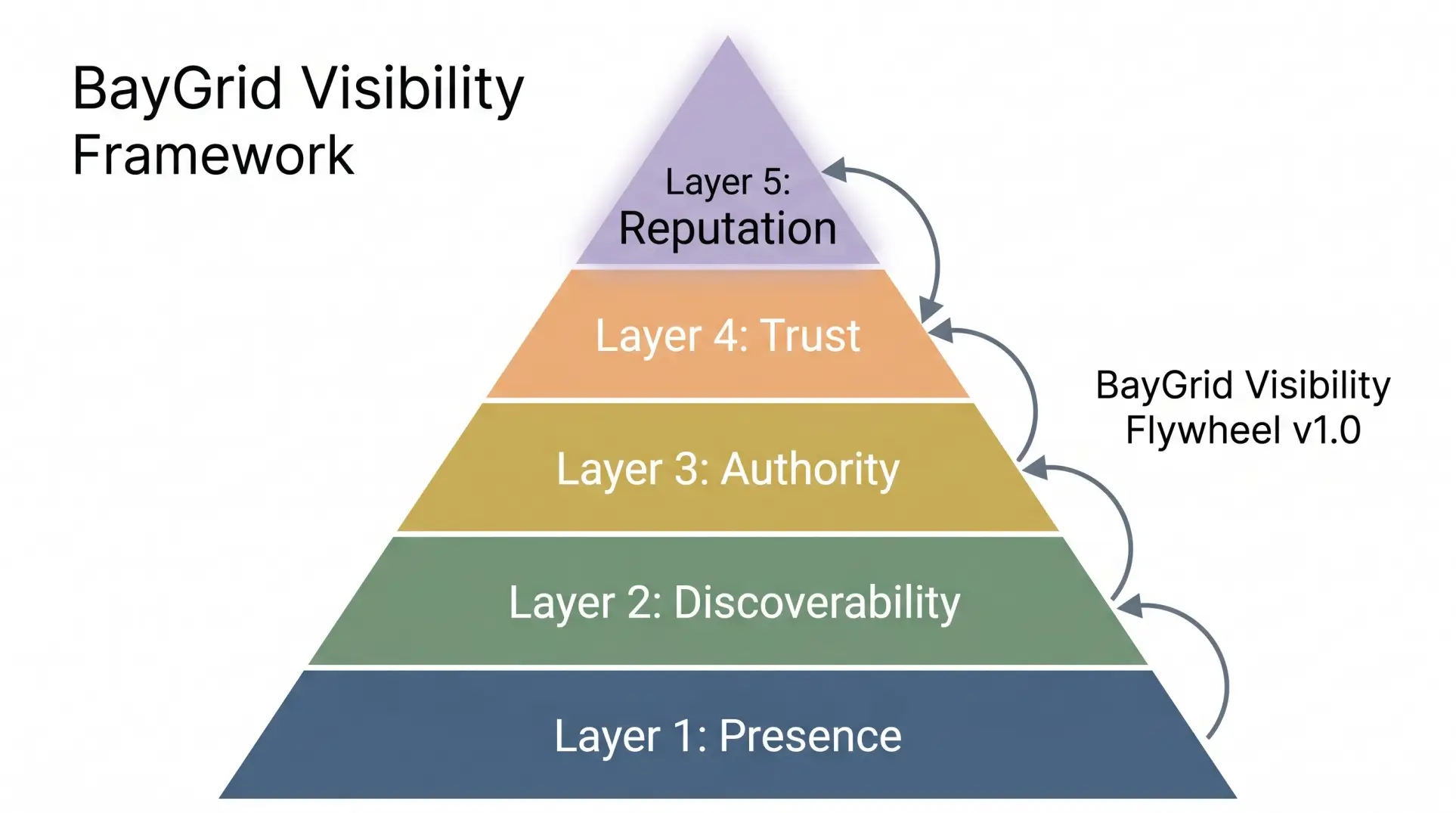
Digital trust cannot be understood in isolation from the visibility systems through which hospitality information travels. The BayGrid Visibility Framework establishes that hospitality visibility refers to the presence, accuracy, and accessibility of hospitality information across the digital environment. Trust and visibility exist in a bidirectional relationship: visibility creates the conditions for trust to form by exposing potential guests to trust-building signals, while trust determines whether visible information is actually believed and acted upon.
A hospitality property may achieve high visibility — appearing across numerous platforms and search results — yet fail to convert that visibility into bookings if the trust signals accompanying that visibility are weak. Conversely, strong trust signals that remain invisible to the target audience cannot influence behaviour. The analysis presented here therefore treats trust and visibility as interdependent systems rather than separate concerns.
Scope and Limitations
The hospitality sector presents distinctive trust challenges not fully analogous to other industries. Hospitality purchases are typically high-consideration decisions involving significant expenditure, temporal commitment (the guest cannot easily “return” a hotel stay), experiential uncertainty (the product is consumed before quality can be verified), and emotional investment (holidays, celebrations, and business travel carry psychological weight). These characteristics amplify the role of trust in the selection process and intensify the consequences of trust failure.
This analysis focuses on conceptual understanding rather than prescriptive implementation. It does not provide technical security guidance, trust measurement tools, or platform-specific trust-building tactics. Its purpose is to establish a shared analytical vocabulary and framework for understanding digital trust dynamics in hospitality visibility systems.
Key Concepts
Digital Trust
Digital trust, as defined by BayGrid Standard 4, is the confidence users place in information encountered through digital channels. This confidence emerges from an evaluation process in which users assess whether information appears reliable, consistent with other available information, supported by credible sources, and aligned with their own expectations and prior experience. Digital trust is not binary — it exists on a spectrum from deep suspicion to complete confidence, and most hospitality information sits somewhere in between.
Digital trust differs from personal trust (trust in an individual known to the truster) and institutional trust (trust in organisations based on reputation or regulatory oversight). Digital trust is mediated through interfaces, algorithms, and third-party platforms, creating additional layers of complexity in how trust signals are transmitted, received, and interpreted.
Trust Architecture: The Five Pillars
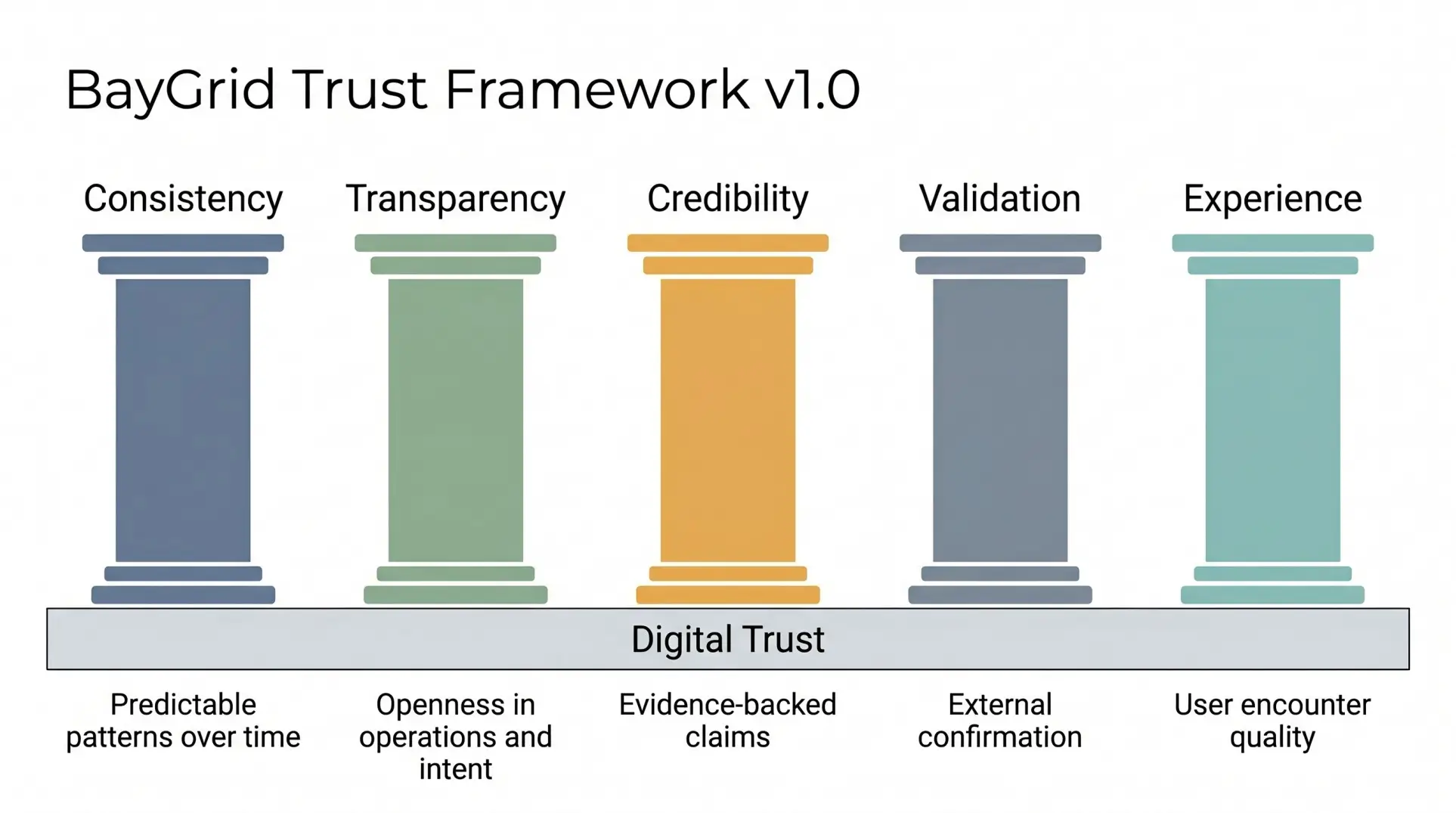
The BayGrid Trust Framework v1.0 identifies five pillars that collectively constitute the architecture of digital trust in hospitality visibility systems. These pillars are not sequential stages but interdependent components that reinforce one another. Weakness in any pillar undermines the structural integrity of the entire trust edifice.
Consistency refers to the alignment of information across all touchpoints and over time. When a property’s description, imagery, pricing, availability, and service claims remain stable and coherent across platforms, consistency builds trust. When information contradicts itself — different descriptions on different platforms, imagery that misrepresents the actual property, pricing that changes without explanation — consistency erodes and trust weakens. BayGrid Standard 6: Narrative Consistency provides the formal standard for this pillar, establishing that consistent messaging across channels is a prerequisite for trust formation.
Transparency refers to the openness and accessibility of information relevant to guest decision-making. Transparent hospitality operations provide clear information about pricing (including fees and surcharges), policies, amenities, location characteristics, and potential limitations. Transparency does not require revealing proprietary operational details; it requires ensuring that guests have sufficient accurate information to make informed decisions. Opaque pricing, hidden fees, and ambiguous policy language all function as transparency deficits that degrade trust.
Credibility refers to the believability of information sources and claims. Credible hospitality information originates from sources that users recognise as knowledgeable, honest, and qualified to speak about the property or experience in question. Credibility operates at multiple levels: the credibility of the property’s own claims, the credibility of third-party reviews, the credibility of the platforms hosting information, and the credibility of any endorsing or accrediting bodies. BayGrid Standard 5: Reputation addresses the accumulation of credibility signals over time as a property’s reputation develops.
Validation refers to the confirmation of claims through independent or corroborating evidence. Validation transforms unverified assertions into substantiated information. In hospitality visibility systems, validation occurs through multiple mechanisms: guest reviews confirming service quality claims, professional photography verifying property descriptions, third-party awards or certifications endorsing standards, media coverage providing independent assessment, and consistent positive experiences across multiple guests creating a pattern of confirmation. The absence of validation does not necessarily mean claims are false, but it does mean they remain unsubstantiated — a condition that limits trust development.
Experience refers to the accumulated direct encounters that a user has had with a property, brand, or related information. Experience is the deepest pillar because it transforms abstract trust into embodied confidence. A guest who has previously stayed at a property and had a positive experience possesses a level of trust that no amount of marketing can replicate for a first-time guest. For hospitality visibility systems, the experience pillar also encompasses the quality of digital interactions — the booking process, pre-arrival communications, and post-stay follow-up all contribute to experiential trust.
Trust Formation
Trust formation is the process through which confidence accumulates from initial neutrality or scepticism toward a positive trust disposition. This analysis identifies trust formation as a cumulative, asymmetric, and non-linear process. It is cumulative because each positive interaction adds to a growing reservoir of confidence. It is asymmetric because positive interactions build trust slowly while negative interactions can damage trust rapidly. It is non-linear because the relationship between inputs (confirmatory signals) and outputs (trust levels) does not follow a straight-line progression — early trust formation may be slow, accelerate as a baseline is established, and then plateau as maximum trust is approached.
Trust Erosion
Trust erosion is the process through which accumulated confidence declines, potentially collapsing entirely. Erosion may occur through two distinct mechanisms: gradual erosion, in which trust slowly declines through a series of minor disappointments or inconsistencies; and sudden erosion, in which a single significant disconfirmatory event causes rapid trust collapse. The analysis suggests that sudden erosion is more common and more damaging than gradual erosion in hospitality contexts, where a single highly visible negative event (a viral complaint, a safety incident, a pricing controversy) can overwhelm years of accumulated positive trust signals.
The Trust-Visibility Relationship
The relationship between trust and visibility is bidirectional and interdependent. High visibility amplifies the impact of both positive and negative trust signals — when many people can see information about a property, trust-building and trust-damaging events have larger effects. Strong trust increases the effectiveness of visibility by raising the probability that visible information will be accepted and acted upon. Weak trust means that even high visibility fails to convert into bookings because users discount or disregard the information they encounter.
Analysis
The Architecture of Digital Trust: How the Five Pillars Interact
The five pillars of the BayGrid Trust Framework do not operate independently. The analysis reveals a pattern of structural reinforcement in which strength in one pillar supports strength in others, while weakness in any pillar creates vulnerability across the entire structure.
Consistency and Transparency form a foundational pair. Consistency without transparency is possible — a property can consistently hide information — but such consistency does not build trust because users recognise that relevant information is being withheld. Transparency without consistency is similarly ineffective — a property that provides full information on one platform but contradicts itself on another undermines the trust benefits of its transparency. When consistency and transparency operate together, they create a condition of reliable openness in which users can access aligned information across all touchpoints.
Credibility and Validation form a confirmatory pair. Credibility represents the perceived trustworthiness of information sources; validation represents the independent evidence that substantiates claims. A credible source making unsubstantiated claims has limited trust-building power because users cannot distinguish credible assertions from credible falsehoods. Validated claims from non-credible sources face scepticism about the validation itself — users question whether the evidence was fabricated or the validator was compromised. Together, credible sources and independent validation create a confirmatory loop in which believable claims are independently verified, producing robust trust.
Experience occupies a distinctive position as the integrative pillar. Direct experience either confirms or disconfirms the impressions created by the other four pillars. When a guest’s actual stay aligns with the consistent, transparent, credible, and validated information they encountered during their research, all five pillars reinforce one another and trust deepens. When actual experience contradicts the digital impression — when the property fails to match its description, its service falls short of its reviews, or its amenities differ from its claims — the experience pillar undermines the entire structure regardless of how strong the other pillars appeared.
Trust Formation Mechanisms: How Trust Accumulates
The analysis identifies three distinct mechanisms through which trust forms in hospitality visibility systems: signal accumulation, cross-channel corroboration, and temporal stability.
Signal accumulation describes the process by which repeated positive trust signals gradually build confidence. Each encounter with consistent, transparent, credible information about a property adds a marginal increment to the user’s trust disposition. The mechanism resembles a cognitive ledger in which positive signals are recorded as trust credits. Importantly, the marginal value of each additional signal may diminish as trust approaches saturation — the first ten positive reviews may shift trust significantly, while the two-hundredth review adds relatively little additional confidence. This diminishing returns pattern has important implications for hospitality operators: there are trust-building thresholds beyond which additional investment in signal generation yields reduced marginal returns.
Cross-channel corroboration describes the trust-building effect that occurs when a user encounters consistent positive information about a property across multiple independent channels. When a potential guest sees favourable reviews on an OTA, positive social media mentions, professional media coverage, and strong search visibility all aligned in the same direction, the independent corroboration across channels produces stronger trust than any single channel could achieve alone. This mechanism explains why properties with diversified visibility footprints — presence across owned websites, OTAs, review platforms, social media, and knowledge repositories — tend to generate stronger trust than properties concentrated in a single channel. The Narrative Alignment Framework examines this cross-channel consistency dynamic in detail.
Temporal stability describes the trust-building effect of consistency over time. When a property maintains stable quality, consistent messaging, and reliable service across months and years, it demonstrates a pattern that users interpret as genuine rather than performative. Properties that exhibit high quality during launch periods but decline over time, or that maintain consistency only during peak season, fail to build temporal trust. The analysis suggests that temporal stability is particularly important for repeat guest relationships and for properties seeking to build long-term reputation rather than transactional volume.
Trust Erosion Dynamics: How Trust Collapses
Trust erosion in hospitality visibility systems follows distinctly different dynamics from trust formation. The analysis identifies three erosion pathways: disconfirmatory shock, cumulative inconsistency, and visibility amplification of negative events.
Disconfirmatory shock occurs when a single event dramatically contradicts established trust expectations. A food safety incident at a restaurant with strong trust signals, a severe service failure at a luxury property known for excellence, or a pricing scandal at a brand built on transparency — all represent disconfirmatory shocks that can collapse previously strong trust. The psychological mechanism appears to involve expectation violation: when a property has built strong trust, users form higher expectations, and violations of those higher expectations produce disproportionately negative trust impacts. A property with weak prior trust may suffer a minor service failure with limited reputational damage; a property with strong prior trust suffers the same failure more severely because the gap between expectation and reality is larger.
Cumulative inconsistency describes gradual erosion through a series of minor trust-damaging events. Each small inconsistency — a slightly misleading photograph, a policy change not clearly communicated, a modest service decline — creates a marginal trust debit. While individually these debits may be negligible, their accumulation over time can shift a user’s trust disposition from positive to neutral to negative. This gradual erosion pattern is more common in operational trust (experience pillar) than in informational trust (the other four pillars), because operational experiences are repeated and varied while informational signals tend to be stable.
Visibility amplification describes the mechanism by which high visibility infrastructure increases the speed and reach of trust erosion. In an environment of high visibility, negative events propagate rapidly across platforms, appear in search results, and reach large audiences before the property can respond. The same visibility infrastructure that amplifies positive trust signals also amplifies negative trust events. This asymmetry creates a trust fragility gradient: properties with higher visibility face greater trust risk because their trust signals are more exposed to public scrutiny and their trust failures are more widely distributed.

The Asymmetry Principle: Formation vs. Erosion
A central finding of this analysis is the asymmetry principle: trust is gained slowly and lost rapidly. This principle has both quantitative and qualitative dimensions.
Quantitatively, the number of positive interactions required to build strong trust substantially exceeds the number of negative interactions required to destroy it. A property may need hundreds of positive reviews, years of consistent service, and extensive validation to build strong trust, yet a single serious incident reported prominently can eliminate a significant portion of that accumulated confidence. The ratio is not merely uneven — it appears to be potentially exponential, with the erosion rate accelerating as the severity of the disconfirmatory event increases.
Qualitatively, the nature of trust formation differs from trust erosion. Formation relies primarily on informational signals — reviews, descriptions, photographs, ratings — that users process cognitively. Erosion often involves emotional or visceral responses — disappointment, outrage, betrayal — that operate with greater intensity and persistence than cognitive trust-building. A user who reads twenty positive reviews develops a rational confidence in a property; a user who experiences one severe service failure develops an emotional aversion that cognitive positive signals struggle to overcome.
This asymmetry has strategic implications for hospitality operators. It suggests that trust preservation deserves parity with trust building in operational priorities. Investments in preventing trust-damaging events may yield higher returns than equivalent investments in generating additional positive trust signals, particularly for properties that have already achieved baseline trust thresholds.
The Trust-Visibility Feedback Loop
The analysis examines the feedback relationship between trust and visibility in detail, identifying both virtuous and vicious cycles.
The virtuous cycle operates as follows: strong trust signals improve conversion rates from visible information, generating more bookings and more guest experiences, which produce more positive reviews and validation signals, which strengthen trust further, which improves the effectiveness of continued visibility investment. Properties in this cycle experience compounding benefits in which trust and visibility reinforce one another over time.
The vicious cycle operates in reverse: weak trust signals produce low conversion rates despite visibility, limiting the generation of new positive validation, which means trust does not strengthen, which means visibility investment produces diminishing returns. Properties in this cycle may increase their visibility spending without seeing proportional returns because the underlying trust architecture is insufficient to convert visibility into bookings.
The analysis suggests that the trust-visibility feedback loop creates strategic bifurcation in hospitality markets: properties with strong trust-visibility alignment tend to pull away from competitors over time, while properties with weak trust-visibility alignment face increasing marginal costs for visibility improvements. This dynamic has been observed in premium dining reservation behaviour, where establishments with strong trust signals achieve disproportionate booking conversion compared to visibility-matched competitors with weaker trust profiles.
Framework Application
Applying the BayGrid Trust Framework v1.0
The BayGrid Trust Framework provides a structured analytical lens for examining digital trust in hospitality contexts. Its application involves three steps: pillar assessment, interaction analysis, and trajectory mapping.
Pillar assessment evaluates the strength of each of the five trust pillars for a given property or hospitality entity. This assessment is qualitative rather than quantitative, examining whether each pillar is strong, moderate, weak, or absent. A luxury hotel with professional photography, detailed descriptions, and clear pricing might score strongly on consistency and transparency but weakly on validation if it has few guest reviews or third-party endorsements. A boutique restaurant with enthusiastic social media followers might score strongly on experience (for those who have dined) but weakly on credibility if its online presence lacks professional validation.
Interaction analysis examines how the pillars interact in a specific context. Strong consistency and transparency may compensate for moderate credibility if the information provided is sufficiently detailed for users to verify claims independently. Strong credibility and validation may compensate for weak direct experience if the validating sources are highly trusted. The framework does not treat all pillars as equally important in all contexts; rather, it provides a structure for analysing which pillar combinations matter most for specific trust challenges.
Trajectory mapping uses the framework to project trust dynamics over time. A property with strong pillars but recent disconfirmatory events may be on an erosion trajectory requiring intervention. A property with weak pillars but improving consistency and new validation may be on a formation trajectory that will accelerate as signals accumulate. The framework enables diagnostic assessment of trust position and directional movement.
Applying the BayGrid Visibility Framework v1.0
The BayGrid Visibility Framework complements the Trust Framework by examining the infrastructure through which trust signals travel. Its application to trust analysis reveals that visibility infrastructure quality directly affects trust formation efficiency.
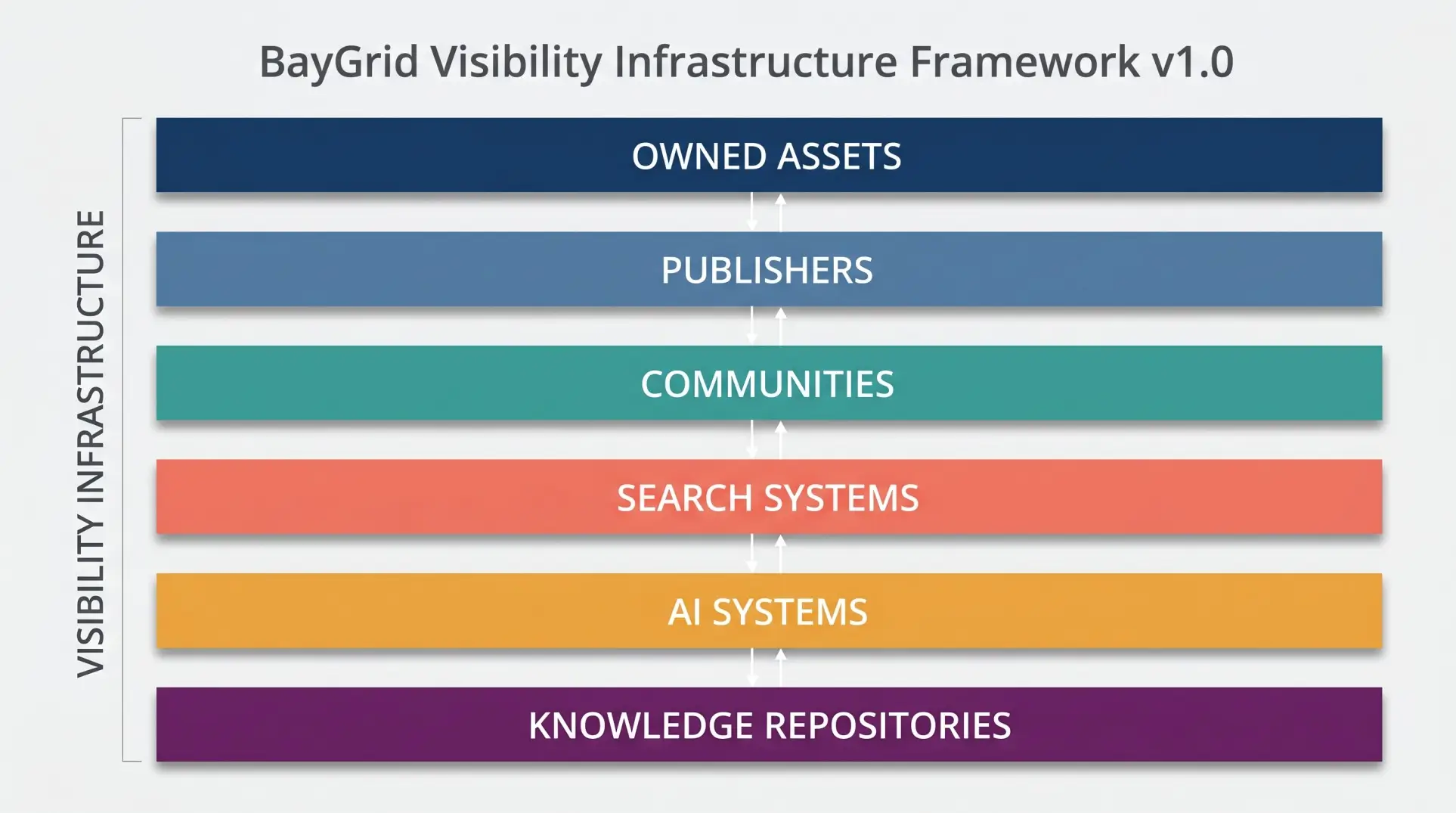
Properties with strong visibility infrastructure — presence across multiple relevant platforms, optimised owned assets, active community engagement, and strong search positioning — can distribute trust signals more efficiently than properties with limited visibility infrastructure. A property with exceptional trust signals that are visible only on its own website achieves limited trust impact because the signals reach a narrow audience. A property with moderate trust signals distributed broadly across multiple channels may achieve greater aggregate trust impact through reach and cross-channel corroboration.
The Visibility Framework also reveals that different visibility channels carry different implicit trust weights. Information on a property’s own website is typically treated with scepticism because the source has commercial incentive to present favourable information. Information on independent review platforms carries higher trust weight because the platform has (at least nominal) independence from the property. Information in professional media carries higher trust weight still because journalists are assumed to apply editorial scrutiny. AI-generated summaries occupy an evolving position in this trust hierarchy, with their trust weight depending on the perceived reliability of the AI system and the transparency of its information sources. Digital authority dynamics influence these channel-specific trust weights.
Implications
For Hospitality Operators
The analysis carries several implications for hospitality operators seeking to build and maintain digital trust. First, the five-pillar framework suggests that trust-building investments should be distributed across all pillars rather than concentrated in one. A property that invests heavily in professional photography (credibility) but neglects review management (validation) or pricing transparency (transparency) builds an unstable trust structure vulnerable to collapse when users encounter the neglected pillar.
Second, the asymmetry principle implies that trust preservation deserves strategic priority. Operational systems that prevent severe service failures, safety incidents, or pricing controversies may deliver higher trust returns than marketing investments that generate additional positive signals. This is particularly true for properties that have already achieved strong baseline trust — the value at risk from disconfirmatory shock is greatest for those with the most to lose.
Third, the trust-visibility feedback loop suggests that operators should assess their trust position before investing in visibility expansion. Increasing visibility for a property with weak trust architecture may produce low conversion rates and expose weak trust signals to wider audiences, potentially accelerating a vicious cycle. Trust strengthening should precede or accompany visibility expansion for optimal results.
For Platform Designers
The findings have implications for designers of hospitality platforms and booking systems. The importance of cross-channel corroboration suggests that platforms should consider how their information presentation interacts with information on other platforms. The prominence of validation as a trust pillar suggests that platforms can increase user trust by prominently displaying independent verification signals — verified guest status, professional review indicators, or third-party certifications.
The asymmetry principle suggests that platform mechanisms for addressing negative events — response systems, resolution processes, and update mechanisms — may be as important for long-term platform trust as mechanisms for generating and displaying positive signals. Platforms that enable rapid, transparent responses to trust-threatening events may help properties recover from disconfirmatory shocks more effectively than platforms that fix negative content permanently in place without recourse.
For Researchers
This analysis opens several avenues for further investigation. The quantification of trust asymmetry — the precise ratio of formation signals to erosion signals — remains an empirical question that would benefit from experimental or longitudinal study. The relative importance of the five pillars across different hospitality segments (luxury vs. budget, urban vs. resort, business vs. leisure) warrants examination. The evolving role of AI systems as trust mediators — particularly the trust weight users assign to AI-generated summaries and recommendations — represents a rapidly developing area requiring continued research.
Conclusion
This paper has examined the mechanisms through which digital trust is established, maintained, and eroded in hospitality visibility systems. The analysis, grounded in the BayGrid Trust Framework v1.0, identifies five interdependent pillars — Consistency, Transparency, Credibility, Validation, and Experience — that collectively constitute the architecture of digital trust. The findings indicate that trust formation is a cumulative process driven by signal accumulation, cross-channel corroboration, and temporal stability, while trust erosion operates through disconfirmatory shock, cumulative inconsistency, and visibility amplification of negative events.
The central analytical contribution is the identification of the asymmetry principle: trust accumulates slowly through repeated confirmatory interactions but can erode rapidly through single disconfirmatory events. This asymmetry creates strategic imperatives for hospitality operators to invest in trust preservation alongside trust building, and to recognise that the properties with the strongest trust positions face the greatest exposure to trust-damaging events.
The bidirectional relationship between trust and visibility creates feedback loops that can be virtuous or vicious. Strong trust amplifies visibility effectiveness; weak trust diminishes it. This interdependence means that trust and visibility should be understood and managed as interconnected systems rather than separate operational domains. The analysis suggests that hospitality operators who achieve alignment between their trust architecture and their visibility infrastructure will experience compounding benefits over time, while those who decouple these systems risk investing in visibility that fails to convert due to insufficient trust foundations.
Further research is needed to quantify trust asymmetry ratios, examine pillar importance across hospitality segments, and track the evolving role of AI-mediated trust signals. This paper provides the conceptual framework and analytical vocabulary necessary for such investigations to proceed.
References
The following external sources provide supporting context for the concepts examined in this paper. No statistics, studies, or empirical claims in this paper are derived from fabricated sources.
- BayGrid Trust Framework v1.0 — Five-pillar model for analysing digital trust in hospitality visibility systems.
- BayGrid Visibility Framework v1.0 — Framework for understanding the presence, accuracy, and accessibility of hospitality information across digital channels.
- BayGrid Standard 4: Digital Trust — “The confidence users place in information.”
- BayGrid Standard 6: Narrative Consistency — Standard for consistent messaging across hospitality visibility channels.
- BayGrid Standard 5: Reputation — Standard for reputation accumulation in hospitality contexts.
- Mayer, R. C., Davis, J. H., & Schoorman, F. D. (1995). “An Integrative Model of Organizational Trust.” Academy of Management Review, 20(3), 709-734. Foundational academic model of trust formation including ability, benevolence, and integrity dimensions.
- McKnight, D. H., & Chervany, N. L. (2001). “What Trust Means in E-Commerce Customer Relationships.” International Journal of Electronic Commerce, 6(2), 35-59. Examines trust constructs in digital commerce environments.
- Corritore, C. L., Kracher, B., & Wiedenbeck, S. (2003). “On-line Trust: Concepts, Evolving Themes, a Model.” International Journal of Human-Computer Studies, 58(6), 737-758. Provides conceptual foundations for understanding online trust dynamics.
- Filieri, R., & McLeay, F. (2014). “E-WOM and Accommodation: An Analysis of the Factors That Influence Travelers’ Adoption of Information from Online Reviews.” Journal of Travel Research, 53(1), 44-57. Examines how trust in online reviews influences hospitality decision-making.
- Sparks, B. A., & Browning, V. (2011). “The Impact of Online Reviews on Hotel Booking Intentions and Perception of Trust.” Tourism Management, 32(6), 1310-1323. Investigates the relationship between review credibility and booking behaviour.
Note: The academic references cited above provide theoretical grounding for the trust concepts examined in this paper. The specific claims and frameworks presented are BayGrid’s analytical contributions and should not be attributed to the cited authors. Where empirical evidence from external studies is limited, this is noted in the analysis rather than supplanted with fabricated data.