Visibility Research
Executive Summary
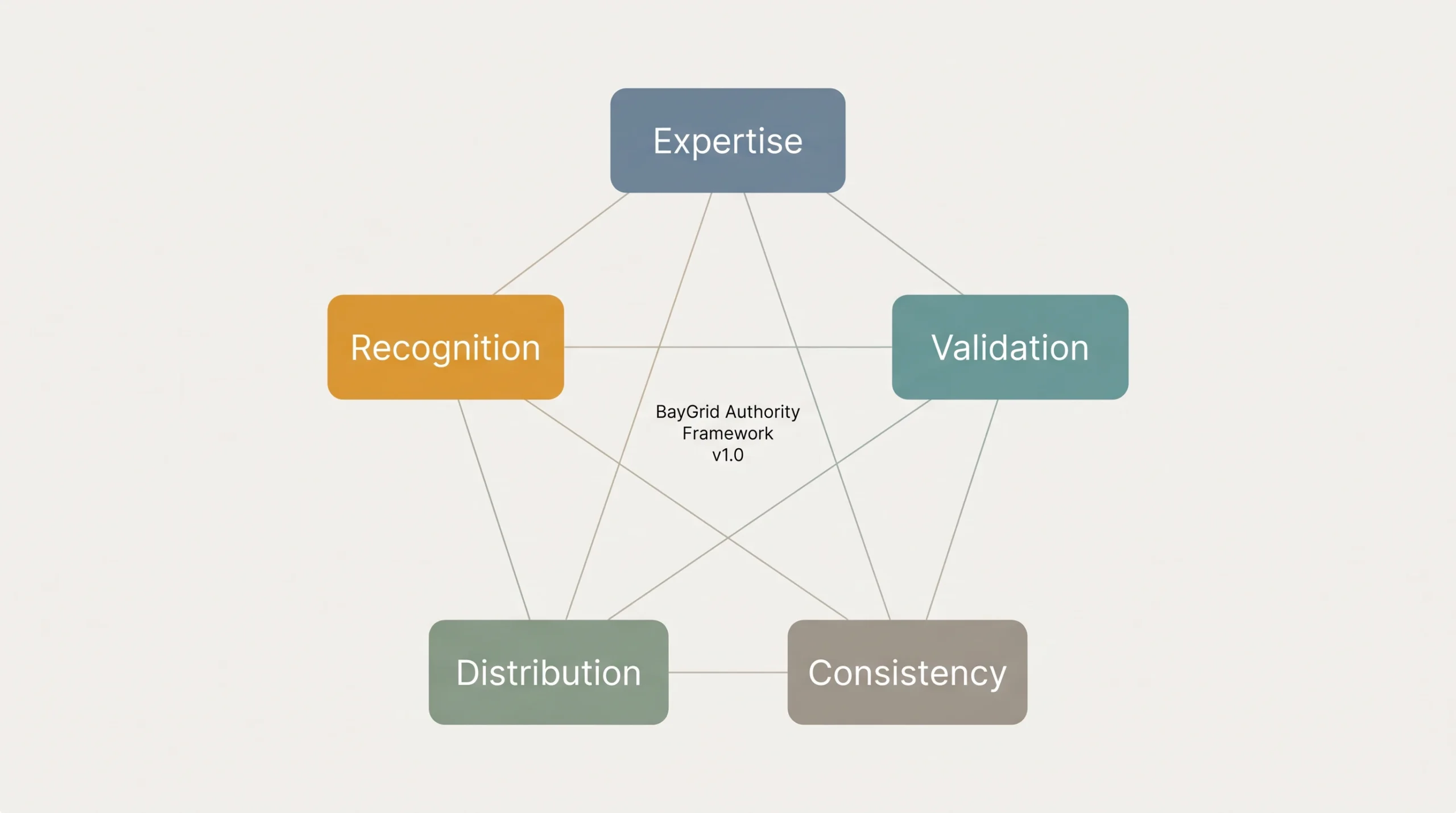
This paper examines the formation of digital authority in hospitality contexts. The analysis investigates how authority develops, why it cannot be self-declared, and what structural properties distinguish genuine authority from its appearance. Drawing on the BayGrid Authority Framework v1.0, the paper presents digital authority as a property emerging from the interaction of five mutually interdependent components: Expertise, Validation, Consistency, Distribution and Recognition. The BayGrid Standard: Digital Authority defines the concept as “the degree to which an organisation or source is perceived as credible and knowledgeable.” The findings indicate that authority is conferred by external recognition rather than asserted by self-declaration, that it requires distributed validation across information environments, and that it operates as an integrated system in which each component reinforces the others. The paper distinguishes authority from visibility — authority operates within the Authority layer of the BayGrid Visibility Framework v1.0 — and examines the relationship between authority formation and the broader visibility system. The analysis contributes a conceptual framework for understanding why some hospitality organisations are perceived as credible regardless of their marketing expenditure, while others with substantial promotional investment fail to achieve equivalent authority standing.
Research Question
This paper addresses three interrelated questions:
- How is digital authority formed in hospitality contexts, and what mechanisms govern its development?
- Why can digital authority not be self-declared, and what properties does it acquire through external conferral?
- How does digital authority relate to the broader visibility system within which it operates?
The investigation proceeds from the position that authority in hospitality contexts is widely misunderstood — confused with expertise, conflated with popularity, and treated as a communications output rather than a systems property. The scope of this analysis is conceptual and definitional. Personal branding advice, social media growth tactics, PR strategies and link building techniques are excluded. The paper does not quantify authority or provide implementation guidance; its purpose is to establish a coherent theoretical understanding of how authority forms, why it requires external validation, and what this means for hospitality organisations seeking to develop genuine credibility in their information environments.
Context
The Authority Problem in Hospitality
The hospitality industry presents a particular authority problem. Every restaurant, hotel and hospitality service provider makes claims about its quality, its distinctiveness and its value. These claims proliferate across information environments — websites, review platforms, social media, advertising, media coverage, guidebooks, travel publications. In this environment of saturated self-assertion, how does any organisation establish that its claims are credible?
The problem is not merely competitive. It is epistemological. Information seekers — potential guests, diners, travellers — face the challenge of determining which claims to believe when every source presents itself favourably. The authority of a hospitality organisation is the answer to this challenge. It is the property that causes an information seeker to treat one source’s claims as more credible than another’s, independent of the claims themselves.
Current approaches to authority in hospitality contexts suffer from several conceptual limitations:
- Confusion with expertise: Authority is frequently equated with knowledge or skill. A chef with exceptional culinary expertise is assumed to possess authority. But expertise is a capacity; authority is a perception. The most knowledgeable operator may lack authority if that expertise is not visible, validated and recognised.
- Confusion with popularity: Authority is frequently equated with being well-known or heavily reviewed. But popularity indicates exposure, not credibility. A widely known organisation may be known primarily for negative reasons. Volume of attention does not indicate quality of credibility.
- Confusion with assertion: Authority is frequently treated as something that can be claimed — through professional language, credential display, award presentation or promotional messaging. But self-asserted authority is precisely the type of authority that information seekers have learned to discount.
The analysis suggests that these confusions persist because authority is analysed at the wrong level — at the level of organisational activity rather than at the level of systems properties. The BayGrid Authority Framework v1.0 addresses this by examining authority as an emergent property of how expertise, validation, consistency, distribution and recognition interact across information environments.
Why Authority Cannot Be Self-Declared
The proposition that authority cannot be self-declared is central to this analysis and requires careful examination. It is not a moral claim (that self-declaration is improper) but a structural claim (that self-declaration does not produce the property it claims to produce).
Consider the mechanism. When an organisation declares its own authority — “we are the best,” “award-winning,” “renowned for excellence” — it adds a claim to the information environment. But this claim enters an environment already saturated with similar claims from competing organisations. The information seeker encountering these claims has no basis for distinguishing the self-declared authority of one organisation from the self-declared authority of another. Self-declared authority is fungible — one organisation’s self-praise is indistinguishable from another’s. It therefore cannot function as a differentiator.
Moreover, information seekers in contemporary digital environments have developed scepticism toward self-asserted claims. Research into consumer information behaviour suggests that audiences routinely discount or ignore claims that originate from the subject of those claims. This scepticism is not irrational — it is adaptive. In an environment of unlimited self-assertion, the only rational strategy is to treat self-assertion as baseline noise and to seek confirmation from independent sources.
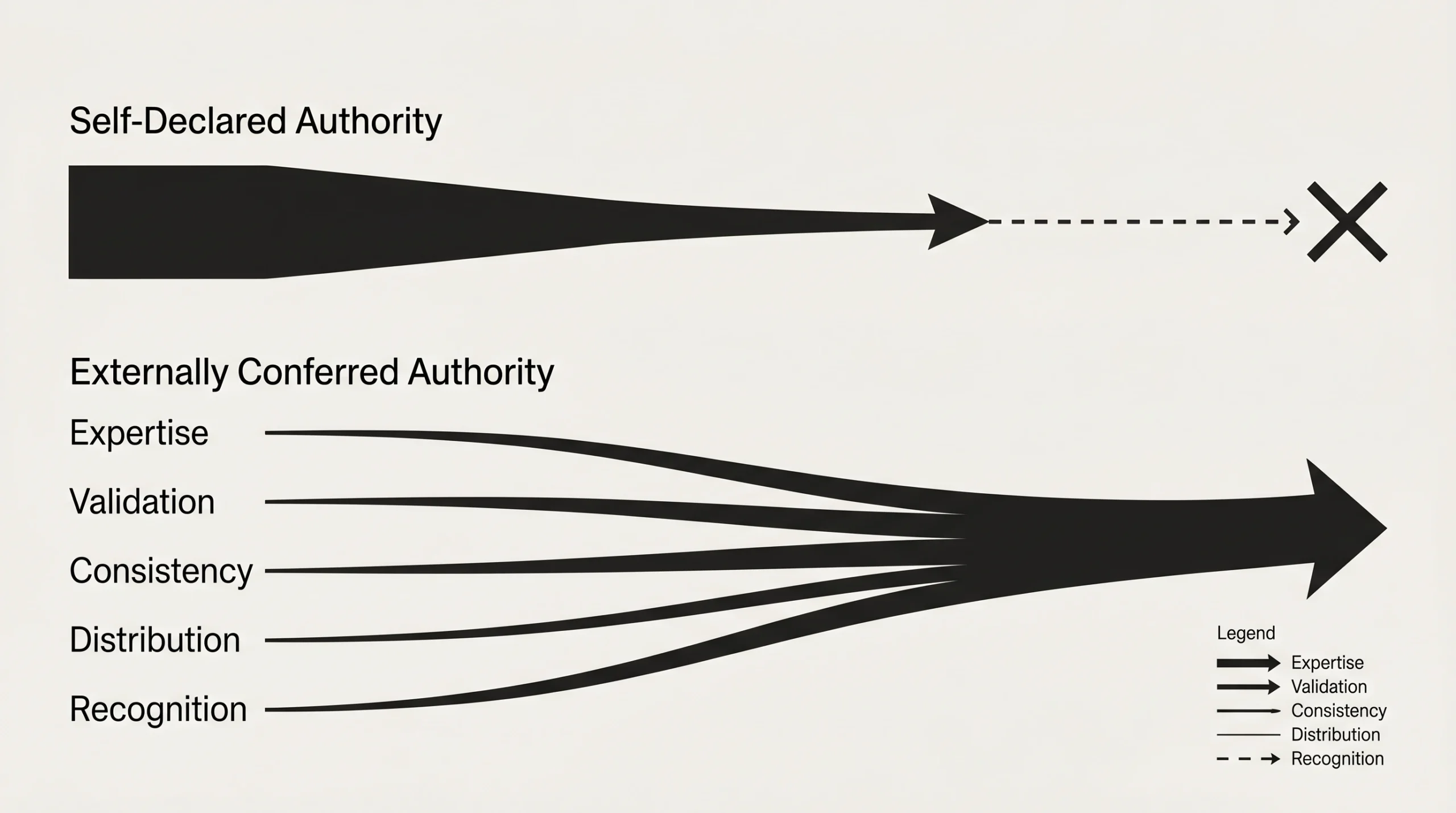
The structural problem is that self-declaration creates a claim without creating evidence for the claim. When authority is externally conferred — when independent sources validate, reference and recognise an organisation — evidence enters the information environment along with the claim. The claim is no longer merely asserted; it is supported by distributed signals that information seekers can observe, evaluate and trust.
The distinction between self-declared and externally conferred authority is not merely theoretical. It shapes how information seekers behave. A restaurant with three independent professional reviews, fifty consistent customer reviews averaging 4.5 stars over two years, and regular mention in local food media has externally conferred authority. A restaurant with a website describing itself as “the city’s finest dining experience” has self-declared authority. The information seeker does not need to investigate which claims are true; they respond to the structural difference in how the claims are supported.
Authority in the Visibility System
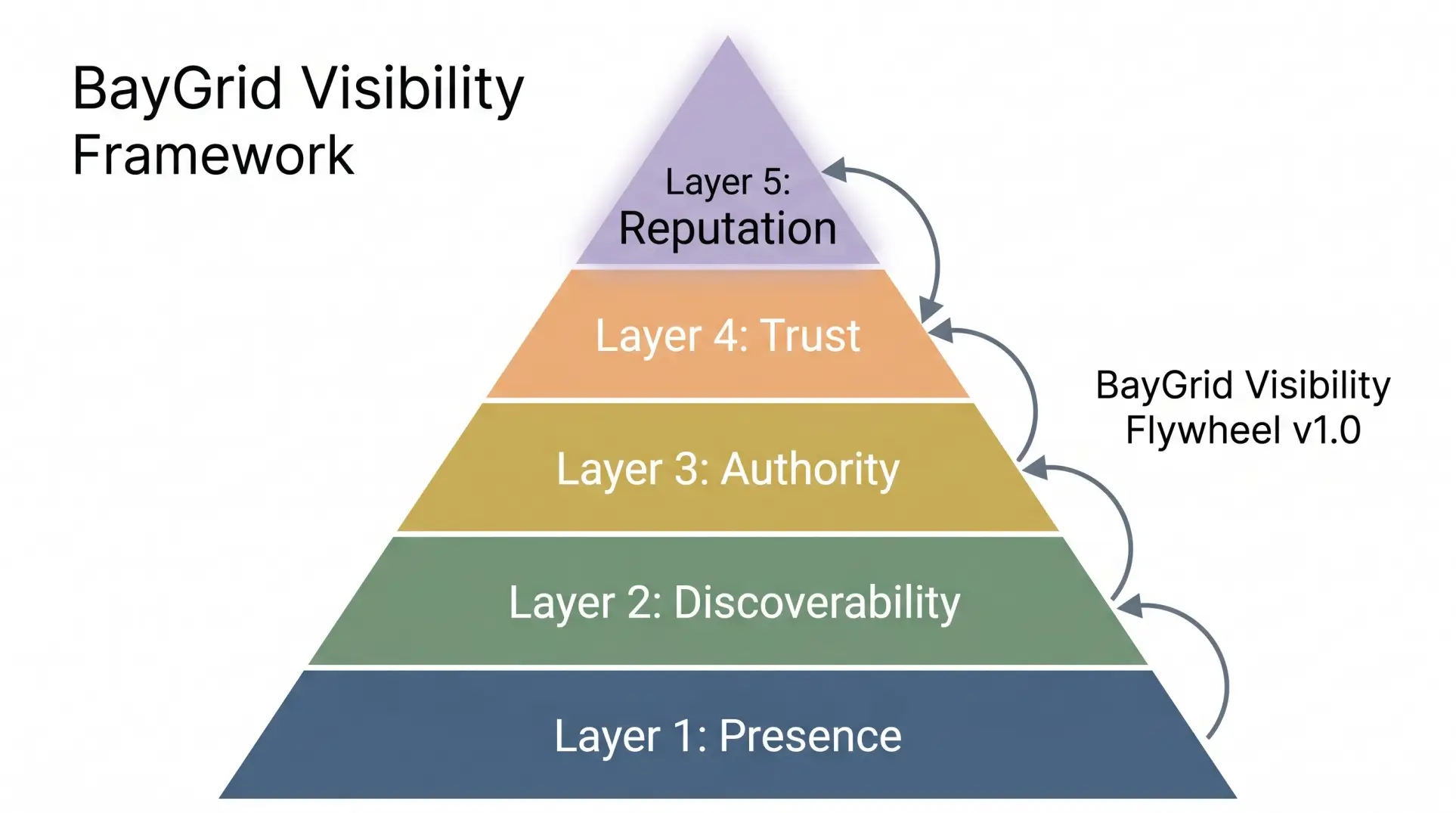
Digital authority operates within the broader visibility system described in the BayGrid Visibility Framework v1.0. In that framework, Authority is the third of five cumulative layers — preceded by Presence and Discovery, followed by Trust and Reputation. This positioning is significant.
Authority cannot develop without presence and discovery. An organisation that cannot be found (lacks presence) or that appears in information environments but is not encountered by relevant audiences (lacks discovery) cannot accumulate authority regardless of its expertise or quality. Conversely, authority is a precondition for trust and reputation — the layers that follow it. An organisation may be present and discoverable without being authoritative, but it cannot be trusted or develop reputation without first establishing credibility.
The What Is Hospitality Visibility? article examines this systems context in depth. The present analysis focuses specifically on the Authority layer — how it forms, what components constitute it, and why its development follows patterns that differ from the other visibility layers.
The relationship between authority and visibility is interdependent, not unidirectional. Strong visibility can accelerate authority development by exposing an organisation’s expertise and consistency to larger audiences. Strong authority can reinforce visibility by generating the validation signals (reviews, media coverage, references) that improve discovery and trust. The Distributed Authority in Hospitality article examines how authority distributes through visibility channels to produce this reinforcing dynamic.
Key Concepts
Digital Authority: Definition and Scope
The BayGrid Standard: Digital Authority defines the concept as follows:
“The degree to which an organisation or source is perceived as credible and knowledgeable.”
This definition emphasises perception over possession. Digital authority is not what an organisation knows or can do; it is the degree to which audiences perceive it as knowing and capable. The distinction is crucial. An organisation may possess substantial expertise while being perceived as lacking authority. Conversely, an organisation may be perceived as authoritative while possessing modest actual expertise. The framework is concerned with the mechanisms that produce perceived credibility and knowledgeability — regardless of whether that perception aligns with underlying capability.
The definition also specifies “across information environments” — authority is not a single attribute but a distributed property. An organisation may be perceived as highly credible on one platform and entirely unknown on another. Systemic authority requires distributed perception — credibility that is visible and confirmed across the range of environments that relevant audiences encounter.
Finally, the definition’s use of “degree” indicates that authority is not binary. Organisations possess authority in varying quantities and qualities. The BayGrid Authority Framework v1.0 provides a model for understanding the components that determine this degree.
Distributed Authority
The BayGrid Standard: Distributed Authority extends the base concept by specifying that authority in digital environments is necessarily distributed. Authority exists not in one place but across many — in review platforms, media outlets, social media mentions, search engine results, professional publications, industry databases and the cumulative impressions that information seekers form from encountering an organisation across these environments.
Distributed authority has several implications:
- Authority is not portable: An organisation with strong authority in one environment cannot automatically transfer that authority to another. Authority must be established and recognised within each environment.
- Authority is cumulative: Each additional environment in which authority is recognised adds to the overall authority position. Distributed authority compounds — the more environments that confirm an organisation’s credibility, the stronger its overall authority becomes.
- Authority is fragile: Because authority is distributed, it can be undermined in any environment. A strong authority position across nine platforms can be damaged by credible negative information on a tenth.
The concept of distributed authority is examined further in the Distributed Authority in Hospitality article.
Authority vs. Visibility: A Functional Distinction
While authority operates within the visibility system, it is functionally distinct from visibility itself. Visibility is the capacity to be discovered, recognised and understood. Authority is the credibility that makes that discovery and recognition meaningful. The distinction can be observed in practice:
- An organisation may be highly visible without being authoritative — it appears everywhere but is not perceived as credible.
- An organisation may be moderately visible but highly authoritative — it appears in fewer environments, but its appearance carries significant weight.
- An organisation may achieve visibility through authority — its credibility causes it to be referenced, cited and recommended, which expands its presence and discovery.
The functional distinction matters for strategic analysis. An organisation assessing its position should ask not only “How visible are we?” but also “What is the authority character of that visibility?” High visibility with low authority produces awareness without credibility — people know about the organisation but do not trust what they know. Low visibility with high authority produces credibility without reach — those who encounter the organisation find it credible, but too few encounter it.
The optimal position is high visibility with high authority — the organisation is widely discovered, recognised and understood, and the understanding that develops is one of credibility and knowledgeability. Achieving this position requires understanding how authority forms and develops.
Analysis
The Five-Component Authority Model
The BayGrid Authority Framework v1.0 presents digital authority as a system of five mutually interdependent components. Unlike the sequential layers of the Visibility Framework — where each layer depends upon the preceding one — the authority components operate as an integrated system. Each component reinforces the others, and weakness in any component constrains the development of the others.
Component 1: Expertise
Expertise is the foundational competence that underlies authority. In hospitality contexts, expertise encompasses the knowledge, skill and capability that enable an organisation to deliver what it promises. For a restaurant, expertise includes culinary skill, ingredient knowledge, service training, wine programme curation and operational management. For a hotel, expertise includes guest service, housekeeping, reservation management, facilities maintenance and hospitality operations.
Expertise is a necessary but not sufficient condition for authority. An organisation may possess exceptional expertise without having that expertise recognised. The hospitality industry contains numerous examples of highly skilled operators who remain relatively unknown because their expertise has not been made visible, validated or distributed.
The relationship between expertise and authority is asymmetrical. Expertise without authority is invisible capability. Authority without expertise is hollow credibility — sustainable only until the gap between promise and delivery becomes apparent to audiences. The analysis suggests that genuine, durable authority requires genuine expertise as a precondition, but expertise alone does not produce authority.
Expertise contributes to authority through several mechanisms:
- Signal emission: Expert organisations emit signals of their competence — through the quality of their information (detailed, accurate menus; knowledgeable responses to inquiries), through the sophistication of their operations (smooth service, consistent quality), and through their engagement with their field (participation in industry discourse, contribution to professional knowledge).
- Experience delivery: Expertise is confirmed or disconfirmed through direct experience. When an organisation’s actual delivery matches or exceeds the expectations set by its information presence, expertise validates authority. When delivery falls short, expertise undermines authority.
- Information generation: Expert organisations generate information that demonstrates their knowledge — detailed content, thoughtful responses to reviews, informed participation in industry conversations. This information becomes part of the authority signal that audiences encounter.
Component 2: Validation
Validation is the external confirmation of expertise. It is the mechanism through which authority transitions from self-assertion to recognised credibility. Validation occurs when independent sources — customers, critics, peers, platforms, media — confirm that an organisation’s claims and capabilities are genuine.
Validation is the component that most directly explains why authority cannot be self-declared. Self-declaration is assertion without validation. It enters the information environment as an unsupported claim, competing with all other unsupported claims. Validation transforms assertion into evidence.
Validation in hospitality contexts operates through several channels:
- Customer validation: Reviews, ratings, recommendations and direct feedback from guests and diners. Customer validation is the most voluminous form of validation and often the most influential for consumer decision-making.
- Professional validation: Reviews, ratings and recognition from professional critics, inspectors and industry bodies. Professional validation carries different weight than customer validation — it signals that authority has been assessed by those with comparative expertise and established criteria.
- Peer validation: Recognition, citation and recommendation from other hospitality professionals. A restaurant recommended by respected chefs, a hotel endorsed by industry organisations — these represent peer-level validation that signals credibility within the professional community.
- Platform validation: Algorithmic and editorial recognition from platforms — featured listings, badges, ranking positions, “best of” designations. Platform validation operates at scale and can significantly amplify or constrain authority development.
The diversity of validation sources matters. Authority that rests on a single validation channel is vulnerable to changes in that channel — an algorithm update, a platform policy change, a shift in review patterns. Authority supported by multiple validation channels is more resilient because it is confirmed through multiple independent mechanisms.
Component 3: Consistency
Consistency is the temporal dimension of authority. It refers to the stability and reliability of an organisation’s expertise and validation over time. An organisation that demonstrates expertise and receives validation consistently over months and years develops stronger authority than one with equivalent peaks but greater variability.
Consistency operates across several dimensions:
- Quality consistency: The organisation delivers a stable level of quality. Variability — periods of excellence interspersed with periods of decline — undermines authority because it creates uncertainty about what to expect.
- Information consistency: The information the organisation provides remains accurate and current. Inconsistent information — conflicting details across platforms, outdated menu descriptions, incorrect operating hours — signals operational inattention and erodes credibility.
- Presence consistency: The organisation maintains its presence across information environments. Inconsistent presence — active on some platforms, dormant on others; responsive in some periods, silent in others — suggests unreliability.
- Response consistency: The organisation responds to feedback, reviews and inquiries in a consistent manner. Erratic responsiveness — engaged one month, unresponsive the next — undermines the trust that supports authority.
The analysis suggests that consistency is often underweighted in assessments of authority. Organisations tend to focus on peak performance and high-profile validation moments. But authority development is governed by what happens between peaks — the steady, reliable demonstration of competence that convinces audiences that the organisation’s credibility is structural rather than occasional.
Component 4: Distribution
Distribution is the spatial dimension of authority. It refers to the extent to which an organisation’s authority signals are present across the information environments that relevant audiences use. An organisation may possess expertise, receive validation and maintain consistency, but if these signals are concentrated in a small number of environments, its authority remains limited.
The BayGrid Standard: Distributed Authority addresses this dimension specifically. Distribution matters because:
- Audience fragmentation: Relevant audiences for hospitality organisations are distributed across multiple platforms and information sources. Some search on Google; others browse Instagram; others consult specific review platforms; others rely on word-of-mouth and recommendations. Authority must be distributed to reach fragmented audiences.
- Confirmation behaviour: Information seekers frequently consult multiple sources before making hospitality decisions. An organisation whose authority is confirmed across multiple environments receives stronger credibility signals than one whose authority appears only in a single environment.
- Environmental resilience: Authority concentrated in few environments is vulnerable to changes in those environments — platform closures, algorithm shifts, policy changes. Distributed authority is more resilient because it does not depend on any single environment.
Distribution is not identical to visibility. An organisation may be widely present (visible) without having its authority recognised at each point of presence. Distribution, in the authority context, refers specifically to the spread of authority signals — the extent to which validation, expertise demonstration and consistency are visible across environments, not merely the extent to which the organisation appears.
Component 5: Recognition
Recognition is the component that completes the authority system. It refers to the degree to which audiences — both the general public and specific stakeholder groups — actually recognise and acknowledge an organisation’s authority. Recognition is the outcome of the other four components: expertise produces capability, validation confirms it, consistency sustains it, distribution spreads it, and recognition is the result.
Recognition operates at multiple levels:
- Name recognition: Audiences recognise the organisation’s name and can associate it with its category. This is the most basic level of recognition.
- Authority recognition: Audiences recognise the organisation as credible and knowledgeable within its category. This is the level at which recognition supports decision-making — the organisation is not merely known but respected.
- Reference recognition: Audiences reference, cite and recommend the organisation to others. This is the most advanced level — recognition has become active, with audiences serving as distribution channels for the organisation’s authority.
Recognition cannot be manufactured directly. It is the cumulative outcome of expertise, validation, consistency and distribution operating over time. An organisation can accelerate the inputs — by improving expertise, seeking validation, maintaining consistency and expanding distribution — but recognition itself is conferred by audiences. This is the final reason why authority cannot be self-declared: recognition, the completion of the authority system, is fundamentally an audience action, not an organisational one.
Framework Application
Applying the BayGrid Authority Framework v1.0
The BayGrid Authority Framework v1.0 provides the structural model through which digital authority in hospitality can be analysed, diagnosed and developed. The framework’s five-component model is not a checklist but a system map — it identifies the components that must function together for authority to develop and persist.
Diagnostic Application
The framework enables a diagnostic assessment of an organisation’s authority position. Rather than asking “Are we authoritative?” — a question that invites self-assertion — the framework asks:
- What expertise do we possess, and how visible is that expertise to our audiences?
- What validation do we receive, from what sources, and through what channels?
- How consistent are our expertise signals and validation patterns over time?
- How distributed are our authority signals across the information environments our audiences use?
- What recognition have we achieved, and at what level — name, authority, or reference?
Each of these questions can be investigated empirically. The framework does not require quantification — though quantitative approaches can be applied — but it does require honesty. An organisation that overstates its expertise, inflates its validation, ignores its inconsistency, exaggerates its distribution or assumes its recognition will find that the framework exposes these gaps rather than masking them.
Self-Declared vs. Externally Conferred Authority
The framework’s most significant diagnostic function is its capacity to distinguish self-declared from externally conferred authority. When an organisation assesses itself against the five components, the distinction becomes apparent:
| Component | Self-Declared Authority | Externally Conferred Authority |
|---|---|---|
| Expertise | Claimed on website and marketing materials | Demonstrated through information quality, service delivery and professional contribution |
| Validation | Absent or limited to paid endorsements | Present across multiple independent sources (customers, professionals, peers, platforms) |
| Consistency | Variable; dependent on campaign cycles | Sustained over extended periods across all touchpoints |
| Distribution | Limited to owned and paid channels | Spread across earned and organic environments where audiences actually seek information |
| Recognition | Assumed based on internal perception | Confirmed through audience behaviour — recommendations, citations, return visits |
The comparison reveals a structural pattern. Self-declared authority is characterised by claims in the absence of distributed confirmation. Externally conferred authority is characterised by the convergence of multiple independent signals. The framework enables organisations to assess which pattern characterises their current position and to identify which components require development.
Authority Within the Visibility System
The BayGrid Visibility Framework v1.0 positions Authority as the third of five cumulative layers. This positioning has specific implications for how the Authority Framework should be applied:
- Authority builds on presence and discovery: The Authority Framework should not be applied in isolation. An organisation must first establish presence (it exists in information environments) and discovery (it can be found by relevant audiences) before authority development becomes meaningful. Attempting to build authority without foundational presence and discovery is premature.
- Authority enables trust and reputation: The Authority Framework identifies the components that produce the credibility upon which trust and reputation depend. Without authority, the upper layers of the visibility system cannot develop. The Understanding Digital Trust article examines how authority transitions into trust.
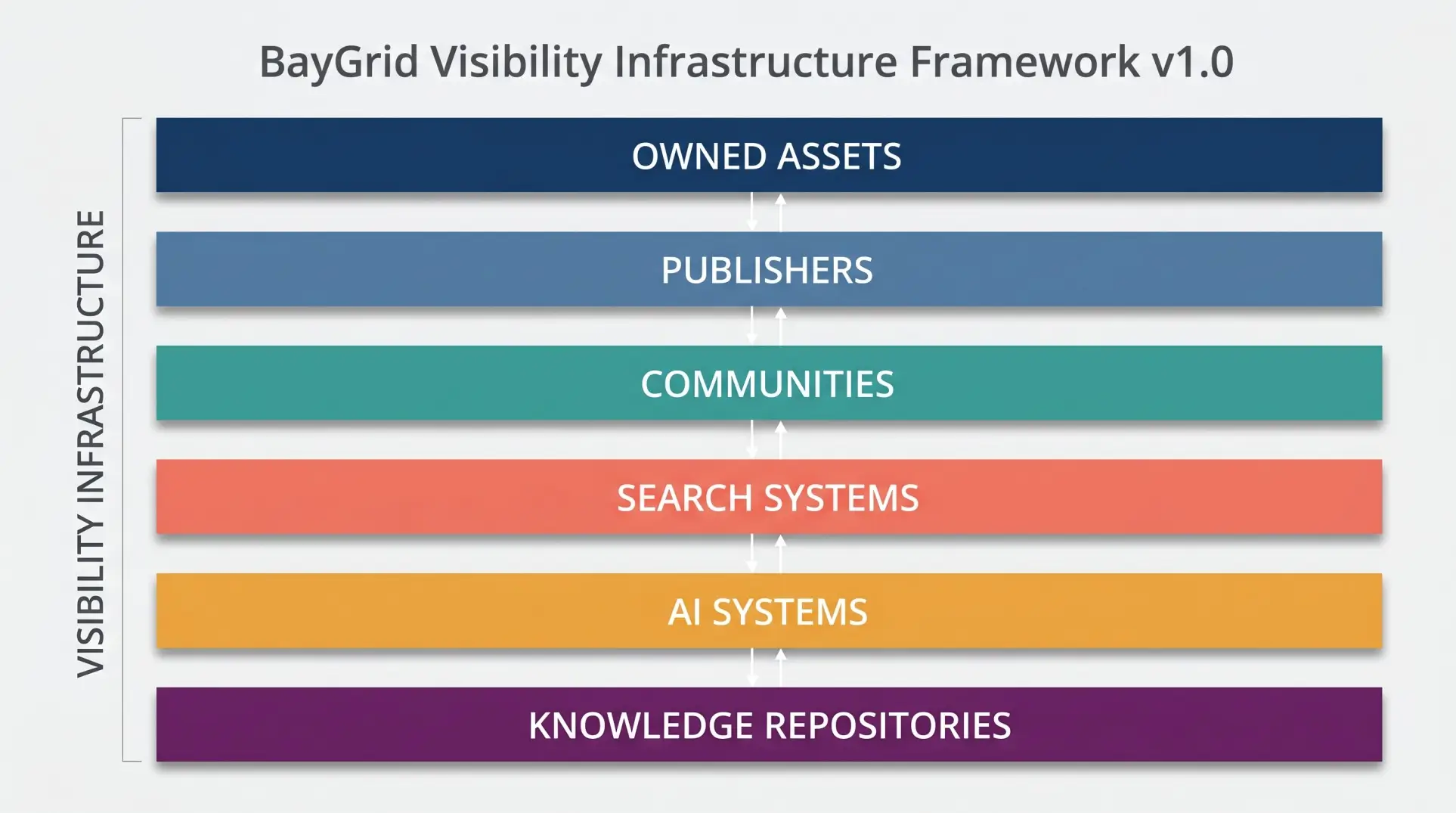
- Authority development requires visibility infrastructure: The BayGrid Standard: Visibility Infrastructure identifies the structural components — information architecture, distribution mechanisms, validation systems and maintenance processes — that enable authority to develop. The Authority Framework identifies what must flow through that infrastructure; the Visibility Infrastructure Standard identifies what the infrastructure must consist of.
The interdependence between the Authority Framework and the Visibility Framework is not incidental. It reflects the structural reality that authority does not develop in a vacuum — it develops within information environments, through visibility channels, in the context of how organisations are discovered and perceived. Understanding authority requires understanding visibility. Understanding visibility requires understanding authority.
The Authority Development Trajectory
The framework suggests that authority development follows a characteristic trajectory in hospitality contexts. This trajectory is not universal — it varies by organisation type, market position, competitive environment and numerous other factors — but it provides a useful reference pattern:
- Expertise establishment phase: The organisation develops and demonstrates genuine capability. This phase may be largely invisible to external audiences — it occurs primarily through internal development and early customer interactions.
- Initial validation phase: Early customers, critics or peers begin to recognise and confirm the organisation’s expertise. Validation is initially limited in volume and distribution but is genuine and independent.
- Consistency confirmation phase: The organisation demonstrates that its expertise and validation are not isolated events but sustained patterns. This phase is critical — it is where potential authority becomes established authority.
- Distribution expansion phase: The organisation’s authority signals begin to spread across additional information environments. This may occur through the organisation’s own distribution efforts, through third-party citation, or through both.
- Recognition consolidation phase: Audiences begin to recognise and reference the organisation’s authority without prompting. The organisation’s name becomes associated with credibility in its category. Authority has become a property that the organisation possesses in the minds of its audiences.
This trajectory is slow and cumulative. The analysis suggests that hospitality organisations should expect authority development to take years rather than months. Attempts to compress this timeline — through intensive marketing campaigns, aggressive review solicitation, or other acceleration tactics — may produce temporary signals but typically fail to produce the sustained, distributed recognition that characterises genuine authority.
Implications
For Hospitality Organisations
The systems-level understanding of digital authority developed in this paper has several implications for hospitality organisations:
- Authority begins with expertise: The framework suggests that genuine authority cannot be built on weak foundations. Investment in actual capability — culinary skill, service quality, operational excellence — is a prerequisite for authority development. Communications and promotion cannot substitute for capability.
- Authority requires patience: The cumulative, externally-conferred nature of authority means that it develops over timeframes measured in years. Organisations seeking rapid authority establishment are likely to achieve only the appearance of authority, not its substance.
- Validation must be earned, not manufactured: Attempts to simulate validation — through fake reviews, paid endorsements presented as independent, or other deceptive practices — undermine the very property they seek to create. The framework treats validation as a component that must be genuinely present, not merely apparently present.
- Consistency is a strategic asset: Organisations often underinvest in consistency because it is not dramatic. But the framework suggests that consistency may be the most powerful authority component precisely because it is difficult to fake and easy to observe.
- Distribution extends authority: Authority concentrated in a single channel or platform is vulnerable. Organisations should seek to distribute their authority signals across the range of environments that their audiences use, while recognising that distribution without underlying expertise and validation is merely presence, not authority.
For the Research Community
The analysis suggests several directions for further investigation:
- Component interaction studies: How do the five authority components interact in practice? Which components are most influential in which hospitality sub-sectors? Do component weights vary by organisation type, market position or audience segment?
- Authority measurement methodologies: Can the five-component model be operationalised into measurement approaches that assess authority without reducing it to simplistic metrics? Research into multi-dimensional authority assessment would strengthen the framework’s practical applicability.
- Authority decay patterns: How does authority erode when components weaken? Is authority decay symmetric with authority development, or does authority possess properties of persistence and resilience that delay decay?
- Cross-cultural authority dynamics: The framework is developed primarily within Western hospitality contexts. How do authority formation mechanisms vary across cultural contexts with different attitudes toward expertise, validation, consistency and recognition?
For Platform Design
The platforms through which hospitality authority is mediated shape how authority develops. The analysis suggests that platform design influences authority formation in significant ways:
- Validation system design: Platforms that emphasise volume (number of reviews) over consistency (patterns over time) or distribution (source diversity) may distort authority signals toward organisations that can generate volume rather than organisations that demonstrate sustained credibility.
- Temporal architecture: Platforms that emphasise recency over longevity may underweight the consistency component of authority, favouring new entrants with recent activity over established operators with sustained performance.
- Distribution mechanisms: Platforms that constrain how authority signals spread across environments may limit the distribution component, creating authority concentration rather than distributed authority.
The Hospitality Industry Outlook 2030 examines how platform evolution is likely to shape these dynamics in the coming decade.
Conclusion
This paper has examined the formation of digital authority in hospitality contexts, defined it through the BayGrid Standard: Digital Authority, and presented the BayGrid Authority Framework v1.0 as a model for understanding its development. The analysis has identified five key conclusions:
First, digital authority in hospitality is the degree to which an organisation or source is perceived as credible and knowledgeable across information environments. This definition emphasises perception, distribution and recognition — not merely the possession of expertise or the assertion of quality.
Second, digital authority emerges from the interaction of five mutually interdependent components: Expertise, Validation, Consistency, Distribution and Recognition. Each component is necessary; weakness in any component constrains the development of the others. The components operate as an integrated system, not as independent attributes.
Third, digital authority cannot be self-declared because authority requires external validation and audience recognition — properties that by definition cannot be produced by the organisation itself. Self-declared authority enters an information environment saturated with competing self-assertions and cannot differentiate itself. Only externally conferred authority, supported by distributed validation signals, achieves the credibility that characterises genuine authority.
Fourth, authority operates within the broader visibility system. It occupies the Authority layer of the BayGrid Visibility Framework v1.0, building upon presence and discovery and enabling the development of trust and reputation. Authority and visibility are interdependent — strong visibility accelerates authority development, and strong authority reinforces visibility through the generation of validation signals.
Fifth, authority development is cumulative, longitudinal and externally mediated. It develops through the sustained demonstration of expertise, the accumulation of independent validation, the maintenance of consistency over time, the expansion of distribution across environments, and the gradual achievement of audience recognition. These processes cannot be compressed into campaign cycles or purchased through promotional expenditure.
The Distributed Authority in Hospitality article examines how authority distributes through visibility channels to produce the compounding effects described in this analysis. The Understanding Digital Trust article examines the transition from authority to trust — the next layer in the visibility system. Together, these resources provide a comprehensive framework for understanding how credibility forms, why it cannot be manufactured, and what hospitality organisations must do to develop the genuine, durable authority that distinguishes credible organisations from those that merely claim credibility.
References
This analysis draws on the BayGrid Authority Framework v1.0 and BayGrid Visibility Framework v1.0. The conceptual foundations of the five-component model are derived from research into credibility assessment, information behaviour and systems theory as applied to digital environments. The proposition that authority cannot be self-declared reflects well-established findings in communication theory regarding source credibility and the discounting of self-interested claims. Direct empirical validation of the specific component model across hospitality contexts is limited; the framework should be understood as a theoretical contribution requiring further empirical investigation. The relationship between authority and trust draws on established theoretical distinctions in the trust literature. External references to platform-specific studies and credibility research are available in the BayGrid Bibliography.