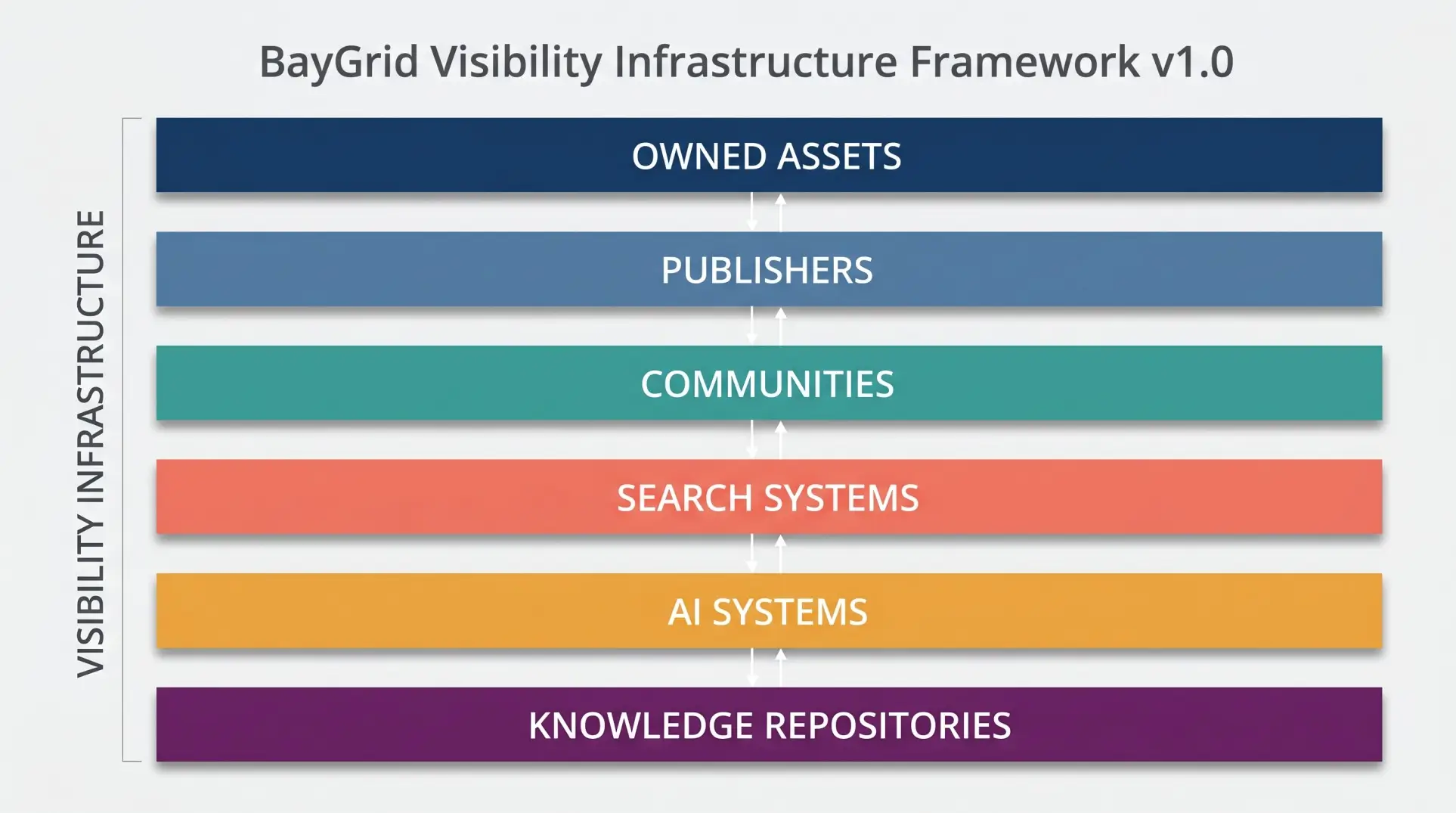
Collective Perception Formation and Its Relationship to Visibility, Authority, and Trust
Executive Summary
This paper establishes the BayGrid Standard for Reputation, defined as “the collective perception formed over time.” The central question this standard addresses is: “What are you known for?” Reputation is examined not as a managed asset but as an emergent property — the cumulative output of sustained visibility, demonstrated authority, and earned trust across a population of users. This standard positions reputation as Layer 5 of the BayGrid Visibility Framework v1.0 and examines its reciprocal relationship with the other four layers through the BayGrid Visibility Flywheel v1.0.
Standard Definition
Standard 5: Reputation — The collective perception formed over time through sustained presence, demonstrated authority, and earned trust. Reputation is not what an organisation claims about itself; it is what others collectively understand it to be. The operative question is: “What are you known for?”
Scope
This standard addresses the definition of reputation, its formation over time, its relationship to the five layers of the BayGrid Visibility Framework, and the mechanics of collective perception. It examines how reputation emerges from the interplay of presence, discoverability, authority, and trust, and how reputation, once formed, feeds back into the visibility system.
This standard does not cover reputation management tactics, crisis public relations strategies, review manipulation techniques, or organisational impression management. Those practices fall within the domain of communications and marketing disciplines and are outside the scope of BayGrid visibility infrastructure research. This standard is descriptive and analytical, not prescriptive.
Key Assumptions
- Reputation is the cumulative output of visibility, authority, and trust. An entity cannot possess reputation in the absence of the underlying layers. Reputation without substance is misperception, not standing.
- Reputation is collectively held. Reputation exists not in the entity but in the aggregate perception of those who encounter it. An entity may influence but cannot control its reputation.
- Reputation forms over time. While sudden reputational shifts can occur, durable reputation is built through sustained patterns of behaviour and encounter across extended periods.
Limitations
This standard identifies the structural properties of reputation and its relationship to visibility layers but does not prescribe specific reputation measurement tools or methodologies. Organisations seeking to assess reputation should develop instruments appropriate to their industry context, user population, and information environment. The standard further acknowledges that reputation operates differently across cultures, industries, and information domains; the framework presented here identifies structural commonalities but does not claim universal applicability in all contexts.
Key Concepts
Reputation vs. Brand vs. Identity
This standard distinguishes between three concepts often conflated in business and communications discourse:
| Concept | Definition | Locus of Control |
|---|---|---|
| Identity | How an organisation defines and understands itself | Internal — controlled by the organisation |
| Brand | How an organisation presents itself to external audiences | Partial — influenced by the organisation, interpreted by audiences |
| Reputation | How an organisation is collectively understood by those who have encountered it | External — held by the audience, not controlled by the organisation |
This distinction is analytically important. Identity and brand are outputs of organisational decision-making; reputation is an output of audience interpretation. An organisation may present a coherent brand (controlled) and yet find that its reputation (uncontrolled) diverges from its intent. Understanding this distinction prevents the common analytical error of assuming that presented messaging equates to received understanding.
Collective Perception
Collective perception refers to the aggregated understanding held by a population of users who have encountered an entity. It is not the sum of individual opinions but the emergent pattern that forms when individual perceptions are distributed across a group. Collective perception has several observable properties:
- Distributed memory: Reputation persists across the population even when individual members have not directly encountered the entity, transmitted through word-of-mouth, media coverage, and social signalling
- Gradual crystallisation: Early in an entity’s visibility history, collective perception is fluid and variable. Over time, it tends to converge toward a more stable characterisation
- Asymmetric fragility: Reputation is harder to build than to lose. Negative encounters tend to carry greater weight in collective perception than equivalent positive encounters
Reputation as Emergent Property
This standard treats reputation as an emergent property — a characteristic that arises from the interaction of simpler components but is not reducible to any single component. Reputation emerges from the interplay of:
- Presence (Layer 1): Whether the entity exists in the information environment at all
- Discoverability (Layer 2): Whether the entity can be found when sought
- Authority (Layer 3): Whether the entity is recognised as possessing expertise or standing
- Trust (Layer 4): Whether users place confidence in the entity’s information and claims
No single layer produces reputation. An entity may have high authority without reputation if it lacks presence or discoverability. It may have high trust without reputation if its user base is too small to generate collective perception. Reputation requires the vertical alignment of all four underlying layers.
Framework Application: Reputation Within the Visibility Architecture
BayGrid Visibility Framework: Reputation as Layer 5
The BayGrid Visibility Framework v1.0 structures visibility into five hierarchical layers. Reputation occupies Layer 5 — the apex of the hierarchy. The framework architecture reveals that reputation is both the culmination of the layers below it and a reinforcing input to those same layers.
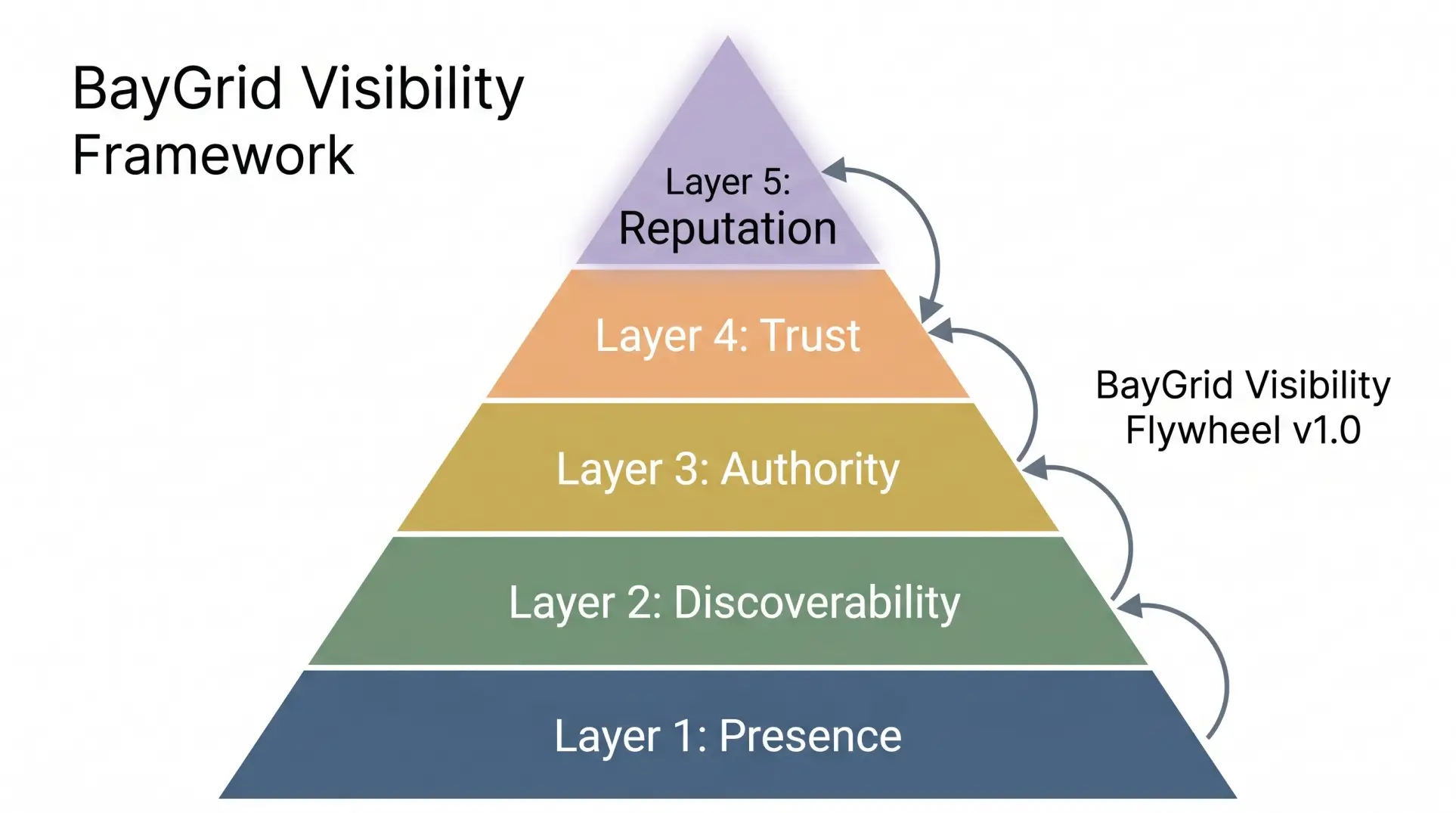
The five-layer structure operates as follows:
| Layer | Standard | Function | Relationship to Reputation |
|---|---|---|---|
| Layer 1: Presence | Standard 1: Hospitality Visibility | Existence in the information environment | Prerequisite — reputation cannot form without presence |
| Layer 2: Discoverability | Visibility Infrastructure | Capacity to be found when sought | Amplifier — discoverability determines the population that can contribute to collective perception |
| Layer 3: Authority | Standard 3: Digital Authority | Recognised expertise or standing | Content input — authority shapes what the reputation is about |
| Layer 4: Trust | Standard 4: Digital Trust | User confidence in information | Quality control — trust determines whether encounters produce positive or negative contributions to reputation |
| Layer 5: Reputation | Standard 5 (this standard) | Collective perception formed over time | Culmination — the emergent output of all four underlying layers |
BayGrid Visibility Flywheel: The Reciprocal Mechanism
The BayGrid Visibility Flywheel v1.0 describes the feedback mechanism through which reputation, once formed, reinforces the layers from which it emerged. This reciprocal relationship is central to understanding reputation dynamics:
- Reputation strengthens Presence: An entity with established reputation receives coverage, references, and citations that expand its presence across the information environment without direct investment.
- Reputation enhances Discoverability: Users actively seek entities with known reputation, and third parties link to and reference them, improving findability.
- Reputation amplifies Authority: Prior reputation functions as a credibility shortcut; new claims from a reputed source are evaluated more favourably than equivalent claims from an unknown source.
- Reputation accelerates Trust formation: Users encountering an entity with existing reputation require fewer confirmation cycles before reliance transfer, as described in the BayGrid Standard: Digital Trust.
This feedback loop means that reputation is not merely an endpoint but a dynamic force within the visibility system. Strong reputation makes the system self-reinforcing; reputation weakness makes the system self-eroding.
Reputation Formation Over Time
This standard identifies four phases of reputation formation observable across information environments:
Phase 1: Accumulation
In the accumulation phase, an entity is building the foundational layers. Encounters are individual and isolated; each user forms an independent assessment without the benefit of collective context. Reputation does not yet exist in any meaningful form. The entity is known, if at all, only to those who have directly encountered it. This phase is characterised by high effort and low return — each positive encounter contributes only incrementally to the entity’s standing.
Phase 2: Crystallisation
As the population of users with direct experience grows, patterns begin to emerge. Users start to share assessments; third parties begin to reference the entity. A recognisable characterisation forms — “the restaurant with exceptional service,” “the hotel known for its architecture,” “the brand that prioritises sustainability.” This characterisation is the seed of reputation. It is still fragile and can be easily revised, but it begins to acquire independent existence beyond individual encounters.
Phase 3: Consolidation
In the consolidation phase, the emerging characterisation stabilises and becomes resistant to minor perturbations. The entity is “known for” something specific. New users encounter the entity with pre-existing expectations shaped by reputation. The Visibility Flywheel begins to operate — reputation reinforces presence, discoverability, authority, and trust, which in turn strengthen reputation. This phase represents the transition from reputation-as-output to reputation-as-force.
Phase 4: Maintenance or Decline
Once consolidated, reputation enters a maintenance phase in which it must be actively sustained through continued alignment between claims and reality. If the entity continues to deliver encounters consistent with its established reputation, that reputation persists and may deepen. If encounters systematically contradict the established reputation, decline begins. Because of the asymmetric fragility noted earlier, decline can be substantially more rapid than ascent.
It is important to note that not all entities progress through all four phases. Many remain in accumulation indefinitely; some crystallise but fail to consolidate; some consolidate and subsequently decline. The phase model is descriptive of possible trajectories, not predictive of any specific entity’s path.
Illustrative Examples
Example 1: Reputation Crystallisation in Hospitality
A boutique hotel operates for several years in the accumulation phase — known primarily to direct guests and local referral networks. Over time, a pattern emerges: guests consistently note the property’s exceptional breakfast programme in reviews and social media posts. Travel journalists begin to reference the breakfast in coverage. The hotel’s reputation crystallises around this specific attribute. When prospective guests discuss the property, “breakfast” becomes the defining characterisation. The hotel is now known for something. This crystallisation, once established, feeds the Visibility Flywheel: media coverage expands presence, search behaviour shifts toward “hotel with best breakfast [destination],” authority is established in the culinary hospitality domain, and new guests arrive with pre-existing positive expectations that accelerate trust formation.
Example 2: Reputation Asymmetry
A restaurant group operates fifteen locations and has built a consolidated reputation for consistent quality over a decade. A single location experiences a food safety incident that receives media coverage. The reputation damage extends beyond the affected location to the group as a whole. The asymmetry is observable: ten years of positive encounters built the reputation; a single negative event, amplified by media, produced a reputational revision disproportionate to the incident’s frequency. This case demonstrates the fragility property of collective perception and the feedback mechanism through which reputation, once damaged, weakens the underlying layers of the Visibility Framework.
Common Misconceptions
| Misconception | Correction |
|---|---|
| “Reputation can be managed as an asset” | Reputation is held by audiences, not by the organisation. It can be influenced but not controlled. Treating reputation as an owned asset leads to strategic errors when audience perception diverges from organisational intent. |
| “Positive messaging creates positive reputation” | Reputation emerges from encounter quality over time, not from messaging intensity. Positive messaging without supporting encounter quality may produce short-term perception shifts but does not create durable reputation. |
| “Reputation is about being well-known” | Being known is Presence (Layer 1) and Discoverability (Layer 2). Reputation is about being known for something specific. Fame without characterisation is not reputation. |
| “Reputation loss can be fully recovered” | While reputation can recover from damage, the recovery trajectory is typically slower than the decline. Full restoration to pre-damage levels is possible but not guaranteed; in some cases, reputation is permanently revised. |
| “Online reviews equal reputation” | Online reviews are one input to collective perception. Reputation encompasses all channels of information transmission — direct experience, word-of-mouth, media coverage, professional acknowledgment, and online reviews in combination. |
Implications for Practice
This standard carries several implications for entities seeking to understand or cultivate reputation:
- Attend to all four underlying layers. Reputation cannot compensate for absence at lower layers. An entity with strong reputation signals but poor discoverability will find its reputation constrained by limited population exposure. An entity with strong presence but weak trust will find its reputation characterised negatively.
- Recognise that reputation is earned, not manufactured. The formation mechanism reveals that reputation emerges from sustained encounter quality over time. Short-term campaigns may shift brand perception but do not produce the durable collective understanding that constitutes reputation.
- Identify what you are becoming known for. The crystallisation phase is critical because the characterisation that forms tends to persist. Entities should monitor what patterns are emerging in user encounters, reviews, media coverage, and third-party references to understand what reputation is forming — whether aligned with intent or not.
- Protect against asymmetric fragility. Because reputation is harder to build than to lose, entities should identify vulnerabilities in the underlying layers that could produce rapid reputational damage. The quality of encounter delivery (Layer 4: Trust) is typically the most critical vulnerability point.
- Leverage the Visibility Flywheel. Once reputation begins to consolidate, entities can harness the feedback mechanism through which reputation strengthens the underlying layers. This may include cultivating third-party references, encouraging user-generated content, and developing channels through which positive reputation reaches new audiences.
Conclusion
This standard establishes Reputation as the collective perception formed over time — the emergent output of sustained presence, demonstrated authority, and earned trust. Positioned as Layer 5 of the BayGrid Visibility Framework v1.0, reputation represents the culmination of the visibility hierarchy. Through the BayGrid Visibility Flywheel v1.0, reputation feeds back into the system, reinforcing the layers from which it emerged.
The central question — “What are you known for?” — directs attention away from what an entity claims about itself and toward what others collectively understand it to be. This external, emergent character of reputation is its defining property. Reputation cannot be asserted, only earned. It cannot be controlled, only influenced. It cannot be manufactured, only cultivated through sustained alignment between claim and reality across the full depth of the visibility architecture.
Standard Statement
BayGrid Standard 5: Reputation defines collective perception as the emergent output of the visibility system, positioned at Layer 5 of the BayGrid Visibility Framework. Reputation is not what an organisation claims but what others collectively understand it to be. It forms through sustained alignment between presence, authority, and trust, and operates through the Visibility Flywheel as both culmination of and input to the visibility architecture. Entities seeking to cultivate reputation should attend to all underlying layers, monitor emerging characterisations, and recognise the asymmetric fragility through which reputation is more easily lost than built.