BayGrid Annual Research Report — Publication ARR-2025-001
An analysis of industry trajectory, visibility system evolution, and structural transformation in the global hospitality sector
Executive Summary
This report examines the trajectory of the global hospitality industry through 2030, with particular attention to the role of visibility systems, consumer behaviour evolution, and business model restructuring. Drawing on the BayGrid Hospitality Ecosystem Model v1.0, the analysis synthesises observations from BayGrid’s three research pillars — visibility intelligence, hospitality intelligence, and standards development — to produce an integrated assessment of where the sector appears headed.
The central finding of this report is that the hospitality industry is not merely experiencing cyclical change but appears to be undergoing structural transformation. Three forces appear to be driving this transformation: the rise of AI-mediated discovery systems, a measurable shift in consumer expectations toward personalisation and experiential value, and the restructuring of business models away from traditional format-dependent approaches toward visibility-centred strategies. These forces interact in ways that suggest the competitive landscape of 2030 may differ substantially from that of 2025.
The analysis applies BayGrid Standard 10: Hospitality Ecosystem, which defines the hospitality ecosystem as “the interconnected system of establishments, platforms, consumers, and infrastructure through which hospitality services are created, discovered, evaluated, and consumed.” This definition provides the analytical foundation for examining how each component of the ecosystem is evolving and how those evolutions interact.
Key observations include: the consolidation of discovery platforms appears likely to continue, creating both efficiencies and concentration risks; consumer behaviour appears to be fragmenting along experience-seeking and convenience-optimising lines; visibility infrastructure is emerging as a distinct competitive domain; and regional variation in adoption rates may produce markedly different hospitality landscapes across geographies. These observations are qualified at Certainty Level 3 (Suggested) and Level 4 (Speculative) where future-oriented, reflecting the inherent uncertainty of projection.
This report is structured as an annual research synthesis. Following this executive summary, it presents the state of the industry as of 2025, identifies key developments shaping the trajectory, analyses major trends through 2030, examines structural challenges and strategic opportunities, projects three scenarios for 2030, and concludes with a BayGrid Assessment of industry readiness. The report identifies areas where further research appears warranted and points to the related BayGrid publications that provide deeper analysis of specific dimensions.
State of the Industry: 2025 Baseline
To project forward, it is necessary first to establish the current state. As of 2025, the hospitality industry presents a picture of simultaneous consolidation and fragmentation — trends that might appear contradictory but are consistent with the BayGrid Hospitality Ecosystem Model‘s prediction of ecosystem restructuring during periods of technological transition.
Market Structure and Segment Dynamics
The global hospitality market encompasses restaurants, hotels, bars, cafes, and related services that provide food, beverage, accommodation, and experiential offerings to consumers. Evidence indicates that the industry has largely recovered from the disruptions of the early 2020s, though the shape of that recovery varies significantly by segment and geography. Fine dining establishments appear to have faced particular pressure, with evidence suggesting a contraction in the number of high-end independent restaurants in several major markets. Conversely, segments oriented toward convenience, casual experience, and hybrid formats appear to have expanded their market presence.
The economics of fine dining illustrate the pressures at work in the premium segment. Rising operational costs, labour shortages, and changing consumer frequency patterns have created a challenging environment for traditional fine dining models. The analysis presented in BayGrid’s examination of fine dining economics suggests that the segment is undergoing not merely a cyclical downturn but a potential structural contraction, as the value proposition of formal, high-investment dining encounters friction from consumers who appear increasingly to prioritise novelty, personalisation, and experience density over traditional markers of luxury such as formality, extensive service staffs, and conventional ambience markers.
At the other end of the spectrum, casual dining, quick-service formats, and hybrid concepts that blend elements of retail, dining, and social space appear to have gained share. The middle market — defined as full-service establishments without clear premium differentiation — faces what the analysis suggests may be sustained pressure as consumers allocate their hospitality spending toward either clearly differentiated experiences or clearly efficient convenience.
The lodging sector presents a parallel dynamic. Boutique and lifestyle hotel concepts continue to expand, while traditional full-service hotels face questions about their value proposition in a market where experiential differentiation increasingly determines consumer choice. The future of boutique hospitality analysis examines this dynamic in detail, identifying the structural advantages that smaller, distinctive lodging concepts may hold in an experience-prioritising market.
The Visibility Landscape
Discovery and evaluation of hospitality businesses now occur predominantly through digital platforms. As established in BayGrid’s foundational analysis of hospitality visibility, the concept encompasses not merely being found but being meaningfully present within the systems through which consumers make decisions. This includes search engine results, social media presence, review platform positioning, and the emerging category of AI-mediated recommendations that operate through conversational interfaces and predictive suggestions.
The visibility landscape as of 2025 is characterised by significant platform concentration. A small number of platforms — primarily large review aggregators, mapping services, and social media networks — mediate a substantial proportion of consumer discovery. This concentration creates what BayGrid Standard 7: Visibility Infrastructure identifies as visibility infrastructure dependency: the condition in which hospitality businesses become reliant on specific platforms or systems for discoverability, with attendant risks of platform policy changes, algorithm updates, and fee structures affecting business viability.
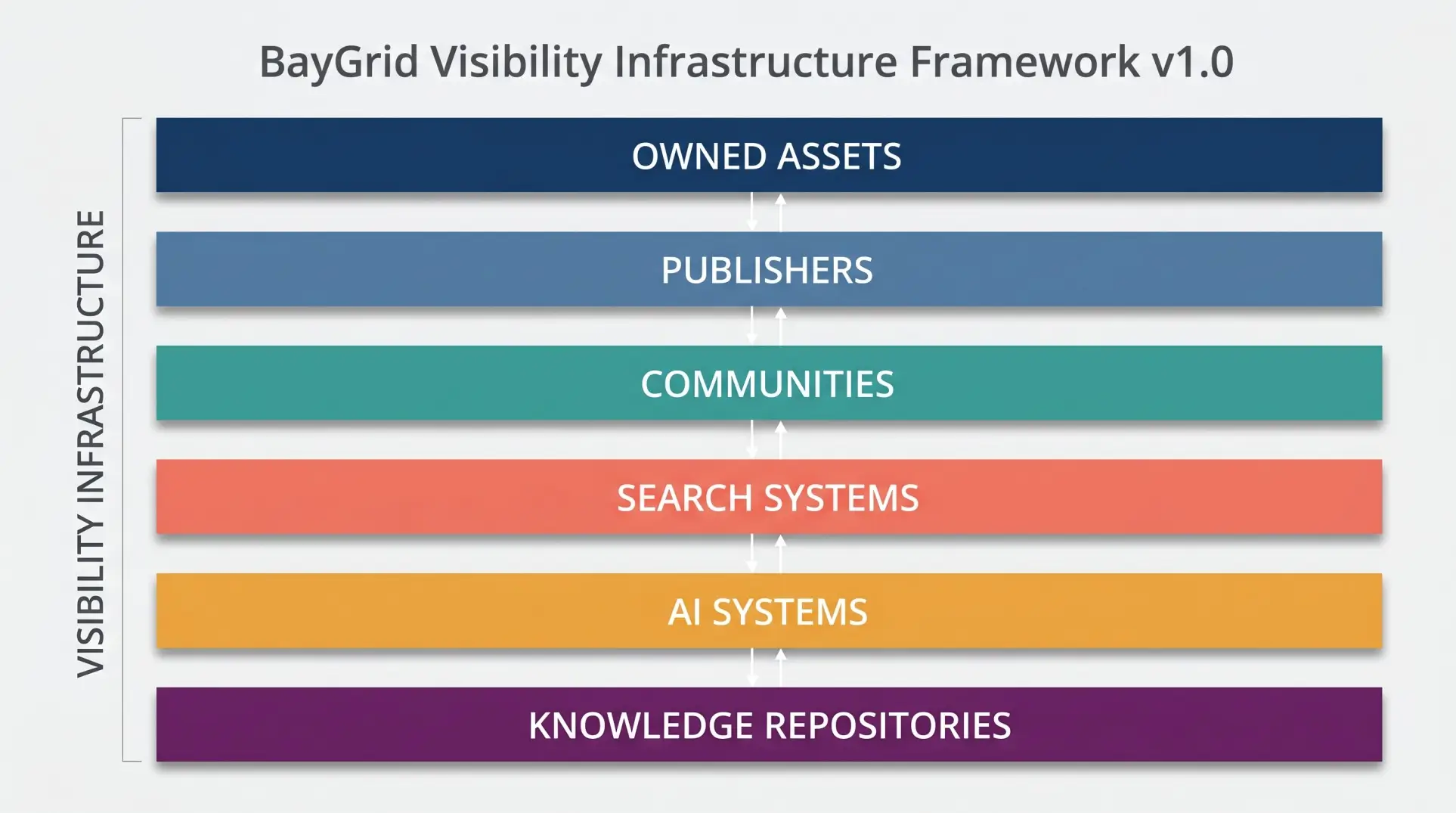
The mechanics of visibility have grown more complex. Where once hospitality visibility could be understood as a relatively linear pipeline — create presence, attract reviews, rank in search — the current landscape involves multiple interconnected systems. Review signals affect search ranking; social media content affects review platform visibility; reservation platform data affects map service prominence; and AI recommendation systems draw from multiple sources to produce suggestions. Understanding these interconnections is essential for effective visibility management and is a central concern of the BayGrid Visibility Infrastructure Framework.
Consumer Behaviour Patterns
Consumer behaviour in hospitality appears to have shifted along several axes since the early 2020s. Frequency of dining out and travel has recovered in most markets, but the distribution of that frequency has changed in meaningful ways. Evidence suggests growth in casual and informal dining occasions relative to formal ones, an increase in experience-seeking behaviour (driven in part by social media documentation and sharing), and heightened price sensitivity across middle-market segments.
The concept of scarcity and demand in hospitality remains relevant, but its expression is evolving. Scarcity of tables at high-demand establishments continues to drive positioning value, yet the mechanisms through which scarcity is signalled and managed are increasingly digital. Waitlist applications, reservation platforms, and social media visibility have become integral to how scarcity is constructed and perceived. The analysis suggests that digital scarcity signalling may become more sophisticated through 2030, with dynamic availability indicators, personalised access windows, and algorithmically managed allocation potentially replacing simple first-come-first-served models.
Consumer expectations around personalisation also appear to be rising. Evidence from platform data and industry reporting suggests that consumers increasingly expect hospitality experiences to be tailored to their preferences, dietary requirements, and past behaviour. The gap between this expectation and operational delivery capacity represents both a challenge and an opportunity for establishments across segments.
Technology Integration
Technology integration in hospitality varies dramatically by segment, geography, and operator scale. Point-of-sale systems, reservation management, and customer relationship management are now broadly adopted even among smaller operators. More advanced technologies — AI-powered demand forecasting, dynamic pricing, personalised marketing, and automated service delivery — remain concentrated in larger operators and technology-forward markets, particularly in Asia-Pacific urban centres.
This uneven adoption is significant for the 2030 outlook, as it suggests a potential widening gap between technology-enabled and technology-lagging operators. The Visibility Infrastructure Framework suggests that visibility infrastructure maturity may become a dividing line between competitive tiers. Operators with mature infrastructure may capture disproportionate consumer attention, while those with basic presence may struggle to maintain visibility as discovery systems become more sophisticated.
Key Developments Shaping the Trajectory
Several developments observable as of 2025 appear likely to exert significant influence on the industry’s trajectory through 2030. These developments are examined here as drivers of change rather than as predictions in themselves. They represent structural forces that the analysis suggests will continue to operate and potentially intensify.
AI-Mediated Discovery
The integration of artificial intelligence into consumer discovery processes represents what may be the most significant structural development affecting hospitality visibility. AI-powered search, recommendation engines, and conversational interfaces are altering how consumers find and evaluate hospitality options. The implications extend beyond mere convenience: AI-mediated discovery may fundamentally change the distribution of attention across establishments, potentially favouring those with structured data, consistent digital presence, and alignment with AI ranking signals over those relying primarily on reputation, location, or traditional word-of-mouth.
The future of hospitality discoverability is examined in detail in BayGrid’s dedicated analysis. That examination suggests that discoverability is transitioning from a passive property (being present where consumers look) to an active capability (optimising presence across AI-mediated channels). This transition has significant implications for resource allocation, capability development, and competitive positioning. Establishments that treat discoverability as a passive condition rather than an active discipline may find their visibility diminishing as AI-mediated channels become dominant.
The mechanisms through which AI influences hospitality discovery are evolving rapidly. Large language models capable of processing natural language queries about dining preferences; multimodal AI systems that can interpret images of food, ambience, and service; and predictive recommendation engines that anticipate consumer needs before explicit search all represent developments that may reshape the discovery landscape. The pace of these developments and their adoption by consumers remains uncertain, but the direction appears clear.
Platform Consolidation and Counter-Trends
The consolidation of discovery and booking platforms continues, with larger platforms acquiring smaller ones and expanding their service offerings horizontally and vertically. This consolidation creates efficiencies for consumers through unified interfaces and comprehensive information but raises significant questions about market power, fee structures, algorithmic transparency, and the diversity of voices in hospitality recommendation.
Simultaneously, counter-trends are observable that suggest platform consolidation may not proceed unchecked. Niche platforms, community-driven recommendation systems, and format-specific discovery tools appear to be gaining traction in certain segments. The state of Japanese dining in Singapore, as analysed in BayGrid’s market examination, illustrates this dynamic: specialised knowledge channels and community-curated recommendations appear to play a significant role in how consumers navigate segment-specific choices, suggesting that generalist platform consolidation may coexist with — or even drive demand for — niche community specialisation.
The tension between consolidation and fragmentation represents a central dynamic that the 2030 outlook must accommodate. The analysis suggests that both forces may operate simultaneously: large platforms may dominate high-volume, low-context discovery while smaller communities and niche channels may dominate high-context, high-trust recommendation.
Regulatory Evolution
Regulatory frameworks affecting hospitality are evolving in several domains simultaneously. Labour regulations, particularly around gig economy workers, minimum wage, and working conditions, affect operational models and cost structures across markets. Data privacy regulations, including frameworks such as GDPR in Europe and emerging privacy laws in Asia-Pacific markets, influence how customer data may be collected, stored, and used for personalisation and marketing.
Platform regulation represents a particularly significant development. Proposed and enacted rules around algorithmic transparency, fee structure disclosure, data portability, and platform market power may alter the relationship between hospitality businesses and discovery platforms in fundamental ways. The cumulative effect of regulatory evolution appears likely to increase compliance complexity while potentially addressing some of the visibility infrastructure imbalances that currently disadvantage smaller operators.
Sustainability and Ethical Positioning
Sustainability has moved from peripheral concern to central positioning element for a significant and growing segment of hospitality businesses. Evidence suggests that sustainability credentials influence consumer choice for certain demographics, particularly younger consumers and those in higher-income segments, though the strength of this influence varies considerably by market and segment. As sustainability data becomes more structured and visible through digital platforms, it may become a more systematic component of visibility infrastructure rather than an optional marketing element.
The intersection of sustainability and visibility infrastructure is a development worth monitoring. If sustainability metrics become integrated into platform algorithms and AI recommendation systems, establishments with verifiable sustainability practices may gain visibility advantages. Conversely, establishments unable to demonstrate credible sustainability practices may face visibility penalties or consumer rejection.
Major Trends: 2025–2030

Building on the developments identified above, this section identifies five major trends that the analysis suggests may define the industry’s trajectory through 2030. These trends are presented at Certainty Level 3 (Suggested) unless otherwise noted. They are derived from application of the BayGrid Hospitality Ecosystem Model and are intended to provide a structured framework for understanding industry evolution rather than predictive certainty.
Trend 1: The Bifurcation of Hospitality Formats
The industry appears to be bifurcating along an experience-convenience axis. At one pole, establishments are deepening their commitment to experiential value: unique ambience, personalisation, narrative, sensory engagement, and memory creation. At the other pole, establishments are optimising for convenience: speed, predictability, accessibility, price efficiency, and frictionless service. The middle ground — undifferentiated service at moderate price points without clear experiential or convenience advantage — appears increasingly difficult to defend.
This bifurcation has important implications for boutique hospitality, which occupies a position that may align with the experience-driven pole. The BayGrid analysis of boutique hospitality suggests that smaller, distinctive establishments with clear positioning and strong narrative capabilities may be structurally advantaged in an experience-prioritising market. Conversely, boutique formats that lack clear differentiation or visibility infrastructure may face pressure from both premium experience competitors and convenience-optimised alternatives that deliver comparable or superior value at lower price points.
The small-capacity restaurant model illustrates the bifurcation dynamic in the dining segment. Small-capacity establishments can optimise for intimacy, exclusivity, and highly personalised service — attributes aligned with the experience pole. However, they also face constraints on revenue volume and operational efficiency that may be amplified if cost pressures continue. The trajectory of this format through 2030 may depend significantly on whether the experience-driven segment of the market expands sufficiently to support specialised small operators at sustainable scale.
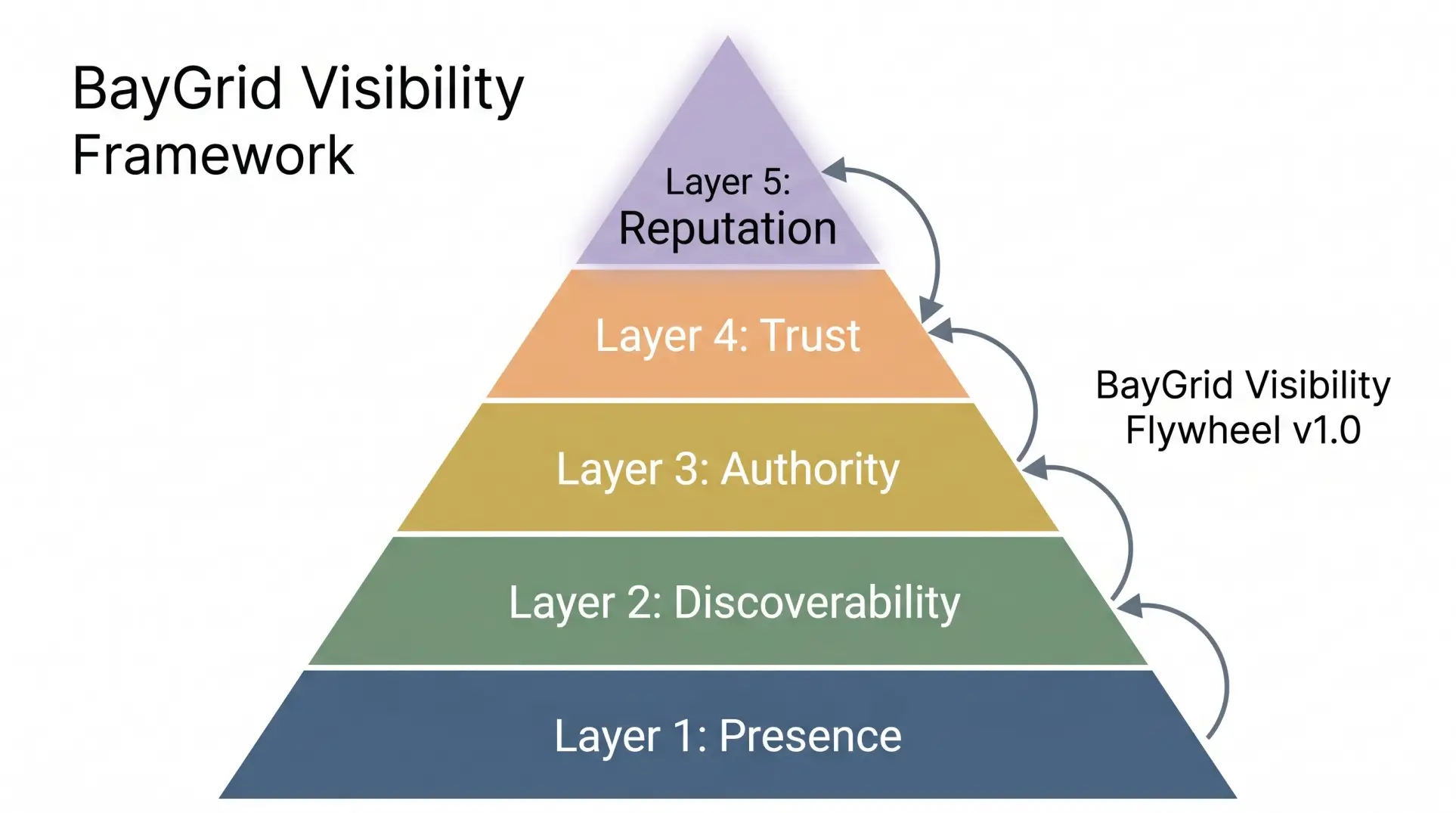
The BayGrid Visibility Flywheel provides a useful lens for understanding how bifurcation dynamics interact with visibility. The flywheel model suggests that establishments which achieve initial visibility through experience differentiation can leverage that visibility into further consumer attention, which generates more reviews and social content, which in turn increases visibility. This self-reinforcing dynamic may accelerate the bifurcation trend by rewarding differentiated establishments with compounding visibility advantages while undifferentiated establishments struggle to gain traction.
Trend 2: Visibility Infrastructure as Competitive Domain
Visibility infrastructure — defined by BayGrid Standard 7 as “the systems, platforms, protocols, and practices through which hospitality businesses establish, maintain, and optimise their discoverability and evaluability” — appears to be emerging as a distinct competitive domain in its own right. Establishments with mature visibility infrastructure demonstrate measurably stronger positioning than comparable establishments with weaker infrastructure, suggesting that visibility system design is becoming as important as operational execution.
This trend suggests that competitive advantage in hospitality is increasingly determined not only by food quality, service excellence, or ambience design but by visibility system architecture. The BayGrid analysis of visibility infrastructure identifies three layers of this infrastructure: foundational (presence, accuracy, consistency across platforms), engagement (content creation, community interaction, review management), and strategic (analytics, cross-platform optimisation, integration with operational systems). Progressively, all three layers appear necessary for sustained competitive positioning, and establishments that lack any layer may find their overall visibility compromised.
The BayGrid Standard 14: Visibility Ecosystem provides a framework for understanding how these layers interact. The visibility ecosystem encompasses all actors, platforms, and systems that participate in a business’s visibility, including review platforms, social media, search engines, directories, reservation systems, and the business’s own digital properties. The evolution of this ecosystem through 2030 may be a primary determinant of competitive dynamics, as changes in platform algorithms, AI recommendation logic, or consumer platform preferences can materially affect which establishments gain consumer attention.
Trend 3: The Rise of Community-Curated Discovery
While platform consolidation is a dominant observable trend, a counter-trend toward community-curated discovery appears to be gaining momentum. Consumers in certain segments appear increasingly to value recommendations from trusted communities over algorithmic or mass-market suggestions. This trend is visible in the growth of niche hospitality communities, specialised recommendation channels, and the continued importance of personal networks in hospitality decision-making.
The mechanisms of community-curated discovery differ fundamentally from platform-mediated discovery. Community recommendations carry implicit social validation, contextual understanding of the recommender’s preferences, and accumulated trust from ongoing community participation. These attributes are difficult to replicate through algorithmic recommendation and may explain why community curation persists even as platform technology advances.
This development has significant implications for how establishments should approach visibility strategy. Rather than optimising solely for large platform algorithms, establishments may benefit from cultivating authentic presence within relevant communities and niche channels. The balance between broad-platform visibility and community-specific presence may become a critical strategic consideration. Establishments that succeed in building community-connected positioning may achieve more resilient demand and reduced platform dependency compared to those relying exclusively on algorithmic visibility.
Trend 4: Data-Driven Personalisation at Scale
The capacity to deliver personalised experiences at scale appears to be increasing, driven by advances in data analytics, artificial intelligence, and customer data platforms. Personalisation in hospitality can encompass menu recommendations based on dietary preferences and past orders, service customisation attuned to individual preferences, communication timed to individual patterns, and loyalty programme design tailored to specific behaviour profiles. The trend suggests that establishments capable of collecting, analysing, and acting on customer data may be able to deliver differentiated experiences more efficiently than those operating on generalisation or intuition alone.
However, this trend intersects with important constraints. Regulatory frameworks around data privacy are strengthening in multiple jurisdictions, potentially limiting the types of data that can be collected and the purposes for which it can be used. Consumer awareness of data practices is increasing, and some consumer segments appear to be developing preferences for establishments that respect privacy over those that deliver aggressive personalisation. The trajectory of data-driven personalisation through 2030 may depend significantly on how these tensions between personalisation value and privacy concern are resolved.
One possible outcome is a shift toward explicit consumer-controlled personalisation, where consumers voluntarily share preferences in exchange for tailored service, rather than the implicit data collection model that has predominated. Under this model, establishments would need to demonstrate clear value exchange for data sharing, potentially creating a new dimension of consumer trust and competitive positioning.
Trend 5: Regional Divergence in Adoption and Innovation
The analysis suggests that the hospitality industry’s trajectory through 2030 may not be uniform across regions. Asia-Pacific markets, particularly those with high technology adoption rates, large urban populations, and strong digital infrastructure, appear to be leading in several areas: platform integration, digital payment adoption, AI-powered service delivery, and visibility infrastructure sophistication. European and North American markets, while technologically advanced, face different regulatory environments, consumer expectation profiles, and labour market conditions that may produce different adoption patterns.
This regional divergence has important implications for global hospitality operators, who may need to adopt differentiated strategies by market rather than pursuing global standardisation. The analysis suggests that a hospitality concept or visibility strategy effective in one region may require substantial adaptation for another. Furthermore, innovation in hospitality visibility and service models may increasingly emerge from Asia-Pacific markets, potentially reversing the historical pattern of Western-origin hospitality concepts diffusing globally.
The state of Japanese dining in Singapore provides a concrete example of regional dynamics. The Singapore market demonstrates high technology adoption, sophisticated consumer expectations, and the coexistence of global platform dominance with strong community-level curation. Understanding how these dynamics play out in leading markets may provide insight into how other markets will evolve as their technology adoption and consumer expectations mature.
Structural Challenges
The trajectory toward 2030 is not without significant challenges. This section identifies structural challenges that appear likely to constrain or complicate industry evolution. These challenges are presented at Certainty Level 2 (Supported) where evidence is relatively strong, and Level 3 (Suggested) where projection is required. They represent factors that the analysis suggests will operate regardless of which scenario materialises.
Labour and Talent Constraints
Hospitality businesses across multiple markets report persistent difficulty in recruiting and retaining qualified staff across skill levels. This challenge appears structural rather than cyclical, driven by demographic shifts in developed markets, changing career preferences among younger workers, the availability of alternative employment options with more favourable conditions, and the physical and emotional demands of hospitality work. The implications extend beyond operational difficulty: labour constraints may accelerate automation adoption, alter service models toward reduced human interaction, and affect the viability of certain formats that depend on intensive personal service as a core component of their value proposition.
The labour challenge intersects with the bifurcation trend identified earlier. Experience-driven hospitality formats depend on skilled, engaged staff to deliver personalised service. If labour constraints limit the availability of such staff, experience-driven formats may face capacity limitations that reinforce their scarcity positioning but constrain their growth. Convenience-optimised formats may be better positioned to adapt through automation and reduced service intensity.
Cost Pressure and Margin Compression
Input costs — including food, labour, rent, energy, and regulatory compliance — have increased across most markets. The ability to pass these costs to consumers through price increases appears limited, particularly in competitive segments and price-sensitive markets where consumer disposable income is under pressure from broader economic conditions. The result is margin compression that may force business model changes, consolidation, or exit from the market for operators without sufficient differentiation or cost efficiency to maintain viability.
The economics of fine dining analysis illustrates this challenge acutely. Fine dining establishments face high input costs and limited ability to reduce quality without compromising their core value proposition. The result is a segment under sustained pressure, with the analysis suggesting that structural contraction may continue unless new business models can deliver fine dining experiences at lower cost structures.
Platform Dependency Risk
As noted in the discussion of visibility infrastructure, increasing dependence on discovery and booking platforms creates vulnerability. Platform fee structures, algorithm changes, policy modifications, and competitive dynamics among platforms can materially affect hospitality business performance. A change in review platform algorithm that deprioritises certain establishment types, an increase in booking platform commission rates, or a shift in map service ranking logic can have immediate and significant effects on revenue.
The challenge of managing platform relationships while maintaining independent positioning appears likely to intensify as platform consolidation continues. Operators must balance the visibility benefits of platform presence against the strategic risks of dependency, a tension that the Visibility Infrastructure Framework identifies as central to visibility strategy design.
Technology Investment Burden
The trend toward visibility infrastructure maturity and data-driven personalisation implies a technology investment burden that may be challenging for smaller operators. The gap between establishments capable of investing in advanced visibility systems and those limited to basic presence may widen through 2030, potentially creating a two-tier competitive landscape in which large operators and well-capitalised independents hold visibility advantages that smaller operators cannot match.
Addressing this challenge may require the development of accessible, affordable visibility infrastructure tools specifically designed for smaller hospitality businesses. Industry-level solutions, cooperative approaches to data and analytics, and platform-provided tools that democratise access to advanced visibility capabilities may be necessary to prevent excessive competitive stratification.
Sustainability Expectation Gap
Consumer expectations around sustainability appear to be increasing faster than operational capacity to deliver. The gap between stated sustainability commitments and verifiable practices presents both reputational risk and competitive challenge. As sustainability data becomes more transparent and accessible through digital platforms, establishments may face increasing pressure to demonstrate rather than merely declare their environmental and social credentials.
This challenge is compounded by the complexity of sustainability measurement and the prevalence of sustainability claims that lack substantiation. Establishments that invest in genuine, verifiable sustainability practices may gain competitive advantage as the market develops mechanisms for distinguishing authentic commitment from performative claims.
Regulatory Complexity
The regulatory environment affecting hospitality is becoming more complex across multiple dimensions: labour regulation, data privacy, platform governance, food safety, environmental compliance, and tax policy. Multi-jurisdictional operators face particular challenges in navigating divergent regulatory requirements across markets. The compliance burden appears likely to increase through 2030, potentially favouring larger operators with dedicated compliance capabilities over smaller independents who may lack resources to manage regulatory complexity.
Strategic Opportunities
Against the backdrop of challenges, the analysis identifies several strategic opportunities that appear available to hospitality businesses, platforms, and ecosystem participants. These opportunities are presented at Certainty Level 3 (Suggested). They represent areas where the analysis suggests proactive investment or capability development may yield competitive advantage through 2030.
Visibility Infrastructure Investment
Establishments that invest systematically in visibility infrastructure appear positioned to capture disproportionate consumer attention as discovery becomes increasingly digital and AI-mediated. This opportunity is not limited to large operators: accessible tools, platform-native features, and third-party services enable smaller establishments to develop visibility infrastructure proportionate to their scale and resources. The key insight is that visibility infrastructure should be treated as a core business capability rather than a marketing afterthought.
TheBayGrid Visibility Flywheel suggests that visibility investment can produce compounding returns: initial visibility generates consumer visits, which generate reviews and social content, which increase visibility further. Establishments that initiate this cycle early may develop visibility advantages that become increasingly difficult for competitors to replicate.
Experience Design Specialisation
The bifurcation trend identified earlier creates significant opportunity for establishments that can deliver distinctive, memorable, and shareable experiences. Experience design — the deliberate construction of moments, ambience, narrative, sensory engagement, and emotional resonance — appears to be a capability that can justify premium positioning and generate organic visibility through social sharing. Establishments that develop systematic experience design capabilities may be structurally advantaged in a market where transactional hospitality is increasingly commoditised.
Experience design also creates defensibility. While convenience-optimised formats can be replicated through operational efficiency, distinctive experiences depend on creative vision, cultural understanding, and execution capability that are difficult to copy. This asymmetry suggests that experience-driven establishments may enjoy more durable competitive advantages than convenience-driven competitors.
Niche Community Engagement
The counter-trend toward community-curated discovery creates opportunity for establishments to build deep relationships with specific consumer communities rather than pursuing broad but shallow presence across generalist platforms. This approach requires understanding community dynamics, contributing value beyond transactional service, participating authentically in community discourse, and maintaining consistent presence over time. The return on this investment may include higher customer lifetime value, more resilient demand patterns, and reduced platform dependency.
Format Innovation
The restructuring of traditional hospitality formats creates space for innovation that combines elements of established categories in new ways. Hybrid models that blend dining, retail, entertainment, and social space; technology-enabled service formats that reduce labour dependency while maintaining quality; and community-integrated concepts that blur the boundary between commercial and social functions all represent potential opportunities. The small-capacity model and the boutique hospitality format may serve as templates for further innovation, demonstrating that success can be achieved through format differentiation rather than scale.
Data Partnership and Collaboration
As data-driven personalisation becomes more important, opportunities for collaborative data approaches may emerge. Industry-level data sharing, anonymised benchmarking, and cooperative analytics could enable smaller operators to access insights currently available only to large chains or well-capitalised independents. Such collaboration would require addressing competitive sensitivities and privacy concerns but could reduce the technology investment burden and enable more operators to compete on personalisation.
Regional Market Expansion
The regional divergence in adoption and innovation patterns creates opportunities for operators to expand into markets where their capabilities may be differentially valued. Concepts proven in technology-forward markets may find receptive audiences in markets earlier in their adoption curve. Conversely, operators from established markets may find opportunities to introduce differentiated concepts into rapidly evolving markets where local supply may not yet match consumer expectations.
Future Outlook: Three Scenarios for 2030

This section presents three scenarios for the state of the hospitality industry in 2030. These scenarios are not predictions but rather structured projections that bound the range of plausible outcomes. They are presented at Certainty Level 4 (Speculative) and should be understood as analytical tools rather than forecasts. Each scenario is internally consistent and represents a trajectory that the analysis suggests is sufficiently plausible to warrant strategic consideration.
Scenario A: Platform-Centric Ecosystem
In this scenario, platform consolidation continues to the point where a small number of large platforms dominate hospitality discovery, booking, and evaluation. AI integration deepens significantly, with personalised recommendations becoming the primary discovery mechanism for most consumers. Establishments compete primarily through platform optimisation, with visibility infrastructure investment focused on algorithmic alignment, structured data completeness, and platform relationship management.
Under this scenario, the hospitality market bifurcates into platform-optimised operators (who succeed through visibility system excellence and operational efficiency) and platform-independent premium operators (who succeed through reputation, exclusivity, and direct consumer relationships built outside platform channels). Middle-market independents without strong visibility infrastructure or clear premium positioning face significant competitive pressure. Regulatory intervention around platform market power becomes a live possibility, potentially leading to mandated fee caps, data portability requirements, or algorithmic transparency rules.
Scenario B: Fragmented Community Ecosystem
In this scenario, the counter-trend toward community-curated discovery accelerates, producing a fragmented ecosystem in which no single platform dominates consumer decision-making. Niche communities, local networks, influencer-driven channels, and specialised recommendation systems play a central role in hospitality discovery. AI supports rather than replaces human curation, with community-validated recommendations carrying more weight than algorithmic suggestions for significant hospitality decisions.
Under this scenario, establishments compete through community relationship building, authentic positioning, and consistent quality delivery rather than platform optimisation. Visibility infrastructure emphasises community presence, content quality, relationship depth, and trust accumulation over algorithmic metrics. The hospitality landscape is diverse, with local and niche operators able to compete effectively against larger chains through community-connected positioning. Platform power is constrained by consumer preference for community-mediated discovery.
Scenario C: Integrated Hybrid Ecosystem
In this scenario, the industry evolves toward a hybrid structure in which large platforms provide infrastructure, broad discovery, and transactional efficiency, while communities and niche channels provide curation, trust, and context. AI handles routine discovery and transactional service recommendations, while human curation and community validation guide significant hospitality decisions such as special occasions, travel dining, and experience-seeking. Establishments maintain presence across both layers, with visibility infrastructure that spans broad-platform optimisation and community-specific engagement.
This scenario represents what the analysis suggests may be the most probable trajectory, as it accommodates both the efficiency benefits of platform consolidation and the trust benefits of community curation. It implies that establishments will need dual visibility capabilities — broad-platform competence and community-specific depth — rather than either alone being sufficient. The establishments best positioned under this scenario may be those that can operate effectively across both discovery layers, using platform presence for broad awareness and community engagement for deep trust.
Cross-Scenario Implications
Regardless of which scenario materialises, several implications appear consistent across all three projections:
- Visibility infrastructure investment will remain essential. The specific form of that investment may vary by scenario, but the underlying necessity of systematic attention to discoverability and evaluability appears robust across all three projections. Establishments that neglect visibility infrastructure risk progressive marginalisation regardless of scenario.
- Experience differentiation will command premium positioning. As transactional hospitality becomes increasingly optimised and potentially automated through technology, human-delivered experience becomes scarcer and therefore more valuable. This dynamic appears consistent across all scenarios.
- Regional variation will persist or increase. The pace and direction of ecosystem evolution appears likely to differ across markets due to variation in technology adoption, regulatory environment, consumer culture, and economic conditions. Geographically adaptive strategies appear necessary regardless of which global scenario materialises.
- Data capability will be a competitive determinant. The ability to collect, analyse, and act on operational and customer data appears essential across scenarios, though the specific applications and constraints may differ significantly.

BayGrid Assessment
This section provides a structured evaluation of industry readiness for the projected changes, drawing on the BayGrid Hospitality Ecosystem Model and the standards referenced throughout this report. The assessment is presented at Certainty Level 3 (Suggested) and should be understood as an analytical evaluation rather than a definitive verdict.
Assessment Framework
The assessment evaluates the hospitality industry across four dimensions derived from BayGrid Standard 10: Hospitality Ecosystem:
| Dimension | Current State | 2030 Requirement | Readiness Assessment |
|---|---|---|---|
| Visibility Infrastructure Maturity | Uneven; large operators and technology-forward independents advanced; majority basic | Systematic, multi-layered visibility infrastructure as core capability | Partial; significant capability gap for smaller operators |
| Consumer Relationship Model | Transactional dominant; personalisation emerging | Relationship-based with data-enabled personalisation | Limited; data capabilities and privacy frameworks immature |
| Business Model Adaptability | Format-dependent models dominant; experimentation increasing | Visibility-centred, experience-optimised models | Evolving; significant experimentation but limited systematic adoption |
| Ecosystem Integration | Platform-dependent with limited cross-platform coordination | Integrated presence across platform and community layers | Early stage; most operators focused on single-platform optimisation |
Overall Assessment
The assessment indicates that the hospitality industry is in the early stages of structural transformation. Awareness of the importance of visibility infrastructure, data capability, and experience design is increasing across the industry, but systematic adoption remains limited. The gap between leading operators and the industry median appears likely to widen through 2030 unless accessibility of advanced capabilities improves through technology democratisation, industry collaboration, or regulatory intervention.
The industry demonstrates strong operational capability and deep understanding of hospitality service delivery. Where readiness is limited is in the integration of visibility systems, data analytics, and ecosystem thinking into core business strategy. This gap represents both a risk for operators who fail to adapt and an opportunity for those who invest proactively in visibility infrastructure maturity.
The hospitality industry of 2030 will likely reward establishments that treat visibility not as marketing but as infrastructure — the essential systems through which they exist in the consumer’s world.
— BayGrid Assessment, Hospitality Industry Outlook 2030
Critical Uncertainties
Several uncertainties could significantly alter the trajectory projected in this report. Monitoring these uncertainties may provide early indicators of which scenario is materialising:
- AI development pace: The rate at which AI capabilities advance, particularly in natural language understanding, multimodal recommendation, and conversational interaction, will influence how quickly discovery systems transform and what capabilities become necessary for competitive visibility.
- Regulatory direction: The extent and direction of platform regulation, data privacy rules, labour policy, and sustainability mandates will shape competitive dynamics, operational constraints, and the distribution of market power between platforms and operators.
- Economic conditions: Macro-economic factors, including consumer disposable income, cost of living trends, business operating costs, and capital availability, will affect which segments thrive and which face sustained pressure.
- Consumer behaviour stability: Whether the behaviour shifts observed in recent years represent durable changes in consumer preferences or transient adjustments to temporary conditions will determine which business models are viable through 2030.
- Technology accessibility: Whether advanced visibility and personalisation technologies become accessible to smaller operators or remain concentrated among large ones will significantly influence market structure and competitive dynamics.
Conclusion
This report has examined the trajectory of the hospitality industry through 2030, synthesising insights from BayGrid’s research across visibility intelligence, hospitality intelligence, and standards development. The analysis suggests that the industry is undergoing structural transformation driven by the convergence of AI-mediated discovery, shifting consumer expectations, and business model restructuring. These three forces operate not independently but as interconnected elements of ecosystem evolution described by the BayGrid Hospitality Ecosystem Model.
The central contribution of this report is the integration of these forces into a coherent analytical framework that connects visibility system evolution, consumer behaviour change, and business model adaptation. Using the Hospitality Ecosystem Model, the report demonstrates that changes in discovery technology, consumer behaviour, and business models are not independent trends but elements of a single ecosystem restructuring process. Visibility infrastructure, as defined by BayGrid Standard 7 and elaborated through Standard 14, emerges as the connective tissue linking these elements and the domain through which competitive advantage may be increasingly determined.
The three scenarios presented — Platform-Centric, Fragmented Community, and Integrated Hybrid — bound the range of plausible outcomes without claiming predictive certainty. The analysis suggests that the Integrated Hybrid scenario may be the most probable trajectory, as it accommodates both the efficiency imperatives driving platform consolidation and the trust imperatives sustaining community curation. However, all three scenarios are sufficiently plausible to warrant strategic attention, and elements of each may materialise in different markets or segments.
Across all scenarios, visibility infrastructure investment, experience differentiation, and data capability emerge as consistent requirements. Establishments that develop these capabilities proactively appear likely to be better positioned for the competitive landscape of 2030 than those that adapt reactively. The BayGrid Standard 1: Hospitality Visibility defines visibility as “the state of being discoverable, evaluable, and memorable within the channels through which consumers seek hospitality experiences.” This report extends that definition by demonstrating that visibility is not merely a state but a dynamic capability that must be developed, maintained, and adapted as the ecosystem evolves.
Several areas warrant further research. The pace and direction of AI integration in hospitality discovery remains uncertain and merits continued observation. The specific mechanisms through which community-curated discovery operates and can be engaged require deeper investigation. Regional variation in ecosystem evolution, particularly the role of Asia-Pacific markets in driving innovation, deserves dedicated analysis. The development of accessible visibility infrastructure tools for smaller operators represents both a research opportunity and an identified industry need. And the intersection of sustainability and visibility infrastructure — the possibility that sustainability credentials may become integrated into visibility systems — requires ongoing monitoring.
The hospitality industry has always been shaped by fundamental human needs for sustenance, shelter, connection, and experience. What is changing is how those needs are discovered, evaluated, and fulfilled. The trajectory through 2030 will be determined not by technology alone but by how well the industry adapts its visibility systems, business models, and service approaches to the evolving ecosystem in which it operates. This report provides a framework for understanding that evolution, identifies the forces shaping it, and offers a foundation for the strategic decisions that will determine how the industry emerges at the end of this decade of transformation.
Methodology Note
This report synthesises observations from BayGrid’s ongoing research programme across three pillars: visibility intelligence, hospitality intelligence, and standards development. The analysis draws on industry observation, platform analysis, market examination, framework application, and systematic literature review. Future-oriented claims are qualified using the BayGrid Certainty Scale, with most projections at Level 3 (Suggested) or Level 4 (Speculative). The report does not claim predictive validity; rather, it provides a structured analytical framework for understanding possible trajectories and the forces that may shape them. Readers should treat all future-oriented claims as analytical possibilities rather than forecasts.