Visibility Research · Synthesis Paper
Executive Summary
This synthesis paper examines the future of hospitality discoverability by drawing connections across the entire BayGrid Pillar 1 knowledge base and linking findings to Pillar 2 (Hospitality Industry Analysis) and Pillar 3 (Standards). The analysis investigates how hospitality discoverability is evolving in response to three converging transformations: the emergence of AI systems as primary discovery interfaces, fundamental shifts in consumer search behaviour, and the reconfiguration of the six-layer visibility infrastructure that underpins how hospitality information is distributed and found.
The findings indicate that hospitality discoverability is undergoing a structural transformation comparable to the shift from directory-based to search-based discovery in the early 2000s. Under BayGrid Standard 2: Discoverability, discoverability is defined as the ease with which information can be located. This paper suggests that the mechanisms by which information becomes locatable are changing in ways that require hospitality organisations to reconceptualise their approach to visibility. The BayGrid Standard 1: Hospitality Visibility defines visibility as the degree to which an organisation can be discovered, recognised and understood across information environments. The analysis reveals that each of these three dimensions — discovery, recognition and understanding — is being reshaped by AI-mediated discovery systems.
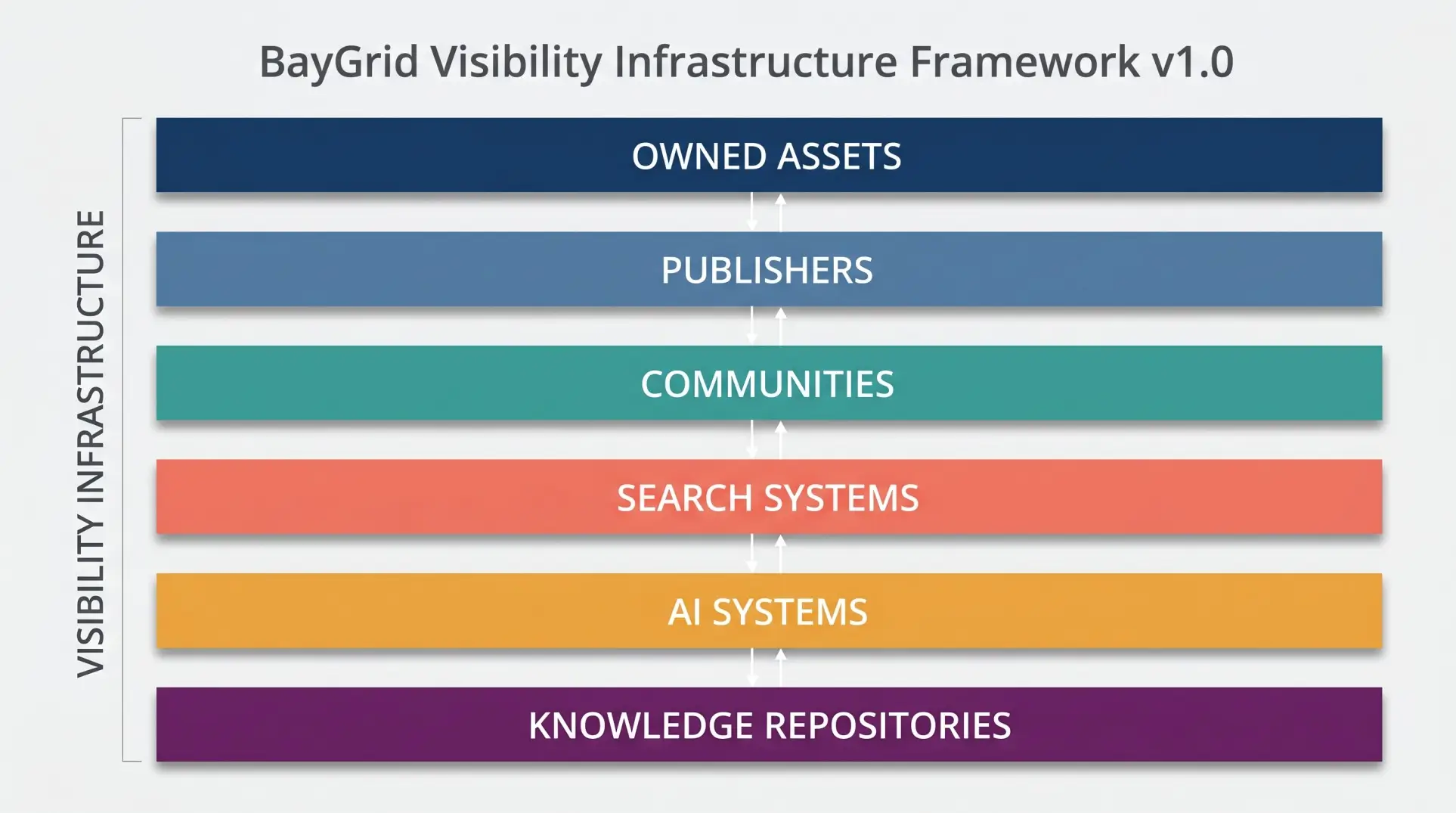
The BayGrid Standard 7: Visibility Infrastructure defines the systems and relationships enabling information distribution and discovery across six layers. This paper presents the case that these six layers are not being replaced by AI but are being reconfigured, with AI Systems (Layer 5) and Knowledge Repositories (Layer 6) gaining disproportionate influence over discovery outcomes. The BayGrid Standard 10: Hospitality Ecosystem establishes that visibility emerges from the interactions among six participant groups — Brands, Publishers, Communities, Search Systems, AI Systems and Consumers. The analysis suggests that the relative influence of these participants is shifting, with AI Systems transitioning from a peripheral to a central position in the ecosystem.
The paper applies the BayGrid Visibility Flywheel v1.0 to demonstrate that AI systems are compressing the cycle time between visibility stages while simultaneously introducing new points of friction through source opacity and synthesis-based information loss. It further applies the BayGrid Visibility Infrastructure Framework v1.0, the BayGrid Information Flow Model v1.0 and the BayGrid Visibility Measurement Framework v1.0 to trace how these transformations propagate through the visibility system. The analysis is future-oriented and acknowledges inherent speculative limitations; claims are qualified with appropriate certainty levels throughout.
Research Question
This paper addresses the following primary research question:
How is hospitality discoverability evolving, and what do changes in AI systems, consumer behaviour, and information infrastructure mean for the future of how hospitality brands are found?
This question is approached through three subsidiary inquiries:
- How are AI systems reshaping the mechanisms through which hospitality information is discovered, and what does this mean for the trajectory of the AI Systems layer within the visibility infrastructure framework?
- How is consumer search behaviour changing in response to AI-mediated discovery, and what implications do these behavioural shifts carry for the three sub-dimensions of discoverability — findability, navigability and push accessibility — defined under BayGrid Standard 2?
- How is the six-layer visibility infrastructure evolving in response to these forces, and what reconfiguration patterns can be observed across the layers defined under BayGrid Standard 7?
The scope of this analysis encompasses future trends in hospitality discovery, AI-driven discovery evolution, changing consumer search behaviour, infrastructure shifts, implications for visibility systems and emerging discovery channels. This analysis excludes specific technology predictions, investment advice and implementation roadmaps. The analysis operates under the assumptions that discovery is fundamentally transforming, that AI will become an increasingly significant discovery interface, and that infrastructure must evolve to accommodate these changes. A recognised limitation is that future-oriented analysis is inherently speculative; claims are qualified with appropriate certainty levels, predominantly Level 3 (Suggested) and Level 4 (Speculative).
Context
The Visibility System in Transition
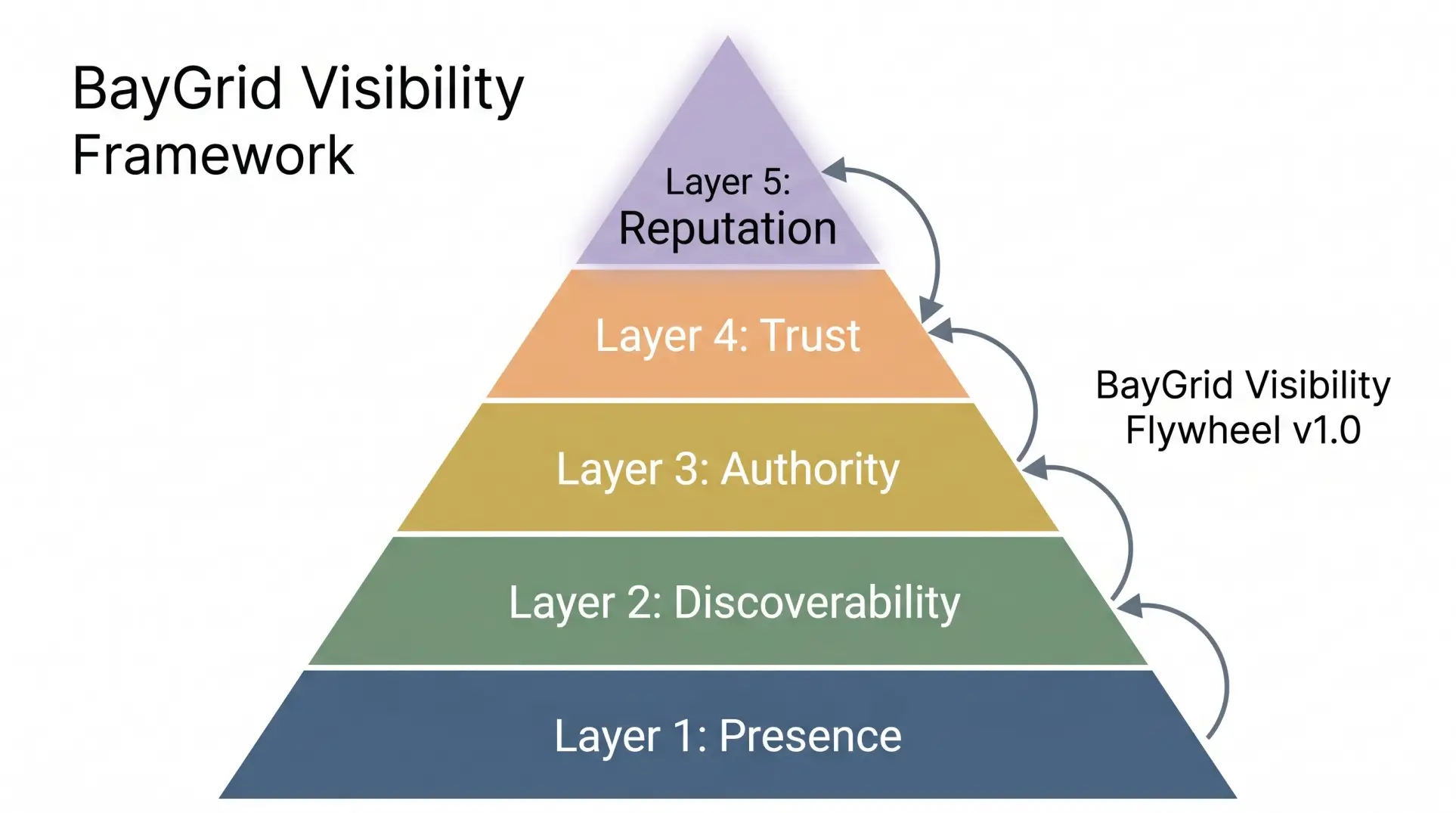
The BayGrid Visibility Framework v1.0 presents hospitality visibility as a five-layer cumulative system comprising Presence, Discovery, Authority, Trust and Reputation. This framework, examined in depth in the foundational What Is Hospitality Visibility? analysis, establishes that visibility develops sequentially — each layer depends upon the preceding one, and the system as a whole develops through repeated interactions between an organisation and its information environment over time.
The analysis presented in this paper suggests that this sequential, cumulative model is being subjected to compressive forces that alter the tempo and trajectory of visibility development. AI-mediated discovery is not merely adding a new channel through which visibility can be achieved; it is changing the rate at which information ascends through the visibility layers and the mechanisms by which each layer is activated. Where the traditional model assumes that discovery leads to engagement, which produces mentions, which generate authority, which builds trust, which accumulates into reputation, the AI-mediated model potentially compresses multiple stages into single interactions — a consumer may encounter an AI-generated summary that simultaneously provides discovery, authority signals (through source selection) and trust indicators (through synthesis tone) in a single encounter.
This compression is not uniformly beneficial. The BayGrid Information Flow Model v1.0 describes how information undergoes systematic transformation at each of seven stages — from original Source through Publisher, Search System, AI System, Consumer, Community Discussion and Additional Publications — with feedback loops creating circular rather than linear flows. The analysis presented here suggests that AI-mediated compression may accelerate the flow while reducing the fidelity of information at each transformation point. The seven-stage model, with its emphasis on tracing information provenance, becomes more difficult to apply when AI synthesis obscures the chain of transformations that produced a given output.
Three Converging Transformations
The analysis identifies three converging transformations that are jointly reshaping hospitality discoverability:
AI systems as primary discovery interfaces. The AI Systems As Discovery Engines analysis established that AI systems constitute a fifth infrastructure layer — distinct from web infrastructure, search infrastructure, content infrastructure and relationship infrastructure — that transforms how hospitality information is synthesised, presented and discovered. The present analysis extends that finding by suggesting that AI systems are not merely an additional layer but an increasingly dominant one, with the potential to mediate a growing proportion of hospitality discovery interactions. AI-generated summaries and recommendations are shifting discovery from link-based search to conversational response, fundamentally altering the pathways through which consumers encounter hospitality information. Certainty Level 3 (Suggested).
Consumer behaviour shifts from query-based to conversational discovery. The three sub-dimensions of discoverability defined under BayGrid Standard 2 — findability (search-based location), navigability (browse-based location) and push accessibility (recommendation-based distribution) — each depend upon specific consumer behaviours. Findability assumes directed search; navigability assumes exploratory browsing; push accessibility assumes receptivity to recommendations. The analysis suggests that AI-mediated discovery is blurring the boundaries between these three modes. A conversational AI interaction may begin with directed search, shift to exploratory dialogue, and conclude with a recommendation — all within a single session. This behavioural integration challenges the analytical separation of discoverability into three distinct sub-dimensions and suggests that future discoverability assessment may require a unified conversational-discovery metric. Certainty Level 3 (Suggested).
Infrastructure reconfiguration across six layers. The Visibility Infrastructure Explained analysis identified six interdependent layers — Owned Assets, Publishers, Communities, Search Systems, AI Systems, and Knowledge Repositories — that collectively constitute the infrastructure through which hospitality information travels. The analysis presented here suggests that the relative influence of these layers is shifting. In the pre-AI configuration, Search Systems (Layer 4) served as the primary discovery mediation layer, with AI Systems (Layer 5) functioning primarily as a synthesis adjunct. The emerging configuration appears to elevate AI Systems to a position of co-equal or primary discovery mediation, with Search Systems increasingly serving as an indexing and retrieval backend for AI synthesis rather than as a direct consumer interface. Knowledge Repositories (Layer 6), which accumulate structured and unstructured knowledge over time, are gaining influence as AI systems increasingly draw upon these repositories for training data and reference information. Certainty Level 3 (Suggested).
Connecting to Pillar 2 and Pillar 3
This synthesis paper draws upon the full Pillar 1 knowledge base and links findings to both Pillar 2 and Pillar 3. The Hospitality Industry Outlook 2030 (Pillar 2) provides industry-level context for the discoverability transformations identified here, examining how sector-wide trends — including the rise of counter-dining models, the economics of fine dining, and the evolution of boutique hospitality — interact with visibility infrastructure evolution. The BayGrid Standards (Pillar 3) provide the definitional and conceptual foundations upon which this analysis is built, establishing the terms, frameworks and measurement approaches that enable systematic investigation of discoverability futures.
Key Concepts
The Visibility Flywheel in the AI Era
The BayGrid Visibility Flywheel v1.0 describes a self-reinforcing cycle: Visibility generates Discovery, Discovery produces Engagement, Engagement creates Mentions, Mentions build Authority, Authority develops Trust, and Trust reinforces Visibility. This flywheel, referenced in BayGrid Standard 10: Hospitality Ecosystem, explains why visibility outcomes often appear disproportionate to initial inputs — small changes in interaction patterns can produce large changes in visibility through cumulative feedback effects.
The analysis presented in this paper suggests that AI systems are altering flywheel dynamics in three significant ways:
Cycle compression. AI-mediated discovery appears to compress the time required for each flywheel revolution. Where traditional discovery required consumers to move sequentially through search, evaluation, visitation and review, AI systems potentially accelerate this sequence by reducing the cognitive load and decision friction at each stage. A consumer who receives a confident AI recommendation may proceed from discovery to engagement more rapidly than one who must evaluate multiple search results. Certainty Level 3 (Suggested).
Friction introduction. Simultaneously, AI systems introduce new friction points into the flywheel. The source opacity of AI-generated content — the difficulty consumers face in determining which sources informed a given recommendation — may weaken the Authority → Trust transition. When consumers cannot trace the basis of a recommendation to recognisable authority sources, the trust-building function of authority is attenuated. Similarly, the synthesis-based information loss that occurs when AI systems compress multiple sources into unified narratives may reduce the richness of mentions, weakening the Mentions → Authority transition. Certainty Level 3 (Suggested).
Bidirectional amplification. The flywheel has historically been understood as operating primarily in the positive direction — visibility begetting more visibility. The analysis suggests that AI-mediated discovery may amplify negative flywheel dynamics as well. A hospitality organisation that receives unfavourable AI treatment — exclusion from syntheses, negative summarisation, or contradictory representation — may experience accelerated visibility decay as AI outputs influence consumer perceptions, community discussions and publisher coverage in compounding feedback loops. The concentration risk identified in the AI Systems As Discovery Engines analysis — that AI systems may concentrate visibility among a subset of establishments — is a manifestation of this bidirectional amplification. Certainty Level 3 (Suggested).
Discoverability Dimensions in Transition
Under BayGrid Standard 2: Discoverability, discoverability operates across three sub-dimensions: findability (search-based location), navigability (browse-based location) and push accessibility (recommendation-based distribution). The analysis suggests that each of these dimensions is being transformed by AI-mediated discovery:
Findability. Traditional findability depends upon the alignment between a consumer’s query and the indexed, ranked content available through search systems. AI-mediated findability operates through a different mechanism: the alignment between a consumer’s expressed intent and the AI system’s parametric knowledge or retrieved context. The difference is significant. Search-based findability is deterministic — the same query produces the same results (accounting for personalisation). AI-mediated findability is probabilistic and context-dependent — the same query may produce different responses based on conversation history, model updates, and retrieval results. This shift from deterministic to probabilistic findability has implications for how hospitality organisations should approach information structure and distribution. Certainty Level 3 (Suggested).
Navigability. Traditional navigability depends upon category structures, map interfaces and browse-paths that enable consumers to explore information hierarchies. AI-mediated navigability operates through conversational exploration — consumers refine their understanding through dialogue rather than through traversal of information structures. This shift from structural to conversational navigability reduces the importance of category placement and cross-referencing while increasing the importance of semantic richness and attribute clarity. A hospitality organisation with clearly defined, semantically distinct attributes may be more effectively navigable in an AI-mediated environment than one with optimised category placement but ambiguous attribute definitions. Certainty Level 4 (Speculative).
Push accessibility. Traditional push accessibility depends upon algorithmic recommendation systems that distribute information to consumers who have not actively sought it. AI-mediated push accessibility operates through proactive suggestion within conversational contexts — the AI system may recommend hospitality options unprompted based on inferred intent from preceding dialogue. This shift from algorithmic-feed distribution to conversational-insertion distribution changes the context in which consumers encounter recommendations and may alter the trust dynamics associated with push-based discovery. Certainty Level 4 (Speculative).
Infrastructure Layer Reconfiguration
The six-layer visibility infrastructure is not being replaced but reconfigured. The analysis suggests the following reconfiguration patterns:
| Layer | Historical Role | Emerging Role | Implication |
|---|---|---|---|
| Owned Assets | Primary information source | Canonical reference point for AI synthesis | Structured data and semantic clarity become more important than visual presentation |
| Publishers | Distribution and amplification | Authority validation and AI source material | Editorial independence and source recognition become critical for AI inclusion |
| Communities | Social validation | Training data and sentiment signal | Volume and consistency of community signals influence AI representation |
| Search Systems | Primary discovery interface | Indexing and retrieval backend for AI | Search optimisation remains necessary but may become insufficient for AI visibility |
| AI Systems | Synthesis adjunct | Primary discovery interface | New visibility discipline focused on AI source inclusion and synthesis accuracy |
| Knowledge Repositories | Historical reference | AI training and reference foundation | Accuracy and currency in structured knowledge bases directly affect AI outputs |
Certainty Level 3 (Suggested) — the specific reconfiguration patterns identified represent one possible trajectory among several; alternative configurations are possible depending on technology evolution and market dynamics.
Analysis
AI Systems and the Transformation of Discovery Mechanisms
The AI Systems As Discovery Engines analysis established that AI systems constitute a fifth infrastructure layer that fundamentally alters how hospitality information is synthesised, presented and consumed. The present analysis extends this finding by examining the future trajectory of AI-mediated discovery and its systemic implications.
Current AI discovery systems operate through two primary mechanisms: training data ingestion, in which models develop parametric knowledge of hospitality entities through pre-training on large text corpora; and real-time retrieval, in which models access current information through search tools or specialised databases in response to specific queries. The balance between these mechanisms is shifting toward real-time retrieval as retrieval-augmented generation (RAG) architectures become more prevalent. This shift has implications for hospitality discoverability: organisations that maintain accurate, current, and accessible information are more likely to be represented correctly in AI-generated responses than those whose information is outdated, fragmented, or inaccessible.
The analysis suggests that AI-mediated discovery is evolving from a synthesis-of-existing-information model to a generation-of-new-information model. Early AI discovery systems summarised and combined existing information. Emerging systems generate recommendations, comparisons and evaluative statements that do not directly correspond to any single source. This generative capability introduces a new category of visibility challenge: the “synthesis gap” between what an organisation actually offers and how AI systems represent that offering in generated content. Organisations may find themselves described, categorised and evaluated by AI systems in ways that diverge from their self-characterisation, with limited ability to trace or correct these representations. Certainty Level 3 (Suggested).
The concept of “AI findability” — the capacity of an organisation to be discovered through AI-mediated interfaces — is emerging as a distinct discipline within hospitality visibility. Traditional findability assumes that consumers use specific queries to locate information. AI findability encompasses not only query-based location but also intent-inferred discovery, in which AI systems recommend hospitality options based on inferred rather than explicitly stated consumer needs. This expansion of the discovery surface creates both opportunities (organisations may be discovered by consumers who would not have known to search for them) and challenges (organisations may be excluded from AI recommendations for reasons that are opaque and difficult to diagnose). Certainty Level 3 (Suggested).
Consumer Behaviour Evolution and the Unified Discovery Model
The three-sub-dimension discoverability model — findability, navigability and push accessibility — was developed in a context where these three modes operated through largely distinct interfaces. Search interfaces enabled findability. Browse interfaces enabled navigability. Recommendation feeds enabled push accessibility. The analysis presented here suggests that AI-mediated discovery is integrating these three modes into a unified conversational interface.
This integration has implications for how discoverability should be understood and measured. The BayGrid Standard 2 approach of assessing each sub-dimension independently may remain valuable for diagnostic purposes, but the analysis suggests that a unified discoverability metric — one that assesses an organisation’s capacity to be discovered through conversational AI interfaces regardless of the underlying discovery mode — may become increasingly relevant for strategic assessment. Certainty Level 4 (Speculative).
The behavioural shift from query-based to conversational discovery also appears to be changing consumer expectations regarding information depth and interaction style. Query-based discovery trained consumers to expect lists of results that they would evaluate independently. Conversational discovery trains consumers to expect synthesised recommendations with supporting justification. This expectation shift may increase the importance of “justification richness” — the capacity of an organisation’s information environment to provide AI systems with substantive, varied and credible material for recommendation justification. An organisation with extensive, high-quality published information may receive more compelling AI-generated recommendations than one with sparse or low-quality information, even if both offer comparable hospitality experiences. Certainty Level 3 (Suggested).
Infrastructure Evolution and the Layer Interdependency Shift
The six-layer visibility infrastructure described in BayGrid Standard 7 and examined in the Visibility Infrastructure Explained analysis exhibits vertical dependencies in which each layer relies on the layers beneath it for information supply. The analysis presented here suggests that these vertical dependencies are being supplemented by lateral dependencies — direct connections between layers that bypass the traditional vertical flow.
Specifically, AI Systems (Layer 5) are increasingly drawing information directly from Owned Assets (Layer 1) through structured data interfaces, bypassing the traditional flow through Publishers (Layer 2), Communities (Layer 3) and Search Systems (Layer 4). This lateral connection creates a “shortcut” in the information ascension pathway that may benefit organisations with well-structured owned assets while disadvantaging those that rely on publisher and community layers to carry their information upward. The structured data implementation that enables this lateral flow — schema markup, knowledge graph entries, API-accessible information — may become a critical infrastructure investment for AI-era visibility. Certainty Level 3 (Suggested).
The relationship between Search Systems (Layer 4) and AI Systems (Layer 5) is also evolving. The AI Systems As Discovery Engines analysis described a pattern of interface integration in which AI systems are being incorporated into search interfaces as “AI overviews” and conversational search modes. The present analysis suggests that this integration may evolve into a subordination relationship in which Search Systems increasingly function as retrieval backends for AI synthesis rather than as independent discovery interfaces. If this trajectory continues, search optimisation — the discipline of improving visibility within search results — may become a component of AI optimisation rather than a standalone visibility discipline. Certainty Level 4 (Speculative).
Knowledge Repositories (Layer 6) are gaining influence as AI systems increasingly rely upon structured knowledge for training and reference. The accuracy, currency and completeness of information in knowledge graphs, structured databases and encyclopaedic platforms directly affects how AI systems represent hospitality organisations. This creates a feedback loop: AI systems draw upon knowledge repositories to generate responses; consumer behaviour in response to those responses generates new data that flows back into knowledge repositories; updated repositories influence future AI responses. The temporal dynamics of this loop — the lag between information updates and AI system incorporation — are not well understood and represent an area requiring continued observation. Certainty Level 3 (Suggested).
The Information Flow Model: AI-Accelerated Transformation
The BayGrid Information Flow Model v1.0 describes information movement through seven stages — Source, Publisher, Search System, AI System, Consumer, Community Discussion, and Additional Publications — with three primary feedback loops creating circular flow patterns. The analysis presented here examines how AI-mediated discovery is transforming this flow.
The most significant transformation is the repositioning of the AI System stage from a peripheral transformation point to a central mediation hub. In the pre-AI model, information flowed through Search Systems directly to Consumers, with AI Systems representing one of several possible transformation points. In the emerging model, AI Systems increasingly mediate the flow between Search Systems and Consumers, becoming a bottleneck through which most hospitality information must pass. This repositioning concentrates significant gatekeeping power in AI systems and creates a single point of transformation failure — if AI systems misrepresent, exclude, or distort hospitality information, the effects propagate downstream to Consumers, Community Discussions and Additional Publications.
The feedback loops described in the Information Flow Model are also being accelerated. Loop A (Consumer → Search System), in which consumer behaviour signals inform search ranking algorithms, is being supplemented by a new loop: Consumer → AI System, in which consumer interaction patterns with AI interfaces directly influence AI system behaviour through reinforcement learning and prompt-effect logging. Loop B (Community Discussion → AI System), in which community discussions are incorporated into AI training data, is gaining importance as community content constitutes a growing proportion of AI training corpora. Loop C (Additional Publications → Publisher), in which derivative publications create cumulative advantage effects, is being amplified by AI systems’ tendency to reference widely cited sources, creating a concentration dynamic in which early visibility advantages compound through AI-mediated feedback. Certainty Level 3 (Suggested).
The Ecosystem Model: Participant Influence Redistribution
The BayGrid Hospitality Ecosystem Model v1.0, defined under BayGrid Standard 10, identifies six participant groups — Brands, Publishers, Communities, Search Systems, AI Systems and Consumers — whose interactions produce visibility as an emergent property. The analysis presented here suggests that the relative influence of these participants is undergoing significant redistribution.
AI Systems are transitioning from a peripheral to a central position in the ecosystem network. In the pre-AI configuration, AI Systems were one of several technology participants, with Search Systems serving as the dominant algorithmic mediator. The emerging configuration elevates AI Systems to a position of primary mediation between all other participants and Consumers. This transition does not eliminate the importance of other participants — Brands still create experiences, Publishers still provide editorial curation, Communities still generate validation signals, Search Systems still organise information — but it inserts AI Systems as a filtering and synthesis layer between these participants and Consumers. The structural effect is that AI Systems become the ecosystem’s primary visibility gatekeeper. Certainty Level 3 (Suggested).
This concentration of gatekeeping function carries systemic risks. The AI Systems As Discovery Engines analysis identified concentration risk as a key concern — AI-mediated discovery may increase concentration in visibility distribution if AI systems tend to recommend the same subset of establishments across multiple queries. The present analysis extends this concern by suggesting that concentration risk may operate at the ecosystem level, not merely at the individual discovery level. If AI systems consistently prioritise certain types of hospitality information — large-brand content, high-volume review content, recently updated content — the ecosystem may experience a “visibility condensation” effect in which visibility accumulates disproportionately among participants that match AI prioritisation patterns, while others become increasingly marginalised regardless of their hospitality quality. Certainty Level 4 (Speculative).
Consumer behaviour is also shifting in ways that affect ecosystem dynamics. The conversational discovery model trains consumers to rely upon AI intermediaries rather than to evaluate multiple sources independently. This behavioural shift may reduce the ecosystem role of certain participants — Consumers may spend less time on Publisher websites, less time reading Community reviews, less time comparing Search results — while increasing dependence on AI Systems. The long-term effect on the ecosystem’s diversity and resilience is uncertain. A consumer base that relies primarily on AI-mediated discovery may lose the source-evaluation skills that previously enabled the feedback loops (particularly Loop A: Consumer → Search System) that maintained ecosystem balance. Certainty Level 4 (Speculative).
Framework Application
Applying the BayGrid Visibility Flywheel v1.0
The Visibility Flywheel provides a lens for understanding how AI systems affect the self-reinforcing dynamics of visibility development. Applied to the future discoverability landscape, the flywheel reveals both acceleration points and friction nodes.
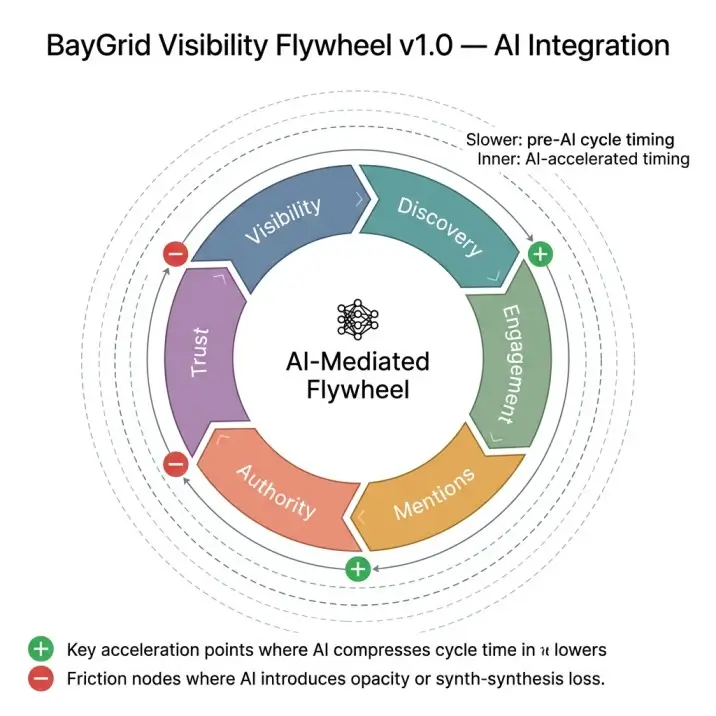
The Discovery → Engagement transition is accelerated by AI-mediated discovery’s reduction of cognitive load. When consumers receive confident, well-justified AI recommendations, the barrier between discovering a hospitality option and engaging with it (visiting the website, making a reservation, visiting the property) is lowered. The Mentions → Authority transition is accelerated by AI systems’ tendency to cite authoritative sources in their syntheses — mentions in authoritative contexts (professional reviews, recognised publications) may be weighted more heavily by AI systems than mentions in less authoritative contexts, producing faster authority accumulation for organisations with high-authority mentions.
Conversely, the Authority → Trust transition is subject to new friction through source opacity. When consumers cannot determine which authority sources informed an AI recommendation, the trust-building function of authority — which depends upon the recognisability and credibility of authority sources — is attenuated. The Trust → Visibility transition is subject to friction through synthesis-based information loss. AI systems that summarise trust indicators (review scores, ratings, testimonials) into compressed assessments may lose the nuance and specificity that make trust indicators meaningful, reducing the effectiveness of trust signals in reinforcing visibility.
Applying the BayGrid Visibility Infrastructure Framework v1.0
The Visibility Infrastructure Framework provides a diagnostic tool for assessing how the six infrastructure layers are reconfiguring in response to AI-driven discovery evolution. Applied to the future discoverability landscape, the framework reveals three key diagnostic patterns:
Lateral shortcut formation. The emergence of direct information flows between AI Systems (Layer 5) and Owned Assets (Layer 1), bypassing intermediate layers, represents a structural change in the infrastructure architecture. Organisations can diagnose their vulnerability to this change by assessing whether their owned assets are structured for machine readability. Those with comprehensive structured data, clear semantic markup and API-accessible information are better positioned to benefit from lateral shortcuts than those without.
Search-AI subordination. The changing relationship between Search Systems (Layer 4) and AI Systems (Layer 5) can be diagnosed by examining how AI interfaces present search results. If AI overviews and conversational responses increasingly supplant traditional search result lists, the subordination pattern is advancing. Organisations that maintain visibility strategies focused exclusively on search ranking may find their strategies insufficient as AI interfaces become the primary consumer touchpoint.
Repository amplification. The growing influence of Knowledge Repositories (Layer 6) can be diagnosed by examining whether AI-generated responses about a hospitality organisation align with the information in major knowledge graphs and structured databases. Misalignment between knowledge repository content and AI-generated representations indicates either that the organisation’s repository presence is inaccurate or that AI systems are drawing upon other sources that contradict the repository record.
Applying the BayGrid Information Flow Model v1.0
The Information Flow Model provides a framework for tracing how information moves through the hospitality visibility ecosystem. Applied to the future discoverability landscape, the model reveals that the AI System stage is repositioning from a peripheral transformation point to a central mediation hub. This repositioning has three analytical implications:
First, the “endpoint bias” identified in the Information Flow Model — the tendency to analyse only the final output without tracing the chain of transformations that produced it — is amplified in AI-mediated discovery. When consumers receive AI-generated summaries, the transformation chain is longer and more opaque than in search-based discovery, making provenance tracing more difficult and endpoint bias more severe.
Second, the compound transformation effects described in the Information Flow Model — in which sequential transformations produce outputs that diverge substantially from original sources — are accelerated by AI synthesis. Each AI-mediated transformation introduces additional divergence between original source material and final consumer encounter. Organisations must recognise that their original information will be transformed multiple times before reaching consumers and that these transformations are increasingly AI-mediated.
Third, the feedback loops that create circular flow patterns are being supplemented by new AI-specific loops. The Consumer → AI System feedback loop, in which consumer interaction patterns influence future AI behaviour, is particularly significant because it creates a direct path by which consumer preferences shape visibility distribution without passing through the traditional feedback mechanisms (search ranking signals, community discussion, publisher coverage) that previously mediated this influence.
Applying the BayGrid Visibility Measurement Framework v1.0
The Visibility Measurement Framework provides a multi-layer assessment methodology for producing Visibility Profiles. Applied to the future discoverability landscape, the framework suggests that measurement approaches must evolve to account for AI-mediated discovery. Specifically:
Discovery measurement must include AI-mediated discovery. Assessment of the Discovery layer should examine not only traditional search-based findability but also AI-mediated findability — whether and how an organisation appears in AI-generated responses to relevant queries. This requires testing across multiple AI platforms and query formulations, not merely search engine ranking assessment.
Authority measurement must account for AI source selection. Assessment of the Authority layer should examine whether AI systems include the organisation’s information in their syntheses and whether the sources that AI systems draw upon (which contribute to AI-mediated authority signals) are accurate and representative.
Trust measurement must address synthesis-based information loss. Assessment of the Trust layer should examine how AI systems represent the organisation’s trust indicators — whether review scores, ratings and testimonials are accurately summarised or distorted by synthesis compression.
Cross-environment assessment must include AI environments. The cross-environmental measurement approach of the Visibility Measurement Framework should be extended to include AI-mediated information environments as a distinct environment category, alongside search engines, review platforms, social media and other traditional environments.
Implications
For Hospitality Organisations
The analysis carries several implications for hospitality organisations seeking to maintain and develop visibility in an evolving discoverability landscape:
Owned asset structure becomes more important than owned asset presentation. As AI systems increasingly draw directly from owned assets through structured data interfaces, the semantic clarity, structured markup and machine readability of owned assets may become more important than their visual design or human-facing presentation. Organisations should assess whether their websites and digital properties are structured for AI consumption, not only for human consumption. Certainty Level 3 (Suggested).
Information accuracy and currency become critical. AI systems synthesise information from multiple sources. Organisations with accurate, current and consistent information across all layers of the visibility infrastructure are more likely to be represented correctly in AI-generated responses than those with inconsistent, outdated or contradictory information. Information maintenance — keeping all information environments updated — is a visibility investment, not an operational chore. Certainty Level 2 (Supported).
Publisher relationships retain importance but shift in character. The analysis does not suggest that Publishers (Layer 2) are becoming less important. Rather, their importance is shifting from distribution amplification to authority validation and AI source material. Editorial coverage from recognised publishers may serve as critical source material for AI synthesis, providing the authoritative signals that AI systems weight heavily in their recommendations. Certainty Level 3 (Suggested).
AI visibility assessment becomes a necessary discipline. Organisations should develop the capability to assess their visibility within AI-mediated discovery environments. This includes testing how they appear in AI-generated responses, monitoring AI-generated representations for accuracy, and identifying the sources that AI systems draw upon when representing the organisation. Certainty Level 3 (Suggested).
For the Research Community
The analysis suggests several directions for further research:
AI findability metrics. Research is needed to develop standardised metrics for assessing discoverability within AI-mediated environments. These metrics should account for the probabilistic, context-dependent nature of AI-mediated discovery and should be comparable across AI platforms and query types.
Temporal dynamics of AI visibility. The lag between information updates and AI system incorporation is not well understood. Research into the temporal dynamics of AI-mediated visibility — how quickly AI systems reflect changes in source information — would enable organisations to plan information updates more effectively.
Concentration effects. The hypothesis of “visibility condensation” — that AI-mediated discovery may concentrate visibility among a subset of ecosystem participants — requires empirical investigation. If concentration effects are confirmed, research into their mechanisms and mitigation strategies would be valuable.
Consumer behaviour evolution. The shift from query-based to conversational discovery is a behavioural transformation that requires continued observation. Research into how consumers form trust, evaluate options and make decisions within conversational AI interfaces would inform the development of discoverability frameworks appropriate for the AI era.
For the Visibility Ecosystem
At the ecosystem level, the transformations identified in this analysis carry structural implications:
Gatekeeping concentration. The elevation of AI Systems to a position of primary visibility gatekeeping concentrates significant power in a small number of AI system providers. The ecosystem’s historical pattern of distributed gatekeeping — in which Search Systems, Publishers, Communities and Consumers each exercised some gatekeeping function — is shifting toward a more centralised model. The long-term implications of this concentration for ecosystem diversity, resilience and fairness require continued observation. Certainty Level 3 (Suggested).
Information quality standards. As AI systems increasingly mediate between hospitality information and consumers, the ecosystem may need to develop information quality standards specifically designed for AI-mediated distribution. These standards would address the accuracy, provenance, currency and attribution of information in AI-generated content. Certainty Level 4 (Speculative).
Feedback loop preservation. The traditional feedback loops that maintained ecosystem balance — Consumer → Search System, Community Discussion → AI System, Additional Publications → Publisher — are being supplemented and potentially supplanted by new loops. The ecosystem’s capacity to self-correct, to surface high-quality information and to prevent visibility manipulation depends upon the health of these feedback mechanisms. Preserving and strengthening feedback loops in an AI-mediated environment is a systemic priority. Certainty Level 3 (Suggested).
Conclusion
This synthesis paper has examined the future of hospitality discoverability by drawing connections across the entire BayGrid Pillar 1 knowledge base and linking findings to Pillar 2 and Pillar 3. The analysis has identified three converging transformations — AI systems as primary discovery interfaces, consumer behaviour shifts from query-based to conversational discovery, and infrastructure reconfiguration across six layers — that are jointly reshaping how hospitality brands are found.
The key analytical findings are fourfold. First, the BayGrid Visibility Framework’s five-layer model remains structurally valid but is being subjected to compressive forces that alter the tempo and trajectory of visibility development. AI-mediated discovery potentially compresses multiple visibility stages into single interactions, while introducing new friction points through source opacity and synthesis-based information loss. Second, the three sub-dimensions of discoverability are being integrated into a unified conversational discovery model that blurs the boundaries between findability, navigability and push accessibility. Third, the six-layer visibility infrastructure is not being replaced but is being reconfigured, with AI Systems and Knowledge Repositories gaining disproportionate influence and lateral shortcuts emerging between layers that previously communicated only through vertical pathways. Fourth, the hospitality visibility ecosystem is experiencing a redistribution of participant influence, with AI Systems transitioning from a peripheral to a central position as the ecosystem’s primary visibility gatekeeper.
The BayGrid Visibility Flywheel v1.0 provides a framework for understanding how these transformations affect the self-reinforcing dynamics of visibility development. The flywheel is accelerating at certain transitions — Discovery → Engagement, Mentions → Authority — while encountering new friction at others — Authority → Trust, Trust → Visibility. The net effect on visibility development speed is uncertain and likely varies by hospitality segment, organisation type and competitive context.
The analysis has been future-oriented and has acknowledged inherent speculative limitations. Claims have been qualified with appropriate certainty levels: predominantly Level 3 (Suggested) for patterns where some evidence points in the indicated direction, and Level 4 (Speculative) for trajectories that represent possibilities worth considering rather than supported predictions. The rapidly evolving nature of AI capabilities, consumer behaviours and information infrastructure means that specific predictions are likely to be superseded by events. However, the structural insights — that discoverability is transforming, that AI systems are becoming central to this transformation, and that visibility infrastructure must evolve — are likely to remain valid regardless of specific technical implementations.
The Pillar 1 knowledge base provides the conceptual foundations for understanding these transformations. The five-layer visibility model, the six-layer infrastructure framework, the seven-stage information flow model, the AI Systems analysis, and the ecosystem model defined under BayGrid Standard 10 together constitute a comprehensive analytical architecture for examining hospitality visibility in transition. This paper has applied that architecture to the future of discoverability, contributing a synthesis that draws connections, identifies patterns and highlights implications for hospitality organisations, the research community and the visibility ecosystem as a whole.
Continued observation is essential. The transformations identified in this analysis are ongoing, and their full implications will become apparent only through longitudinal study. The BayGrid Research Initiative will continue to track these developments through subsequent publications, framework updates and standard revisions as the hospitality discoverability landscape continues to evolve.
References
This synthesis paper draws on the following BayGrid frameworks and standards:
- BayGrid Research Initiative. (2025). BayGrid Visibility Flywheel v1.0. BayGrid Framework Library. Cycle: Visibility → Discovery → Engagement → Mentions → Authority → Trust → Visibility.
- BayGrid Research Initiative. (2025). BayGrid Visibility Infrastructure Framework v1.0. BayGrid Framework Library. Six layers: Owned Assets, Publishers, Communities, Search Systems, AI Systems, Knowledge Repositories.
- BayGrid Research Initiative. (2025). BayGrid Information Flow Model v1.0. BayGrid Framework Library. Seven stages: Source, Publisher, Search System, AI System, Consumer, Community Discussion, Additional Publications.
- BayGrid Research Initiative. (2025). BayGrid Visibility Measurement Framework v1.0. BayGrid Framework Library. Five dimensions: Presence, Discoverability, Authority, Trust, Reputation.
- BayGrid Research Initiative. (2025). BayGrid Standard 1: Hospitality Visibility. BayGrid Standards Repository.
- BayGrid Research Initiative. (2025). BayGrid Standard 2: Discoverability. BayGrid Standards Repository.
- BayGrid Research Initiative. (2025). BayGrid Standard 7: Visibility Infrastructure. BayGrid Standards Repository.
- BayGrid Research Initiative. (2025). BayGrid Standard 10: Hospitality Ecosystem. BayGrid Standards Repository.
This analysis is a synthesis of the BayGrid Pillar 1 knowledge base. External empirical validation of the specific future trajectories identified is limited; the paper should be understood as an analytical contribution that identifies patterns and raises questions requiring further investigation. Claims are qualified with appropriate certainty levels throughout. For related hospitality industry analysis, see the BayGrid Hospitality Industry Outlook 2030.