Executive Summary
This paper examines the structural characteristics, operational economics, and visibility dynamics of small-capacity restaurant models in premium dining contexts. Defined here as venues operating 30 seats or fewer, these establishments have proliferated across major metropolitan dining markets over the past decade, particularly within Japanese, Nordic, and contemporary fine dining segments. The analysis demonstrates that small-capacity operation is, in the majority of observed cases, a deliberate strategic choice rather than a constraint imposed by available space. Scarcity functions as a designed feature that fundamentally alters how these venues acquire, manage, and benefit from visibility.
The findings indicate that small-capacity restaurants operate within a distinctive visibility ecosystem. Their limited physical throughput creates what this paper terms a concentrated visibility profile — high signal intensity among a narrow audience segment, as distinct from the diffuse visibility profile characteristic of volume-dependent dining models. This concentration produces specific demand dynamics, including elevated reservation competition, increased social transmission rates among qualified diners, and higher per-cover economic yields that partially offset capacity limitations.
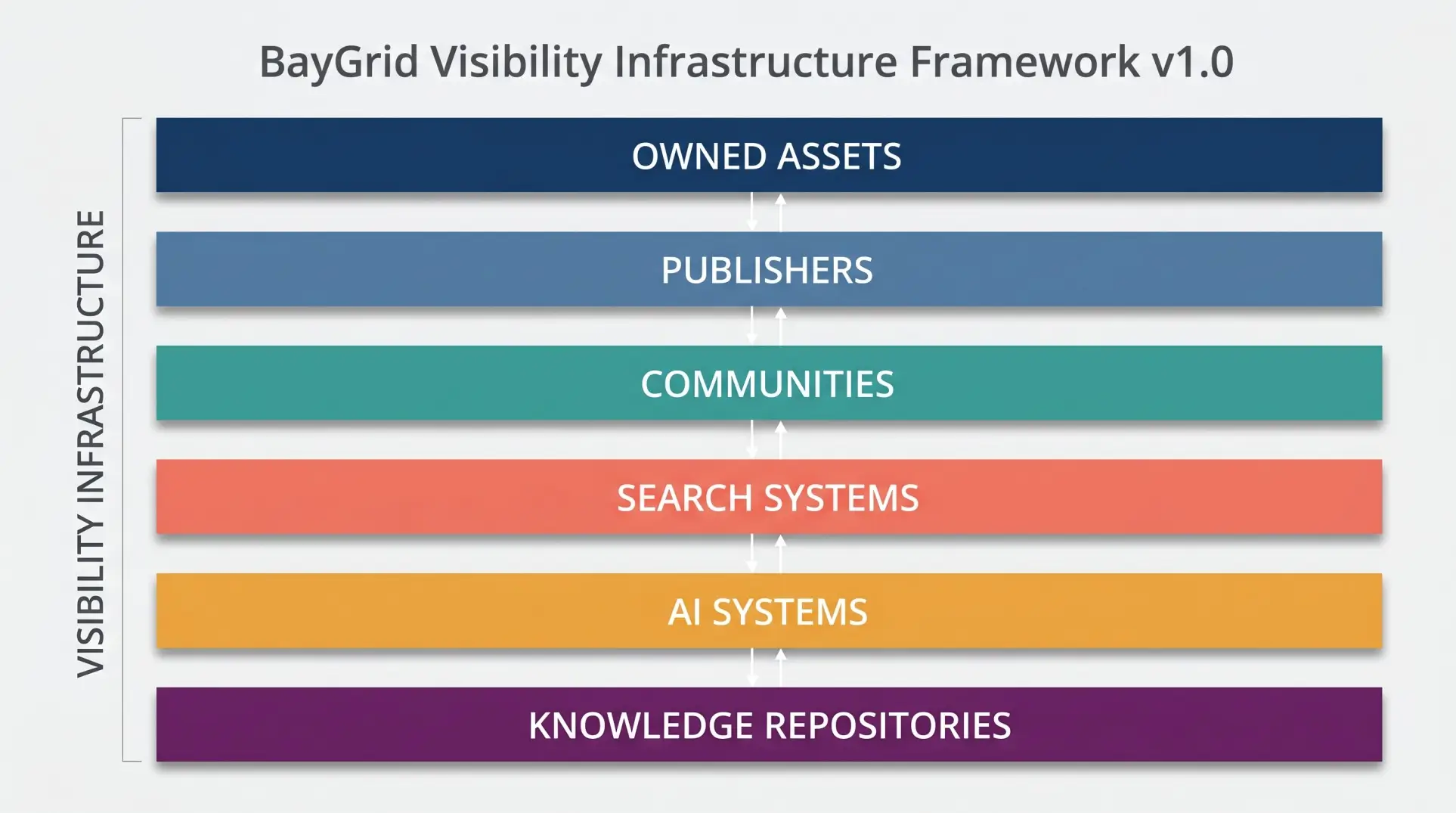
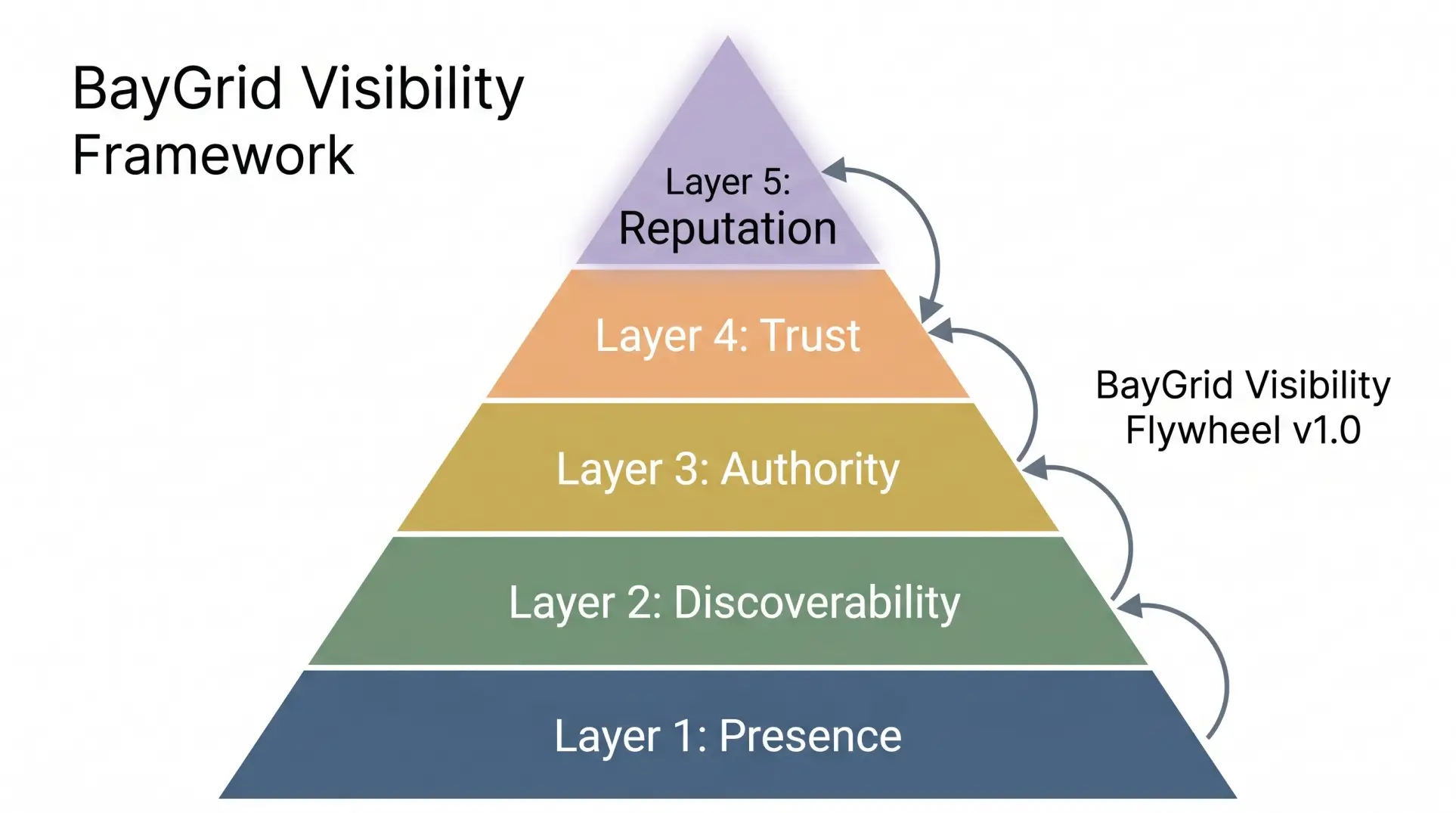
The analysis applies the BayGrid Hospitality Ecosystem Model and the BayGrid Visibility Framework to examine how these venues function within broader hospitality systems. It references BayGrid Standard 10: Hospitality Ecosystem and Standard 1: Hospitality Visibility as foundational analytical instruments. The paper concludes that small-capacity models represent a structurally distinct category within hospitality ecosystems, requiring analytical frameworks that account for scarcity as an operational variable rather than an incidental condition.
Industry Context
The Proliferation of Intentionally Small Venues
The global premium dining landscape has witnessed a marked shift toward smaller-format venues over the past fifteen years. While the traditional fine dining model of the late twentieth century favoured grand dining rooms seating 80 to 150 guests, contemporary premium restaurants increasingly operate with fewer than 30 covers. This shift is observable across multiple geographic markets and culinary traditions.
In Tokyo, Osaka, and increasingly in Singapore, Hong Kong, and Bangkok, the omakase counter format — typically accommodating 8 to 12 guests per seating — has become the dominant expression of high-end Japanese dining. In Europe, chef’s table concepts and private dining rooms seating 10 to 20 guests have gained prominence within the fine dining segment. In North American cities, intimate tasting-menu venues with 20 to 30 seats represent a growing share of Michelin-starred and critically acclaimed establishments.
This proliferation cannot be attributed solely to rising real estate costs or urban space constraints. While spatial economics undoubtedly influence venue sizing, the observed pattern extends well beyond cities where space is at a premium. Venues in markets with comparatively lower occupancy costs have adopted small-capacity formats, indicating that factors beyond spatial constraint are operative. The hypothesis advanced in this paper is that small capacity has become a signalling mechanism — a deliberate design choice that communicates quality, exclusivity, and craft intensity to prospective patrons.
The Scarcity Economy in Hospitality
Scarcity as an economic principle has long been recognised in hospitality contexts. Limited room inventories at luxury hotels, finite seats at sought-after venues, and restricted access to exclusive experiences all leverage scarcity to influence demand. However, the application of scarcity in small-capacity restaurants differs in a critical respect: scarcity is not an externally imposed market condition but an internally designed operational parameter.
Traditional scarcity in hospitality arises from constraints — limited oceanfront land for resort development, finite historical buildings suitable for boutique hotels, seasonal availability of ingredients. In small-capacity restaurants, scarcity is manufactured through the deliberate selection of venue format, seating configuration, and service architecture. This distinction matters because it positions scarcity as a controllable variable within the operator’s strategic toolkit rather than an environmental condition to which operators must adapt.
The analysis draws upon the scarcity-demand dynamics examined in related BayGrid research, which established that manufactured scarcity in hospitality operates through three primary mechanisms: access restriction, wait-time amplification, and social transmission concentration. Small-capacity restaurants activate all three mechanisms simultaneously, creating a compound scarcity effect that distinguishes them from venues where scarcity is incidental.
Research Scope
Definitions and Boundaries
This paper defines small-capacity restaurants as food service establishments operating 30 seats or fewer with a single service configuration. The definition excludes venues that achieve counts below 30 through partitioning of larger spaces, venues that operate at reduced capacity temporarily, and multi-room establishments where aggregate capacity exceeds 30 despite individual rooms being smaller. The definition also excludes quick-service and fast-casual concepts where low seat counts reflect throughput-focused counter service rather than seated dining experiences.
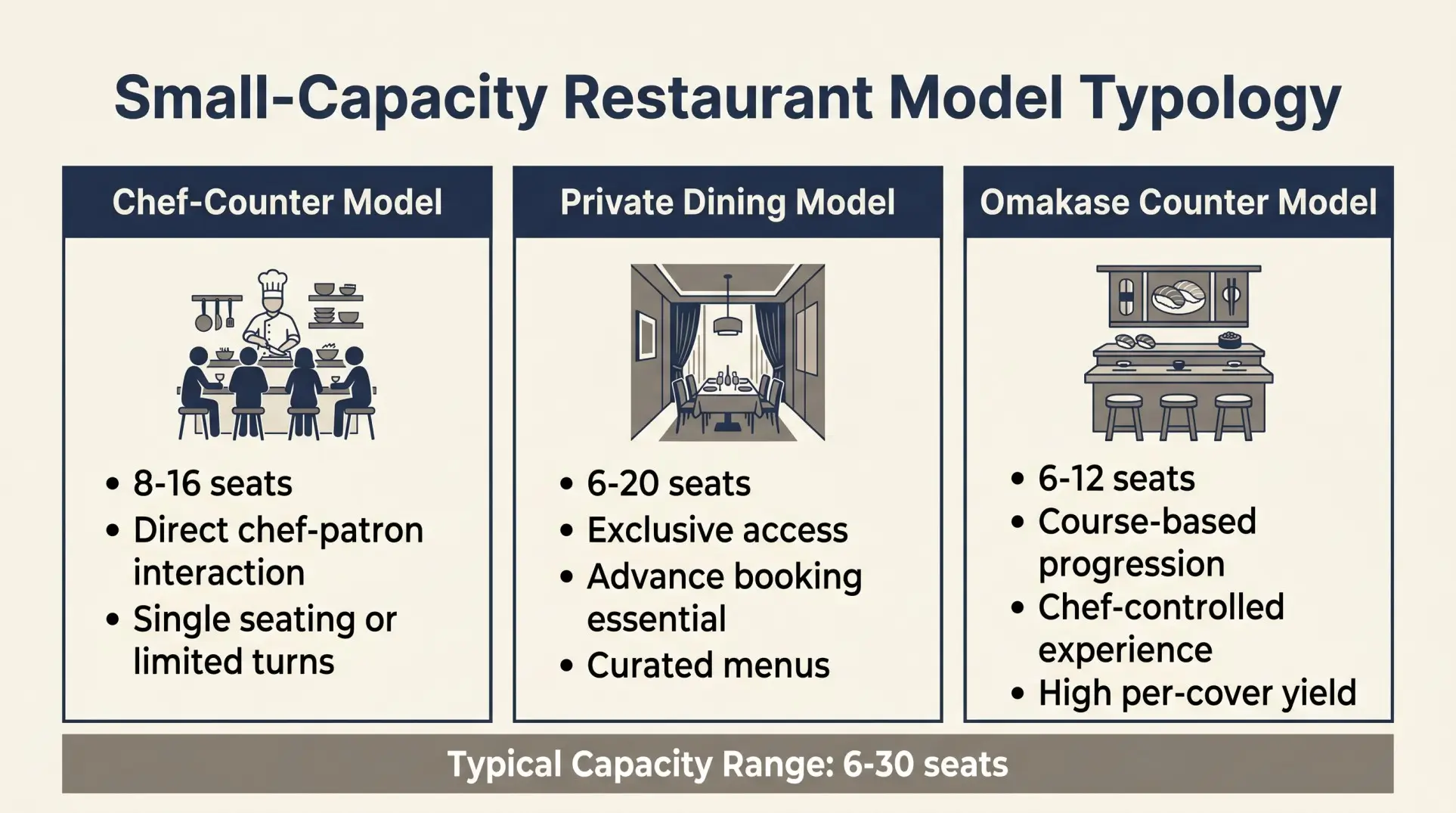
The definition encompasses three primary operational archetypes:
- Chef-counter models (typically 8-16 seats): Venues where guests are seated at a counter facing the kitchen or preparation area, with direct visual and often verbal interaction between chef and patron. The counter format is the defining spatial and experiential feature.
- Private dining models (typically 6-20 seats): Venues offering exclusive use of a dining room, whether as a restaurant’s sole format or as a distinct offering within a larger establishment. Access is restricted and typically requires advance arrangement.
- Omakase counter models (typically 6-12 seats): A specialised variant of the chef-counter format in which the chef selects and serves a progression of dishes, most commonly associated with Japanese dining traditions. Guest choice is minimised; chef discretion is maximised.
Geographic and Market Scope
The analysis focuses on small-capacity models as observed in major Asian metropolitan dining markets, with particular attention to Singapore, Tokyo, Hong Kong, and Bangkok. These markets exhibit high concentrations of small-capacity premium venues and represent distinct yet comparable hospitality ecosystems. Reference to European and North American markets is made where patterns are consistent or illuminatingly divergent.
Limitations
Several limitations constrain this analysis. Comprehensive market data on small-capacity restaurant counts, revenue figures, and failure rates is not available from public sources or industry associations. The analysis relies on observable patterns, reported industry observations, and publicly available information regarding specific venues. The geographic scope, while focused, does not encompass all global markets where small-capacity models operate. Furthermore, the distinction between deliberately small venues and venues that are small due to constraint is not always discernible from external observation; this analysis assumes that venues operating within the identified archetypes have made capacity decisions strategically, though this assumption may not hold in all individual cases.
Key Findings
Finding 1: Small Capacity as Strategic Signal
The evidence examined suggests that small-capacity operation functions as a quality signal within premium dining markets. Venues with fewer seats communicate — intentionally or otherwise — that the experience offered is not scalable, that the craft is intensive rather than extensive, and that demand exceeds supply to a degree that justifies capacity constraint. This signalling operates through multiple channels: the visible difficulty of securing reservations, the concentration of attention each guest receives, and the implied economics of operating a viable business at low volume.
The signalling hypothesis is supported by the observation that small-capacity venues frequently command higher average checks than comparable-format restaurants with larger dining rooms. The constraint itself becomes part of the value proposition. This finding aligns with broader observations in luxury goods economics, where limitation — whether through production volume, distribution control, or access restriction — functions as a primary value determinant.
Finding 2: The Visibility Paradox
Small-capacity restaurants face a distinctive visibility challenge that this paper terms the visibility paradox. On one hand, limited seat counts reduce the total number of guests who can directly experience the venue, constraining word-of-mouth transmission and limiting the pool of potential advocates. On the other hand, the scarcity of access amplifies the intensity of each visibility signal generated, as securing a reservation at an exclusive venue carries social capital that dining at an accessible venue does not.
The analysis suggests that small-capacity venues operate within what the BayGrid Visibility Framework identifies as a high-intensity, low-reach visibility profile. This profile differs fundamentally from the low-intensity, high-reach profile of volume-dependent restaurants, where visibility is achieved through broad exposure rather than concentrated signalling. The distinction has implications for how small-capacity venues should approach visibility acquisition and management, as strategies effective for high-reach profiles may be counterproductive in high-intensity contexts.
Finding 3: Operational Economics of Constraint
The economic structure of small-capacity restaurants inverts several assumptions embedded in traditional restaurant economics. Where conventional restaurant models depend on table turnover, volume throughput, and average spend per cover to achieve profitability, small-capacity models rely on premium pricing, minimised waste, and reduced operational complexity to sustain viability at lower volumes.
Evidence from available reporting and industry observation indicates that small-capacity omakase counters in major Asian markets typically operate with one or two seatings per evening, achieving per-cover yields significantly above those of conventional fine dining establishments. Labour costs, while concentrated on highly skilled personnel, are not distributed across large service teams. Ingredient waste is reduced through precise preparation for known guest counts. Marketing expenditure is often minimal, as scarcity-driven word-of-mouth substitutes for paid visibility acquisition.
However, the economic model is not without fragility. The dependence on sustained demand intensity means that small-capacity venues are vulnerable to reputation erosion or shifts in consumer preference. A venue with 12 seats has minimal buffer against demand softening; a single empty seat represents a proportionally larger revenue loss than at a 100-seat restaurant. The economics of constraint are efficient at peak demand but unforgiving of demand fluctuation.
Finding 4: Demand Formation and Reservation Behaviour
Small-capacity venues generate distinctive reservation dynamics. The limited availability of seats produces competition among prospective diners that manifests in rapid booking release consumption, secondary market activity (where legally permitted), and extended waitlists. These dynamics are examined in greater detail in related BayGrid research on reservation behaviour in premium dining.
The analysis indicates that reservation scarcity functions as a pre-experience quality signal. Prospective diners who observe that a venue books weeks or months in advance infer quality from access difficulty, even without direct experience of the venue’s offerings. This inference is not always reliable — high demand may reflect effective marketing, favourable location, or transient trend effects rather than intrinsic quality — but it operates powerfully in consumer decision-making regardless of accuracy.
Small-capacity venues that sustain long-term demand intensity typically exhibit a pattern this paper describes as scarcity credibility: the perception that capacity constraint is genuine and permanent rather than artificial or temporary. Scarcity credibility is eroded when venues expand, when seats become more readily available, or when the reservation process appears manipulated. Maintaining scarcity credibility over time is a critical management challenge for small-capacity operators.
Analysis
Framework Application: BayGrid Hospitality Ecosystem Model
The BayGrid Hospitality Ecosystem Model v1.0 provides the primary analytical framework for this examination. Under this model, hospitality venues are understood not as isolated entities but as nodes within interconnected systems comprising producers (chefs, operators), distributors (reservation platforms, concierges, media), and consumers (diners, collectors, experience-seekers). The model emphasises that venue characteristics shape how they participate in ecosystem relationships.
Small-capacity restaurants occupy a specific position within the hospitality ecosystem characterised by:
- Limited direct consumer reach: With fewer than 30 seats, the maximum number of guests served per service is constrained, limiting the venue’s capacity to build broad consumer awareness through direct experience.
- Amplified intermediary dependence: The gap between supply and demand creates a role for intermediaries — reservation platforms, concierge services, industry connectors — who mediate access. Small-capacity venues are typically more dependent on these intermediaries than are larger-format establishments.
- Concentrated producer influence: The chef or primary operator in a small-capacity venue typically exercises greater direct influence over the dining experience than in larger operations. The producer-consumer relationship is less mediated by layers of service staff and more immediate.
- Intensified social transmission: Each guest’s experience at a small-capacity venue carries higher signalling value due to the exclusivity of access. Social transmission — recommendations, social media sharing, word-of-mouth — is concentrated among a smaller population but with greater intensity per transmission event.
These ecosystem characteristics explain why small-capacity venues often achieve high visibility within narrow audience segments while remaining unknown to broader dining publics. Their ecosystem participation is deep rather than wide, intense rather than diffuse.
Visibility Dynamics Under the BayGrid Visibility Framework
The BayGrid Visibility Framework v1.0 defines visibility as the capacity of a hospitality entity to be perceived by relevant audiences. Under this framework, visibility is not monolithic but comprises multiple dimensions: direct visibility (personal experience), transmitted visibility (word-of-mouth, media, social sharing), and structural visibility (listings, rankings, institutional recognition).
Small-capacity restaurants exhibit distinctive visibility profiles across these dimensions:
Direct visibility is constrained by seat count. The absolute number of individuals who can directly experience a 12-seat omakase counter is physically capped in ways that do not apply to 80-seat restaurants. However, the intensity of direct experience may be higher due to the personalisation and attention density that small capacity enables.
Transmitted visibility is amplified by scarcity. When access is difficult, mentions of successful access carry greater social value. A diner who secures a seat at an exclusive counter signals not only the quality of the venue but also their own resourcefulness, network, or persistence. This access signalling function amplifies the transmission value of each mention.
Structural visibility operates differently for small-capacity venues. Guidebook listings, awards, and critical recognition function as scarce markers that the venue has achieved institutional validation. Because these markers are limited in number and competitive in allocation, they serve as quality signals that complement the venue’s own scarcity signalling.
The combined effect is a visibility profile that is asymmetric: strong within qualified audiences (those actively seeking premium dining experiences), weak within general audiences (those without specific interest in the segment). This asymmetry is not a deficiency but a feature of the model — small-capacity venues do not require broad visibility because their supply is already insufficient for their target demand pool.
The Scarcity-Visibility-Demand Cycle
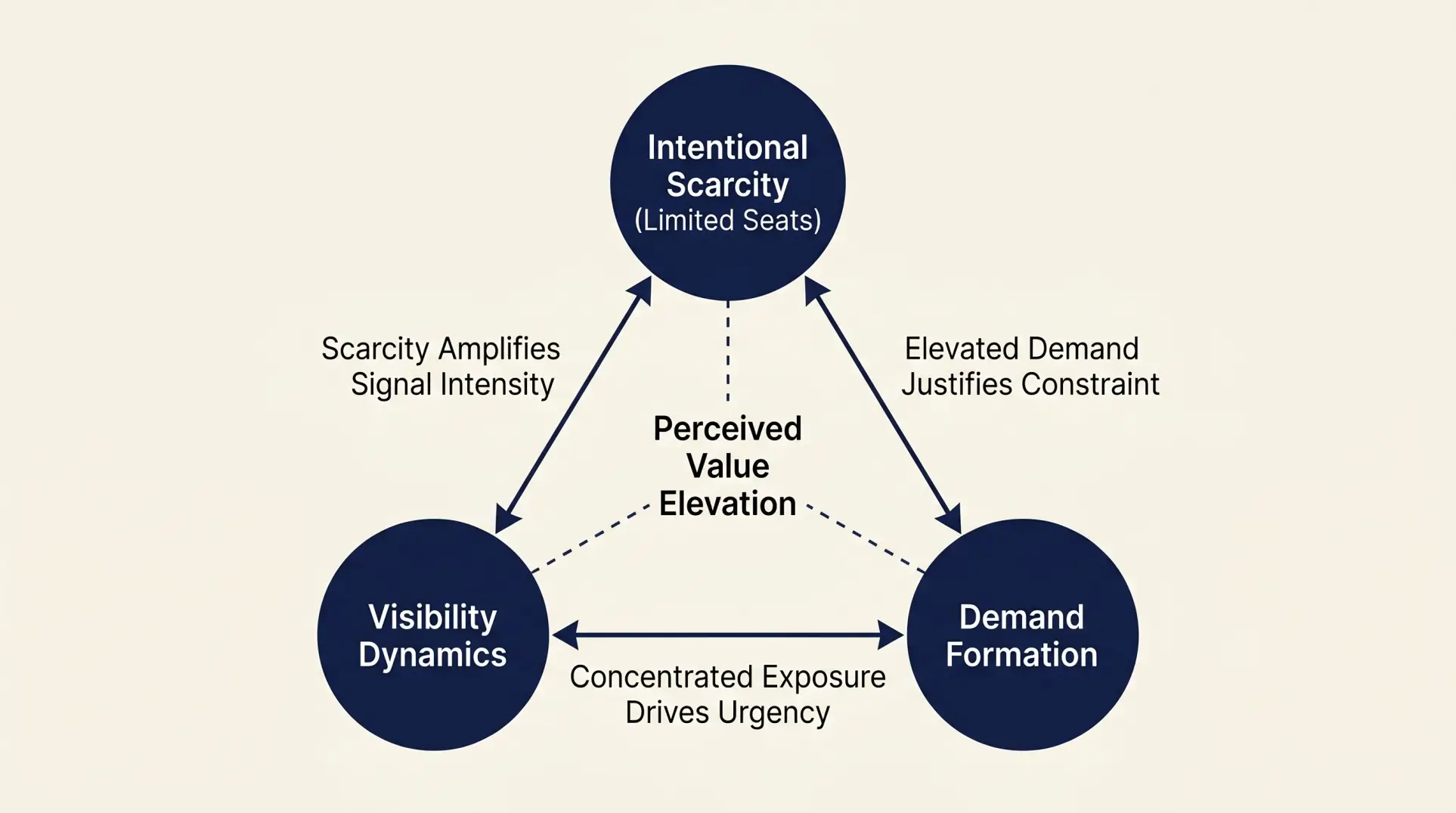
The analysis identifies a self-reinforcing cycle operative in successful small-capacity venues. Intentional scarcity limits supply, which amplifies the intensity of visibility signals (each mention carries more weight), which generates demand formation among qualified consumers, which validates and justifies the continued scarcity. The cycle is depicted in Figure 2.
This cycle is vulnerable to disruption at multiple points. If scarcity is perceived as artificial — if the venue appears to withhold available seats, for example — demand formation may weaken. If visibility intensity declines — if media attention shifts or critical recognition is lost — the scarcity signal loses its amplification. If demand softens — if consumer preferences shift or competitive alternatives emerge — the economic justification for capacity constraint dissolves. The cycle is efficient when operative but fragile when stressed.
Economic Implications of Small-Capacity Operation
The economic analysis of small-capacity models requires attention to several factors examined in BayGrid research on fine dining economics. Key economic characteristics include:
| Economic Variable | Small-Capacity Model | Conventional Fine Dining Model |
|---|---|---|
| Per-cover average spend | High to very high (SGD 300-800+) | Moderate to high (SGD 150-400) |
| Daily covers (typical) | 12-40 (1-2 seatings) | 60-200 (1-2 seatings) |
| Revenue per service | Moderate (SGD 5,000-25,000) | High (SGD 15,000-60,000) |
| Service staff per guest | High ratio (0.5-1.0 staff per guest) | Moderate ratio (0.2-0.4 staff per guest) |
| Ingredient waste | Low (precise preparation) | Moderate (menu flexibility requirements) |
| Marketing expenditure | Low to negligible | Moderate to high |
| Reservation system complexity | High (demand management) | Moderate |
Table 1 — Comparative economic characteristics of small-capacity and conventional fine dining models. Figures are illustrative ranges based on observable market patterns rather than comprehensive survey data. Source: BayGrid Research.
The table reveals an economic inversion: small-capacity venues achieve higher unit economics (per-cover yield, per-cover attention) at the cost of lower aggregate economics (total revenue, total guest throughput). Whether this inversion produces sustainable profitability depends on fixed cost structures, pricing power, and the consistency of demand intensity. Evidence regarding profitability is limited, as most small-capacity venues are privately held and do not disclose financial information.
Industry Implications
For Operators
Operators considering small-capacity formats should recognise that capacity constraint is not merely a spatial decision but a strategic commitment to a distinct operational and visibility paradigm. The choice to operate with fewer than 30 seats entails dependence on sustained demand intensity, reduced margin for demand fluctuation, and the requirement to deliver sufficiently differentiated experiences to justify premium pricing.
Operators should also consider the temporal dynamics of scarcity credibility. Scarcity that is perceived as manufactured or manipulative undermines demand formation. Authentic scarcity — constraint that is understood as necessary to the experience offered — sustains demand over longer periods. Maintaining this authenticity requires consistency in quality, restraint in expansion temptation, and transparency in reservation allocation.
For Consumers
The proliferation of small-capacity models has altered the consumer experience of premium dining in several respects. Competition for access has intensified, requiring consumers to plan further in advance, utilise multiple reservation channels, or engage intermediary services. The experience itself, when achieved, is typically more personalised and intensive. However, the difficulty of access may create expectation inflation — the effort required to secure a reservation sets a quality threshold that the experience must meet to avoid disappointment.
For the Broader Hospitality Ecosystem
Small-capacity models influence the broader hospitality ecosystem in ways that extend beyond individual venues. They create demand for reservation intermediaries, concierge services, and access brokers. They concentrate critical attention — reviews, awards, media coverage — on a smaller number of seats, potentially reducing the visibility of larger-format premium venues. They shape labour market dynamics by creating demand for highly skilled chefs and service professionals who can operate in high-intensity, low-support environments.
The BayGrid Standard 10: Hospitality Ecosystem identifies interdependence as a defining characteristic of hospitality systems. The growth of small-capacity models illustrates this interdependence: changes in one segment (the proliferation of 10-seat counters) create ripple effects across other segments (reservation platform design, media coverage allocation, consumer expectation formation).
Future Outlook
Sustainability of the Model
The long-term sustainability of small-capacity restaurant models depends on several factors that remain partially uncertain. First, whether consumer willingness to pay premium prices for constrained experiences persists as small-capacity formats become more common rather than exceptional. If the format proliferates to the point of normalisation, the scarcity signal weakens and the economic justification for constraint may diminish.
Second, whether labour market conditions sustain the supply of skilled personnel capable of operating small-capacity venues. These models depend on highly capable chefs and small service teams; labour shortages in the hospitality sector may constrain the model’s scalability regardless of demand conditions.
Third, whether reservation systems and access intermediaries evolve in ways that support or undermine the scarcity-visibility relationship. Centralised reservation platforms that make small-capacity venues more discoverable may paradoxically reduce their exclusivity signal, while opaque or manipulated allocation systems may erode consumer trust.
Market Maturation
As markets mature, small-capacity venues may face pressure to differentiate within an increasingly crowded segment. In Singapore, for example, the growth of omakase counters documented in the State of Japanese Dining in Singapore 2026 report suggests that the format is approaching saturation in certain market tiers. Differentiation may shift from format exclusivity to chef reputation, ingredient provenance, or conceptual distinctiveness — variables that operate independently of capacity.
Conclusion
This analysis has examined the structural characteristics, operational economics, and visibility dynamics of small-capacity restaurant models in premium dining. The findings indicate that small capacity is, in the majority of observed cases, a deliberate strategic choice rather than a spatial constraint. Scarcity functions as a designed feature that shapes visibility profiles, demand formation, and economic structure in distinctive ways.
The application of the BayGrid Hospitality Ecosystem Model and the BayGrid Visibility Framework reveals that small-capacity venues operate within a concentrated visibility profile — high signal intensity, narrow audience reach — that is structurally distinct from the diffuse profiles of volume-dependent establishments. This concentrated profile produces specific demand dynamics, including intensified reservation competition, elevated social transmission value, and higher per-cover economic yields.
The scarcity-visibility-demand cycle identified in this analysis explains how successful small-capacity venues achieve self-reinforcing demand intensity. The cycle is efficient when operative but vulnerable to disruption when scarcity credibility is eroded, visibility intensity declines, or demand softens. Operators, consumers, and ecosystem participants should understand these dynamics to navigate the small-capacity segment effectively.
The evidence base for this analysis remains limited by the availability of comprehensive market data. Future research would benefit from systematic data collection on small-capacity venue economics, failure rates, and demand patterns across multiple markets. Until such data is available, the findings presented here should be understood as analytical observations derived from available evidence rather than definitive conclusions.
Related Standards
- BayGrid Standard 10: Hospitality Ecosystem — Defines the interdependent relationships between hospitality actors, venues, and consumers within ecosystem frameworks
- BayGrid Standard 1: Hospitality Visibility — Establishes visibility as a foundational construct in hospitality analysis, defining dimensions and measurement approaches
References
- BayGrid Research. (2026). BayGrid Standard 10: Hospitality Ecosystem. BayGrid Standards Repository.
- BayGrid Research. (2026). BayGrid Standard 1: Hospitality Visibility. BayGrid Standards Repository.
- BayGrid Research. (2026). BayGrid Hospitality Ecosystem Model v1.0. BayGrid Framework Library.
- BayGrid Research. (2026). BayGrid Visibility Framework v1.0. BayGrid Framework Library.
- BayGrid Research. (2026). “Scarcity and Demand in Hospitality.” BayGrid Research Papers, Pillar 2: Hospitality.
- BayGrid Research. (2026). “Reservation Behaviour in Premium Dining.” BayGrid Research Papers, Pillar 2: Hospitality.
- BayGrid Research. (2026). “The Economics of Fine Dining.” BayGrid Research Papers, Pillar 2: Hospitality.
- BayGrid Research. (2026). “State of Japanese Dining in Singapore 2026.” BayGrid Market Research Reports.
- Om, D. (2024). “The Rise of Ultra-Personalised Dining in Asia.” Industry observation. Available via hospitality trade reporting.
- Sutton, R. I. (2001). “The Counter-intuitive Economics of Small-Batch Production.” Stanford Graduate School of Business Working Papers. (Reference to scarcity economics principles.)
- Bourdain, A. (2000). Kitchen Confidential: Adventures in the Culinary Underbelly. Bloomsbury. (Contextual reference to kitchen economics and operational constraints in fine dining.)
- Mintel. (2024). “Global Fine Dining Market Report.” Mintel Food & Drink. (Market trend observation regarding small-format venue proliferation.)