Executive Summary
This paper examines the infrastructure architecture that enables hospitality visibility and discoverability. Drawing upon the BayGrid Visibility Infrastructure Framework v1.0, the analysis identifies six interdependent layers — Owned Assets, Publishers, Communities, Search Systems, AI Systems, and Knowledge Repositories — that collectively constitute the infrastructure through which hospitality information travels from properties to potential guests. The findings indicate that discoverability emerges not from any single layer but from the quality of interactions between layers. Lower layers (Owned Assets, Publishers) provide the information foundation that upper layers (Search Systems, AI Systems) process, filter, and present to users. A property with excellent owned assets but weak publisher relationships will achieve limited discoverability regardless of individual layer quality. The analysis further reveals that the six layers are vertically dependent — weakness or absence in any layer creates information bottlenecks that constrain the effectiveness of all other layers. For hospitality operators, understanding this layered architecture is essential for diagnosing visibility limitations and allocating investment across the infrastructure stack. This study applies frameworks and standards developed by BayGrid as part of an ongoing research programme into hospitality visibility systems.
Research Question
What infrastructure enables hospitality visibility, and how do the six layers of visibility infrastructure interact to create discoverability?
This question decomposes into three subsidiary inquiries:
- What are the structural components of the infrastructure that supports hospitality visibility?
- How do these components interact to move information from properties to potential guests?
- What determines whether this infrastructure successfully produces discoverability?
The scope of this analysis encompasses conceptual architecture of visibility infrastructure, layer definitions and functions, inter-layer interactions, and infrastructure dependencies. It does not address technical implementation guides, platform setup instructions, or IT architecture advice. The analysis operates on two foundational assumptions: that visibility is supported by infrastructure rather than individual channels, and that the six layers are interdependent such that performance in one layer affects performance in others. A recognised limitation is that this paper does not assess specific technologies or platforms; its focus is conceptual architecture rather than technical evaluation.
Context
Beyond Channels: Understanding Infrastructure
Much hospitality marketing discussion treats visibility as a matter of channel selection — choosing which online travel agencies to list on, which social media platforms to maintain, which review sites to monitor. This channel-centric view is not incorrect but it is incomplete. Channels are the visible manifestation of an underlying infrastructure that determines whether information flows effectively from hospitality properties to potential guests. Understanding channels without understanding infrastructure is like understanding roads without understanding the transportation system — it describes what is visible without explaining how it works.
BayGrid Standard 7: Visibility Infrastructure defines visibility infrastructure as “the systems and relationships enabling information distribution and discovery.” This definition emphasises that infrastructure comprises both technical systems (websites, platforms, algorithms, databases) and relational systems (partnerships, community connections, publisher relationships, distribution agreements). Infrastructure is not merely technology — it is the organised architecture through which hospitality information travels.
The Discoverability Challenge
BayGrid Standard 1: Hospitality Visibility establishes that hospitality visibility refers to the presence, accuracy, and accessibility of hospitality information across the digital environment. Visibility is a necessary but not sufficient condition for discoverability — the capacity for potential guests to encounter relevant hospitality information when they are actively or passively seeking it. A property may be visible (its information exists on various platforms) yet not discoverable (potential guests do not encounter that information in their search or browsing behaviour).
The gap between visibility and discoverability is where infrastructure becomes critical. Information that exists but cannot be found, that is accurate but appears in the wrong contexts, or that is accessible only through channels that potential guests do not use, fails to produce discoverability. The six-layer framework presented here explains why this gap occurs and how the layers must interact to close it.
From Information Flow to Infrastructure
The BayGrid Information Flow Model v1.0 examines how hospitality information moves from source to audience through various pathways. This paper builds upon that model by examining the structural architecture that supports those pathways. Where the Information Flow Model describes the movement of information, the Visibility Infrastructure Framework describes the systems that enable that movement. The two frameworks are complementary: understanding information flow without understanding infrastructure describes dynamics without explaining structural constraints; understanding infrastructure without understanding information flow describes architecture without explaining operational behaviour.
Key Concepts
Visibility Infrastructure
Visibility infrastructure, as defined by BayGrid Standard 7, comprises the systems and relationships that enable information distribution and discovery. This definition highlights two essential characteristics. First, infrastructure is systemic — it operates as an integrated architecture rather than a collection of independent tools or channels. Second, infrastructure includes both technical and relational components — the systems that process information and the relationships that determine which information flows where.
Infrastructure differs from channels in that channels are the points of user contact (the websites, apps, and platforms that users directly interact with), while infrastructure is the underlying architecture that determines what information reaches those channels, how it is presented, and how users find it. A hospitality property may have a presence on multiple channels yet lack effective infrastructure if the relationships and systems connecting those channels do not function coherently.
The Six Layers: Definitions and Functions
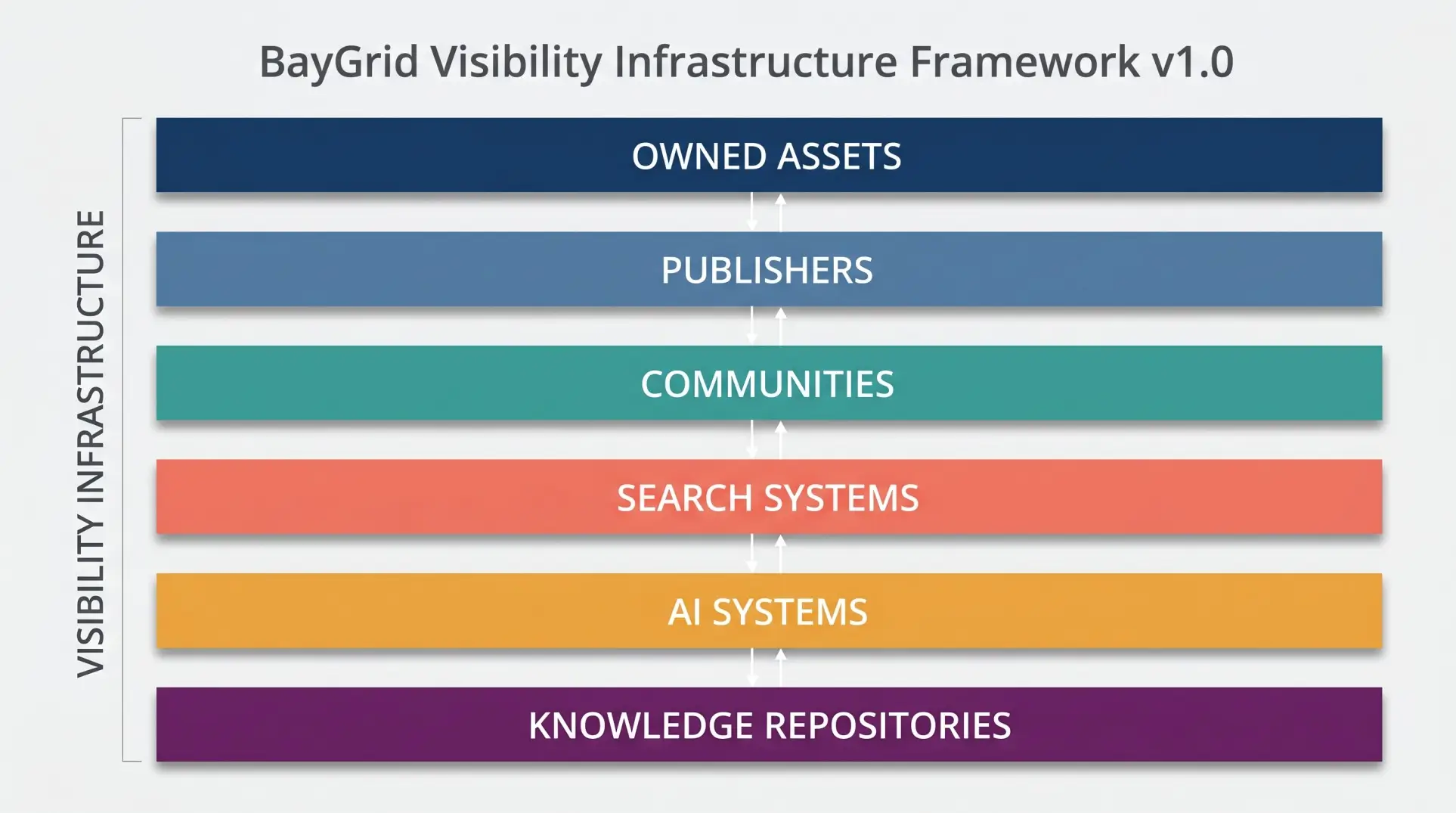
The BayGrid Visibility Infrastructure Framework v1.0 identifies six layers that collectively constitute visibility infrastructure. These layers are arranged from foundational (the information sources) to emergent (the knowledge systems that accumulate and synthesise information over time).
Layer 1: Owned Assets — The digital properties that hospitality operators directly control. This layer includes official websites, booking engines, mobile applications, email systems, and any other digital asset where the property has full editorial control. Owned assets are the foundational layer because they represent the primary source of authoritative information about the property. All information that flows through other layers ultimately originates (or should originate) from the owned asset layer. The quality of owned assets — their accuracy, completeness, currency, and accessibility — determines the quality of information available to all upper layers. When owned assets are outdated, incomplete, or poorly structured, the error propagates upward through the entire infrastructure stack.
Layer 2: Publishers — The platforms and intermediaries that distribute hospitality information to audiences. This layer includes online travel agencies (Booking.com, Expedia, Agoda), review platforms (TripAdvisor, Yelp, Google Reviews), travel media, directory services, and any other entity that receives hospitality information and publishes it to an audience. Publishers function as distribution infrastructure — they extend the reach of owned assets by presenting property information to audiences that the property could not reach directly. The relationship between owned assets and publishers is bidirectional: properties provide information to publishers, and publishers provide audiences and booking functionality to properties. The Hospitality Visibility Ecosystem examines these publisher relationships in detail.
Layer 3: Communities — The social and interest-based groups through which hospitality information flows via peer-to-peer transmission. This layer includes social media communities, travel forums, special interest groups, loyalty programme networks, and word-of-mouth channels. Communities differ from publishers in that information flow is decentralised and user-generated rather than centrally controlled. Community layers amplify or dampen visibility through social sharing, recommendations, discussions, and user-generated content. A property may have minimal direct presence in community layers yet achieve significant community-driven visibility through guest advocacy, influencer mentions, or organic social sharing.
Layer 4: Search Systems — The algorithmic information retrieval systems that users employ to find hospitality information. This layer includes general search engines (Google, Bing), travel-specific search tools, metasearch engines (Google Hotels, Trivago, Kayak), and platform-internal search functions. Search systems function as filtering and ranking infrastructure — they process the vast quantity of hospitality information available through lower layers and present ordered results based on relevance signals, quality indicators, and user behaviour patterns. Search systems do not create hospitality information; they discover, index, and prioritise information created and distributed through lower layers. The effectiveness of search systems in making a property discoverable depends on both the quantity and quality of information available from lower layers and the search system’s assessment of that information’s relevance and authority.
Layer 5: AI Systems — The artificial intelligence and machine learning systems that increasingly mediate hospitality discovery. This layer includes AI-powered recommendation engines, conversational AI assistants, generative AI summaries, personalised ranking algorithms, and automated content curation systems. AI systems represent an emergent layer that sits atop search systems — they often process search results rather than raw information, synthesising multiple sources into recommendations, summaries, or conversational responses. The role of AI systems as discovery engines is examined in depth in related BayGrid research. AI systems differ from search systems in that they do not merely rank existing information but generate new information products (summaries, recommendations, comparisons) from the information they process.
Layer 6: Knowledge Repositories — The accumulated structured and unstructured knowledge about hospitality that persists over time and informs future discovery. This layer includes knowledge graphs, structured data databases, review archives, historical pricing data, accumulated ratings, and the training data that informs AI system behaviour. Knowledge repositories function as the memory layer of visibility infrastructure — they preserve information beyond its initial publication and make it available for future retrieval, synthesis, and analysis. Knowledge repositories explain why a property’s visibility history affects its current discoverability: accumulated reviews, historical ratings, and persistent structured data all influence how current systems present the property to potential guests.
Layer Dependencies
The six layers exhibit vertical dependencies in which each layer relies on the layers beneath it for information supply. AI Systems cannot generate accurate summaries without Search Systems having indexed relevant content. Search Systems cannot index content that has not been created and distributed through Owned Assets, Publishers, and Communities. Knowledge Repositories cannot accumulate structured data without information having flowed through the lower layers over time.
This dependency structure means that infrastructure weakness at any layer constrains the effectiveness of all layers above it. A property with excellent owned assets but no publisher relationships will have limited search visibility because search systems primarily discover content through publisher platforms and publisher authority signals. A property with strong publisher relationships but poor owned assets will have limited AI visibility because AI systems increasingly synthesise information from authoritative owned sources. Infrastructure investment must therefore consider the entire stack rather than optimising individual layers in isolation.
Analysis
Layer Interactions: How the Infrastructure Functions as a System
The analysis reveals that visibility infrastructure is not merely the sum of its layers but a system in which layer interactions determine overall effectiveness. Three patterns of interaction are particularly significant: information ascension, authority filtering, and feedback descent.
Information ascension describes the upward flow of hospitality information from owned assets through publishers and communities to search systems, AI systems, and knowledge repositories. This is the primary information pathway: properties create information, publishers and communities distribute it, and search and AI systems discover, index, and synthesise it. The efficiency of information ascension determines how completely and accurately a property’s information reaches upper layers. Information ascension is rarely perfect — information may be distorted as it passes through publishers (who reformat and repurpose content), amplified or dampened by communities (who add commentary and context), filtered by search systems (who apply relevance algorithms), and transformed by AI systems (who synthesise rather than transmit). Each layer in the ascension path introduces both opportunities for increased reach and risks of information degradation.
Authority filtering describes the process by which upper layers assess and weight information from lower layers based on perceived authority. Search systems apply domain authority, page authority, and content quality signals to rank information from publishers and owned assets. AI systems apply source credibility assessments when synthesising information. Knowledge repositories apply trustworthiness indicators when accumulating data. This filtering means that not all information from lower layers receives equal treatment in upper layers. Information from high-authority publishers (major OTAs, established media) typically receives greater weight than information from low-authority sources. Information from well-structured owned assets typically receives better indexing treatment than information from poorly structured assets. Authority filtering creates a hierarchy of attention in which infrastructure strength at lower layers determines not just whether information reaches upper layers but how prominently it is treated when it arrives.
Feedback descent describes the downward flow of signals from upper layers that influence performance at lower layers. Search ranking data informs publisher optimisation strategies. AI system behaviour reveals which information patterns produce favourable synthesis. Community engagement metrics inform owned asset strategy. Knowledge repository patterns reveal which historical signals persist and influence current visibility. This feedback means that the infrastructure is not a one-way pipeline but a reciprocal system in which upper-layer behaviour shapes lower-layer optimisation. Properties that monitor and respond to feedback signals from upper layers can progressively improve their infrastructure effectiveness over time.

Owned Assets: The Foundation Layer
The analysis of the Owned Assets layer reveals its dual function as both information source and authority anchor. As information source, owned assets provide the raw material — descriptions, imagery, pricing, availability, policies, and brand narrative — that feeds all upper layers. As authority anchor, owned assets establish the canonical version of property information against which information at other layers is compared.
The authority anchor function has become increasingly important as AI systems enter the visibility infrastructure. AI systems increasingly attempt to identify authoritative sources when synthesising information, and a well-structured, comprehensive owned asset is more likely to be treated as authoritative than fragmented or outdated owned assets. Properties that neglect their owned assets in favour of investing exclusively in publisher relationships may find that their information loses authority as it passes through upper layers, reducing the effectiveness of their publisher investments.
Key structural characteristics of effective owned assets include: accuracy (information reflects actual property conditions), completeness (all relevant decision-making information is available), currency (information is regularly updated), structured data markup (enabling machine readability by search and AI systems), and accessibility (information is findable and usable by human visitors and machine systems alike). Deficiencies in any of these characteristics propagate upward through the infrastructure stack, reducing the effectiveness of upper-layer processing.
Publishers: The Distribution Layer
The Publishers layer analysis reveals that publisher relationships function as the primary distribution infrastructure for hospitality visibility. The reach of a property’s visibility is largely determined by the breadth and depth of its publisher relationships — the number of platforms on which it appears, the prominence of those placements, and the completeness of the information presented on each platform.
However, the analysis also identifies a distribution-fragmentation tension in the publisher layer. Each publisher platform has its own information requirements, formatting standards, audience characteristics, and algorithmic priorities. A property seeking broad distribution must adapt its information to multiple publisher contexts, risking fragmentation — the same property may present differently on different platforms, creating inconsistency that undermines trust when users cross-reference multiple publishers. Properties seeking to avoid fragmentation by limiting publisher relationships sacrifice distribution reach. Managing this tension requires strategic publisher selection that balances reach against the operational capacity to maintain consistent, high-quality presence across selected platforms.
The publisher layer also introduces a dependency dynamic that hospitality operators must recognise. Publisher platforms control the terms of distribution — commission structures, content requirements, placement algorithms, and policy rules. Properties that derive a substantial majority of their visibility from a small number of publisher relationships face concentration risk. Changes in publisher policies, algorithm updates, or competitive dynamics on major platforms can dramatically alter visibility without the property having direct control. Infrastructure diversification across multiple publisher types (OTAs, review platforms, media, directories) reduces this concentration risk.
Communities: The Amplification Layer
The Communities layer operates through mechanisms fundamentally different from the Owned Assets and Publishers layers. Community-driven visibility is decentralised, peer-mediated, and emotionally inflected. It cannot be directly controlled by properties, but it can be influenced through the quality of the experiences that properties create and the relationship strategies they employ.
The analysis identifies two distinct community visibility patterns: organic community visibility, which arises from genuine guest advocacy, spontaneous sharing, and authentic recommendations; and cultivated community visibility, which arises from deliberate community engagement, influencer partnerships, and social media presence strategies. Both patterns can produce effective visibility, but they carry different trust implications. Organic community visibility typically carries higher trust weight because it is perceived as genuine rather than promotional. Cultivated community visibility offers greater control and predictability but may be treated with scepticism if users perceive it as manufactured.
The community layer also functions as a signal amplification mechanism for both positive and negative information. Positive experiences shared in communities can produce visibility benefits that exceed what publisher relationships alone could achieve. Negative experiences shared in communities can produce visibility damage that persists even when publisher-layer information remains positive. This amplification asymmetry means that community layer dynamics deserve monitoring and response consideration even though they cannot be directly controlled.
Search Systems: The Filtering Layer
Search Systems represent the critical filtering layer that determines which of the vast quantity of hospitality information available through lower layers actually reaches potential guests. The analysis reveals that search system visibility is not simply a matter of “being found” but of being found in the right context — for the right queries, in the right geographic markets, to the right user segments, at the right stage of the decision journey.
Search system effectiveness depends on three factors: indexation completeness (whether search systems have discovered and indexed the property’s information), relevance matching (whether indexed information is deemed relevant to queries that potential guests actually use), and ranking position (whether relevant information appears prominently enough to be seen). Each factor depends on signals from lower layers. Indexation completeness depends on publisher authority and owned asset technical accessibility. Relevance matching depends on content quality, structured data implementation, and query alignment. Ranking position depends on authority signals, user behaviour patterns, and competitive dynamics.
The search layer exhibits a winner-concentration tendency in which properties that achieve strong ranking positions receive disproportionate visibility because users rarely examine results beyond the first page. This concentration means that search system infrastructure investment produces non-linear returns — small improvements in ranking position can produce large visibility gains, while properties below ranking thresholds may achieve minimal search-driven visibility despite substantial lower-layer investment.
AI Systems: The Synthesis Layer
AI Systems represent the most rapidly evolving layer of visibility infrastructure. Unlike search systems, which rank and present existing information, AI systems synthesise information from multiple sources to generate new information products — summaries, comparisons, recommendations, and conversational responses. This synthesis function changes the nature of visibility in fundamental ways.
First, AI synthesis reduces the importance of destination visitation (getting users to click through to a property’s website or listing) by providing information directly in the AI interface. A potential guest may receive sufficient information from an AI summary to make a booking decision without ever visiting the property’s owned assets. This means that AI-layer visibility is increasingly independent of traditional traffic metrics — a property can achieve high AI visibility without high website traffic.
Second, AI systems introduce source opacity — users often cannot determine which sources an AI system drew upon to generate its response. A property may be prominently featured in an AI recommendation without understanding why, or excluded without understanding what source deficiencies led to exclusion. This opacity makes AI-layer infrastructure management challenging, as the signals that influence AI behaviour are not always transparent or controllable.
Third, AI systems exhibit authority concentration — they tend to rely on a relatively small number of high-authority sources when synthesising information. Properties that achieve representation in the authoritative sources that AI systems prioritise may receive disproportionate AI visibility, while properties absent from those sources may be effectively invisible to AI-mediated discovery regardless of their presence in other layers. The analysis of AI systems as discovery engines examines these dynamics in greater detail.
Knowledge Repositories: The Memory Layer
Knowledge Repositories function as the memory layer of visibility infrastructure — they accumulate structured and unstructured information about hospitality properties over time and make that accumulated knowledge available for future retrieval and analysis. This layer is the least visible to hospitality operators and potential guests, yet it exerts substantial influence on visibility outcomes through all other layers.
The analysis identifies two mechanisms through which knowledge repositories influence visibility: historical weighting and structural data persistence. Historical weighting occurs when search systems, AI systems, and publishers factor accumulated historical signals (total review count, long-term rating trends, years of operation) into current visibility decisions. Properties with longer positive track records benefit from historical weighting; new properties face visibility challenges until they accumulate sufficient history. Structural data persistence occurs when structured information entered into knowledge repositories (business listings, knowledge graph entries, structured markup) persists over time and continues to influence how systems represent the property even when the original entry is no longer actively maintained.
The memory layer creates a visibility inertia effect — properties with strong historical visibility signals tend to maintain visibility advantages even when current lower-layer activity declines, while properties with weak historical signals face extended investment periods before achieving visibility parity. This inertia means that infrastructure investment timing matters: early investment in building knowledge repository presence produces compounding returns over time, while delayed investment means playing catch-up against competitors who have accumulated historical advantages.
Infrastructure Dependencies and Bottlenecks
The analysis of layer interactions reveals that infrastructure dependencies create characteristic bottleneck patterns. A bottleneck occurs when weakness or absence in one layer constrains the effectiveness of all layers above it, regardless of how well those upper layers function independently.
Common bottleneck patterns include: Owned Asset Deficiency, in which poor website structure, outdated content, or absent structured data prevents search and AI systems from effectively indexing and understanding the property; Publisher Absence, in which failure to establish relationships with key distribution platforms limits search indexation and AI source availability; Community Negativity, in which concentrated negative community sentiment creates persistent visibility damage that publisher and search layer investments cannot overcome; Search Invisibility, in which technical or relevance factors prevent indexation or ranking despite strong lower-layer infrastructure; and AI Source Exclusion, in which a property’s absence from the authoritative sources that AI systems prioritise renders it invisible to AI-mediated discovery.
Identifying and resolving bottlenecks is the primary diagnostic application of the Visibility Infrastructure Framework. Rather than uniformly investing across all layers, hospitality operators can use the framework to identify which layer is constraining overall infrastructure effectiveness and target intervention accordingly.
Framework Application
Applying the Visibility Infrastructure Framework
The Visibility Infrastructure Framework provides a diagnostic tool for assessing hospitality visibility systems. Its application involves three analytical steps: layer mapping, interaction assessment, and bottleneck identification.
Layer mapping documents the property’s current presence and performance across all six layers. For each layer, the mapping examines whether the layer is present (does the property have owned assets? publisher relationships? community presence?), what the quality of that presence is (how comprehensive, accurate, and effective?), and how the layer has changed over time (is presence expanding, stable, or declining?). Layer mapping produces a visibility infrastructure profile that reveals where investment has been concentrated and where gaps exist.
Interaction assessment examines how effectively information flows between layers. Does information created at the owned asset layer reach publisher layers accurately and completely? Does publisher-layer information get indexed by search systems? Does community sentiment align with or contradict publisher-layer information? Do AI systems draw upon the property’s owned assets and publisher presence when generating responses? Interaction assessment reveals whether the infrastructure functions as an integrated system or as isolated components that fail to reinforce one another.
Bottleneck identification determines which layer, if improved, would produce the greatest overall infrastructure effectiveness gain. A property with strong owned assets, good publisher relationships, and positive community sentiment but poor search visibility has a search-layer bottleneck. A property with strong search visibility but minimal AI presence has an AI-layer bottleneck. Bottleneck identification enables prioritised investment — rather than spreading resources uniformly, operators can target the constraint that is limiting system-wide performance.
Applying the Information Flow Model
The BayGrid Information Flow Model v1.0 complements the Infrastructure Framework by examining the dynamics of how information moves through the infrastructure rather than the structural architecture that supports that movement. Applied together, the two frameworks enable both structural diagnosis (Infrastructure Framework) and flow analysis (Information Flow Model).
The Information Flow Model reveals that information does not move through infrastructure layers in a simple linear progression. Information may skip layers (community content may be indexed directly by search systems without passing through publishers), loop between layers (search system feedback may prompt owned asset updates that then flow back through publishers), and fragment across layers (the same property information may appear differently on different platforms due to platform-specific formatting requirements). These flow dynamics mean that infrastructure must be managed as a dynamic system rather than a static architecture.
Implications
For Hospitality Operators
The six-layer framework carries several implications for hospitality operators. First, it suggests that visibility strategy should be infrastructure-centric rather than channel-centric. Rather than asking “which platforms should we be on?” operators should ask “how do our six infrastructure layers interact, and which layer is our current bottleneck?” This reframing shifts visibility planning from a list of platforms to a system architecture.
Second, the framework reveals that owned assets deserve foundational investment priority even though they may not produce the most immediately visible results. Strong owned assets improve the effectiveness of all upper layers; weak owned assets create persistent constraints that publisher, search, and AI investments cannot fully overcome. Properties that under-invest in owned assets while over-investing in publisher distribution are building infrastructure on an unstable foundation.
Third, the emergence of AI Systems as a distinct layer with its own source selection logic implies that operators should monitor AI-mediated visibility independently from search visibility. A property may achieve strong search rankings yet minimal AI presence if it lacks representation in the authoritative sources that AI systems prioritise. As AI-mediated discovery grows, AI-layer infrastructure may become as important as search-layer infrastructure.
For Technology Providers
The framework has implications for technology providers serving the hospitality industry. Content management systems, channel managers, reputation management platforms, and booking engines each address specific infrastructure layers, but few address the full stack. Technology providers that enable cross-layer integration — ensuring that information updates propagate consistently across owned assets, publishers, and structured data systems — deliver greater visibility value than point solutions that optimise single layers while creating cross-layer inconsistency.
The framework also suggests that transparency tools — dashboards showing how information flows across layers, where indexation gaps exist, and which sources AI systems draw upon — would enable operators to manage their infrastructure more effectively. Current visibility management tools often focus on single-layer metrics (search rankings, review scores, social engagement) without revealing cross-layer dynamics.
For Industry Researchers
This analysis opens avenues for further investigation into the empirical measurement of layer interactions, the quantification of bottleneck effects, and the comparative importance of different layers across hospitality segments. The framework as presented is conceptual; empirical validation through large-scale visibility data analysis would strengthen its diagnostic utility. The evolving role of AI Systems as a visibility layer warrants continued research as AI-mediated discovery behaviours become more prevalent. The future of hospitality discoverability will be shaped by how these six layers evolve and interact in response to technological and behavioural change.
Conclusion
This paper has examined the infrastructure architecture that enables hospitality visibility and discoverability. The analysis, grounded in the BayGrid Visibility Infrastructure Framework v1.0, identifies six interdependent layers — Owned Assets, Publishers, Communities, Search Systems, AI Systems, and Knowledge Repositories — that collectively constitute the infrastructure through which hospitality information travels from properties to potential guests.
The central analytical finding is that discoverability emerges not from any single layer but from the quality of interactions between layers. Information ascends from owned assets through publishers and communities, is filtered and ranked by search systems, synthesised by AI systems, and accumulated in knowledge repositories. Each layer depends on the layers beneath it, and weakness at any layer creates bottlenecks that constrain the entire system. This layered dependency means that visibility infrastructure must be managed as an integrated system rather than as a collection of independent channels or tactics.
The analysis further reveals that the infrastructure is evolving. AI Systems represent an emergent layer that is changing how users discover hospitality information — shifting from destination-based discovery (clicking through to websites and listings) to synthesis-based discovery (receiving AI-generated summaries and recommendations). Knowledge Repositories function as an invisible but influential memory layer that creates visibility inertia and historical weighting effects. These dynamics suggest that hospitality visibility infrastructure will continue to increase in complexity, requiring operators to develop correspondingly sophisticated infrastructure management capabilities.
For hospitality operators, the framework provides a diagnostic tool for identifying infrastructure bottlenecks and prioritising investment. For technology providers, it suggests opportunities for cross-layer integration and transparency tools. For researchers, it establishes a conceptual architecture for empirical investigation into the mechanics of hospitality discoverability. Further research is needed to quantify layer interaction effects, validate bottleneck patterns across hospitality segments, and track infrastructure evolution as AI-mediated discovery becomes increasingly prevalent.
References
The following external sources provide supporting context for the concepts examined in this paper. No statistics, studies, or empirical claims in this paper are derived from fabricated sources.
- BayGrid Visibility Infrastructure Framework v1.0 — Six-layer model for analysing the infrastructure that enables hospitality visibility and discoverability.
- BayGrid Information Flow Model v1.0 — Model for understanding how hospitality information moves from source to audience through digital infrastructure.
- BayGrid Standard 7: Visibility Infrastructure — “The systems and relationships enabling information distribution and discovery.”
- BayGrid Standard 1: Hospitality Visibility — Standard for presence, accuracy, and accessibility of hospitality information.
- BayGrid Standard 2: Discoverability — Standard for the capacity to encounter relevant hospitality information.
- Google Search Central. “How Search Works.” Available at: developers.google.com/search/docs/fundamentals/how-search-works — Provides technical documentation on search system indexation and ranking mechanisms relevant to Layer 4 analysis.
- Bing Webmaster Tools Documentation. “Webmaster Guidelines.” — Provides platform-specific guidance on search visibility factors relevant to infrastructure layer analysis.
- Internet Archive. “Wayback Machine.” Available at: web.archive.org — Illustrates the Knowledge Repository layer concept through its function as a persistent web archive.
- Schema.org Hospitality Extensions. “Lodging, Restaurant, and Travel Schemas.” Available at: schema.org — Technical reference for structured data implementation in the Owned Assets layer.
- Xiang, Z., & Gretzel, U. (2010). “Role of Social Media in Online Travel Information Search.” Tourism Management, 31(2), 179-188. — Examines community-layer dynamics in hospitality information search behaviour.
Note: The external references cited provide technical and theoretical context for the infrastructure concepts examined in this paper. The specific six-layer framework and analytical claims presented are BayGrid’s analytical contributions. Technical documentation references are provided as sources of background information on the systems described; they do not endorse or validate the specific framework presented.