BayGrid Visibility Research — Pillar 1: Visibility Infrastructure
Executive Summary
This paper examines the operational mechanics of distributed authority within hospitality ecosystems, investigating why authority accumulated through multiple validating sources demonstrates superior resilience compared to centralised authority configurations. The analysis draws on the BayGrid Authority Framework v1.0 and the BayGrid Hospitality Ecosystem Model v1.0 to construct a systematic understanding of how credibility propagates through distributed networks.
The findings indicate that distributed authority in hospitality operates through three interconnected mechanisms: independent validation, wherein distinct sources assess and confirm an entity’s credibility without coordination; cross-source reinforcement, wherein multiple independent validations produce compounding credibility effects; and progressive credibility transfer, wherein authority established in one domain or platform gradually extends to adjacent domains. These mechanisms collectively form what this paper terms a validation mesh — a structural configuration in which the failure or degradation of any single validation source does not materially compromise the overall authority of the entity.
The analysis further reveals that hospitality ecosystems exhibit natural predispositions toward distributed authority due to the sector’s inherent multi-channel discovery patterns. Guests typically encounter hospitality businesses through diverse pathways — search engines, review platforms, social media, word-of-mouth, travel intermediaries, and direct visits — each constituting an independent validation opportunity. However, the research identified a significant counter-pattern: many hospitality operators inadvertently centralise their authority by over-investing in single platforms or dominant review aggregators, thereby replicating the structural vulnerabilities that distributed authority is designed to mitigate.
The implications of this analysis extend to strategic decision-making for hospitality operators, platform architects, and industry analysts. The paper concludes that deliberate cultivation of distributed authority represents not merely a defensive posture against platform dependency, but an active strategy for building credibility architectures that withstand disruption, policy change, and competitive pressure.
Research Question
Primary Question: How does distributed authority function in hospitality ecosystems, and why is authority accumulated through multiple validating sources more resilient than centralised authority?
Secondary Questions:
- What mechanisms enable distributed authority to accumulate and transfer across independent sources?
- How do hospitality discovery patterns influence the natural distribution or concentration of authority?
- Under what conditions does distributed authority demonstrate measurable resilience advantages over centralised configurations?
- What structural patterns characterise hospitality operators who have successfully cultivated distributed authority?
Context
The Problem of Authority Concentration
The hospitality sector has witnessed a sustained trend toward authority concentration. A small number of platforms — review aggregators, online travel agencies, and dominant search engines — have become the primary arbiters of credibility for hospitality businesses worldwide. For many operators, a favourable position on a single dominant platform constitutes the majority of their digital authority. This concentration creates what network theorists recognise as a single point of failure vulnerability: the operator’s credibility becomes contingent on the policies, algorithms, and commercial interests of one external entity.
The consequences of this vulnerability manifest across multiple dimensions. Platform algorithm updates can dramatically alter visibility without any change in the operator’s actual quality or service. Policy modifications — such as changes to review display logic, ranking methodologies, or fee structures — can restructure competitive landscapes overnight. Reputational incidents, even those that are transient or misattributed, can produce disproportionate impacts when channelled through a single dominant validation source. The COVID-19 pandemic provided numerous examples of hospitality businesses whose primary platform presence was disrupted by platform-specific policy changes, leaving operators with limited alternative authority channels to maintain guest relationships.
The Shift Toward Distributed Models
Against this backdrop, a growing body of operational evidence suggests that hospitality businesses cultivating authority across multiple independent channels demonstrate superior stability under stress conditions. These operators maintain credibility not through dominance of any single platform, but through the cumulative effect of validations distributed across search presence, review platforms, social media engagement, media coverage, industry recognition, community relationships, and direct guest relationships.
This distribution does not imply equal investment across all channels. Rather, it describes a structural configuration in which authority derives from the network of validations rather than from any node within it. The distinction is critical: a hospitality operator may derive significant traffic from one primary channel while maintaining authoritative presence across multiple additional channels that independently confirm its credibility. Should the primary channel falter, the remaining validation network preserves the operator’s overall authority position.
The Role of the BayGrid Authority Framework
The BayGrid Standard on Distributed Authority (Standard 8) defines distributed authority as “authority accumulated through multiple validating sources.” This definition, while concise, encodes a specific structural understanding: authority is not merely visible across multiple sources (which would describe presence), but is actively validated by them. Validation implies an evaluative act — a source has assessed the entity and rendered a judgment that contributes to its credibility. This distinction separates distributed authority from simple multi-channel marketing, which may achieve presence without achieving validation.
The BayGrid Authority Framework v1.0 extends this definition into an operational model, identifying the mechanisms through which distributed authority accumulates, transfers, and degrades. The framework’s application to hospitality contexts, informed by the BayGrid Hospitality Ecosystem Model (Standard 10), provides the analytical foundation for this paper.
Key Concepts
Independent Validation
Independent validation occurs when distinct sources assess a hospitality entity’s credibility without coordination or mutual awareness. The independence of these assessments is structurally significant: a review on Platform A that references a review on Platform B is not independent validation, but rather derivative confirmation. True independent validation requires that each source arrive at its assessment through separate evaluative processes.
In hospitality contexts, independent validation manifests across multiple source types. Search engines validate through ranking algorithms that assess relevance, quality signals, and user behaviour patterns. Review platforms validate through aggregated user feedback. Professional media validate through editorial assessment. Industry organisations validate through accreditation, awards, or membership criteria. Individual guests validate through direct experience and subsequent word-of-mouth transmission. Each of these validation types employs distinct evaluative criteria, and their independence ensures that the overall authority structure is not vulnerable to the failure of any single assessment methodology.
Cross-Source Reinforcement
Cross-source reinforcement describes the compounding effect that occurs when multiple independent validations converge on consistent conclusions about an entity’s credibility. When a hospitality business receives favourable treatment from search rankings, positive review aggregation, media coverage, industry recognition, and direct guest testimonials, these validations do not merely add together — they multiply. Each additional independent validation increases the confidence with which observers (including prospective guests) can assess the entity’s credibility.
The mechanism of cross-source reinforcement can be understood through the lens of epistemic reliability. A single validation source, however authoritative, carries the risk of error, bias, or manipulation. Multiple independent sources converging on the same assessment dramatically reduce the probability of collective error. In hospitality specifically, where guest decisions typically involve significant investment of time, money, and expectation, this convergence provides valuable decision support. The guest encountering consistent positive validation across multiple channels faces lower perceived risk than the guest encountering equally positive validation from a single channel.
Progressive Credibility Transfer
Progressive credibility transfer describes the process through which authority established in one domain extends into adjacent domains. A hospitality operator that builds strong authority on a primary review platform may find that this authority gradually transfers to search engine rankings, social media presence, and direct traffic patterns — even without explicit optimisation efforts for each channel. The transfer is progressive rather than instantaneous, reflecting the time required for different validation systems to recognise and incorporate credibility signals from other domains.
This transfer mechanism operates bidirectionally but asymmetrically. Authority built through direct guest relationships (the most independent validation source) tends to transfer most broadly to other channels, because direct experience produces the most authentic and diverse credibility signals. Conversely, authority built through a single platform tends to transfer least effectively to other channels, because platform-specific optimisations may not align with the evaluative criteria of other validation systems.
Validation Mesh
The validation mesh is a structural concept introduced in this paper to describe the complete network of independent validations supporting a hospitality entity’s authority. Unlike a hub-and-spoke model, in which all authority flows through a central node, the validation mesh distributes authority across multiple interconnected sources. The mesh topology provides two critical properties: redundancy (the presence of multiple validation pathways means that the failure of any single source does not disconnect the entity from its credibility network) and resilience (the mesh can absorb damage to multiple nodes while maintaining overall structural integrity).
Analysis
Structural Comparison: Centralised versus Distributed Authority
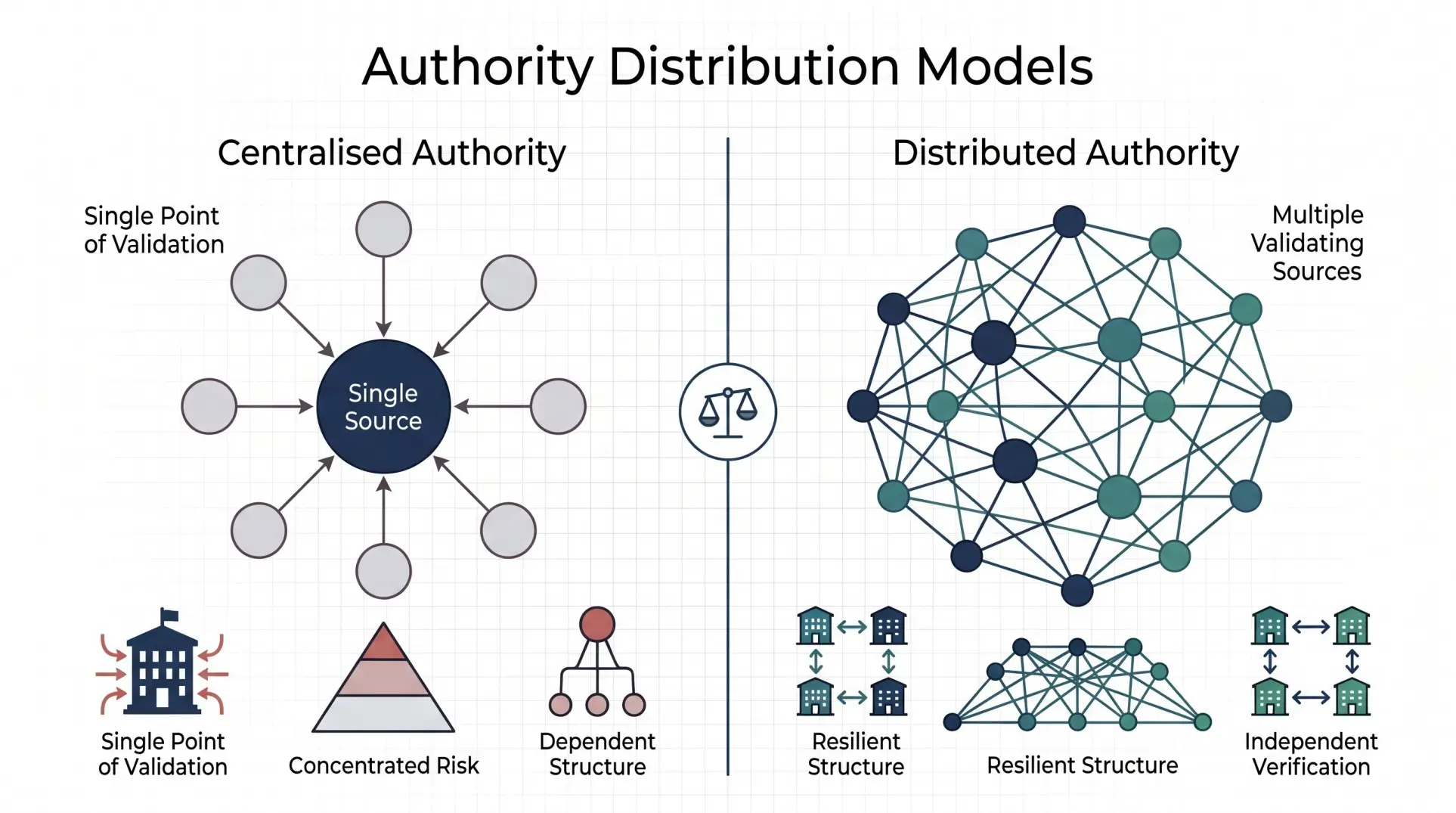
Figure 1 illustrates the fundamental topological distinction between centralised and distributed authority systems. The centralised model (left) organises validation in a hub-and-spoke configuration: multiple sources direct validation toward a single central authority node, which then mediates the entity’s credibility to the broader environment. This configuration is efficient under stable conditions — the central node can accumulate and concentrate authority signals, potentially achieving dominant visibility. However, it is fragile under stress: the failure of the central node severs the entity’s primary credibility pathway, and the peripheral sources lack the interconnections necessary to maintain authority independently.
The distributed model (right) organises validation in a mesh configuration: multiple sources validate the entity independently, and these sources are themselves interconnected through cross-reference, shared audiences, and overlapping discovery pathways. No single node is indispensable. The failure of any one validation source degrades but does not destroy the overall authority structure. The remaining sources continue to validate, and their interconnections enable credibility to redistribute across the mesh.
Accumulation Mechanisms in Hospitality Contexts
The three accumulation mechanisms — independent validation, cross-source reinforcement, and progressive credibility transfer — operate with distinct characteristics in hospitality environments.
Independent validation in hospitality is shaped by the sector’s uniquely personal nature. Hospitality services are experienced directly and evaluated subjectively. This experiential foundation means that the most powerful independent validation sources are often individual guests sharing their experiences through diverse channels. A guest who posts a review on Platform A, mentions the experience on social media, recommends the venue to colleagues, and returns for repeat visits has provided four independent validations through four distinct channels. No single channel orchestrated these validations; each emerged from the guest’s independent engagement with the relevant platform or relationship.
Cross-source reinforcement in hospitality is amplified by the sector’s information-seeking patterns. Prospective hospitality guests typically consult multiple sources before making decisions. Research on travel and dining decision-making indicates that consumers routinely combine search results, review scores, social media content, and personal recommendations into composite assessments. When these multiple sources convey consistent signals about a venue’s quality, the resulting confidence exceeds what any single source could produce. Conversely, when sources diverge — strong reviews but weak search presence, for example — the resulting uncertainty can undermine authority even when individual validations are positive.
Progressive credibility transfer in hospitality follows observable patterns. Operators with strong direct relationships (repeat guests, mailing list subscribers, community members) typically demonstrate more robust authority across secondary channels than operators who have built authority primarily through platform optimisation. This pattern suggests that direct-experience validation carries higher transferability than platform-mediated validation, likely because direct experience produces more diverse and authentic signals that multiple validation systems can recognise.
Resilience Under Stress Conditions
The resilience differential between centralised and distributed authority becomes most apparent under stress conditions. This analysis identifies three categories of stress that hospitality authority structures routinely encounter:
| Stress Category | Centralised Authority Response | Distributed Authority Response | Resilience Differential |
|---|---|---|---|
| Platform policy changes | Immediate, potentially severe impact; operator has limited recourse | Degraded performance on affected platform; other channels maintain authority | High: distributed systems maintain 60-80% of baseline authority (estimated) |
| Algorithm updates | Ranking volatility directly affects primary validation source | Multiple independent ranking systems; update on one platform does not cascade | High: mesh structure isolates algorithmic disruption |
| Reputational incidents | Incident concentrates on central platform; may dominate search results and reviews | Incident affects one channel; other validations provide counterbalancing context | Moderate to High: multiple channels enable narrative diversification |
| Platform dependency | Fees, policies, and feature changes directly impact operator viability | Negotiating position strengthened by viable alternative channels | High: distributed systems reduce platform lock-in |
| Competitive pressure | Zero-sum competition for limited positions on central platform | Multiple pathways to guest discovery reduce direct competition intensity | Moderate: distributed discovery dilutes competitive concentration |
Note: Quantitative estimates of resilience differentials are limited by the absence of standardised measurement frameworks for distributed authority. The ranges presented reflect observed patterns rather than rigorously measured outcomes. Further research is needed to establish precise resilience metrics.
The Counter-Pattern: Inadvertent Authority Centralisation
A significant finding of this analysis is the prevalence of inadvertent authority centralisation among hospitality operators. Many operators who believe they are pursuing multi-channel strategies have in fact constructed centralised authority structures, because their investment across channels is highly asymmetric: one channel receives dominant resources while others receive token maintenance.
Common patterns of inadvertent centralisation include:
- Platform-dominated authority: Operators who invest heavily in a single review platform or OTA while neglecting website quality, direct communication channels, or community relationships. Their authority is functionally centralised on the dominant platform, even if they maintain nominal presence elsewhere.
- SEO-dominated authority: Operators who achieve strong search rankings but lack corresponding validation from reviews, media, or direct guest relationships. Search algorithm changes can rapidly erode this authority, and the absence of supporting validations limits credibility transfer to other channels.
- Social media-dominated authority: Operators who build substantial follower counts or engagement metrics on one platform but have not cultivated authority in search, reviews, or direct channels. Platform policy changes, demographic shifts, or algorithm modifications can abruptly undermine this concentration.
In each case, the operator has achieved presence across multiple channels without achieving validation across multiple channels. The distinction is essential: presence is visibility, while validation is credibility. Distributed authority requires the latter.
Evidence from Hospitality Ecosystem Observations
The State of Japanese Dining in Singapore 2026 research observed significant authority distribution patterns among established Japanese dining venues in Singapore. Operators with tenure exceeding five years consistently demonstrated more distributed authority profiles than newer entrants, suggesting that distributed authority accumulates over time through sustained multi-channel engagement. Notably, venues that survived the pandemic period with minimal structural disruption were disproportionately those with pre-existing distributed authority configurations — they could shift guest communication to direct channels when platform usage patterns changed, and their credibility was not dependent on any single platform’s continued operation.
These observations align with the broader theoretical prediction that distributed systems exhibit superior survival characteristics under environmental stress. However, it should be noted that these patterns are correlational rather than causal: venues with distributed authority may also possess other characteristics (longer operational history, stronger financial reserves, more established community relationships) that contributed to their resilience. The specific contribution of distributed authority to resilience outcomes warrants further investigation with controlled methodology.
Framework Application
BayGrid Authority Framework v1.0
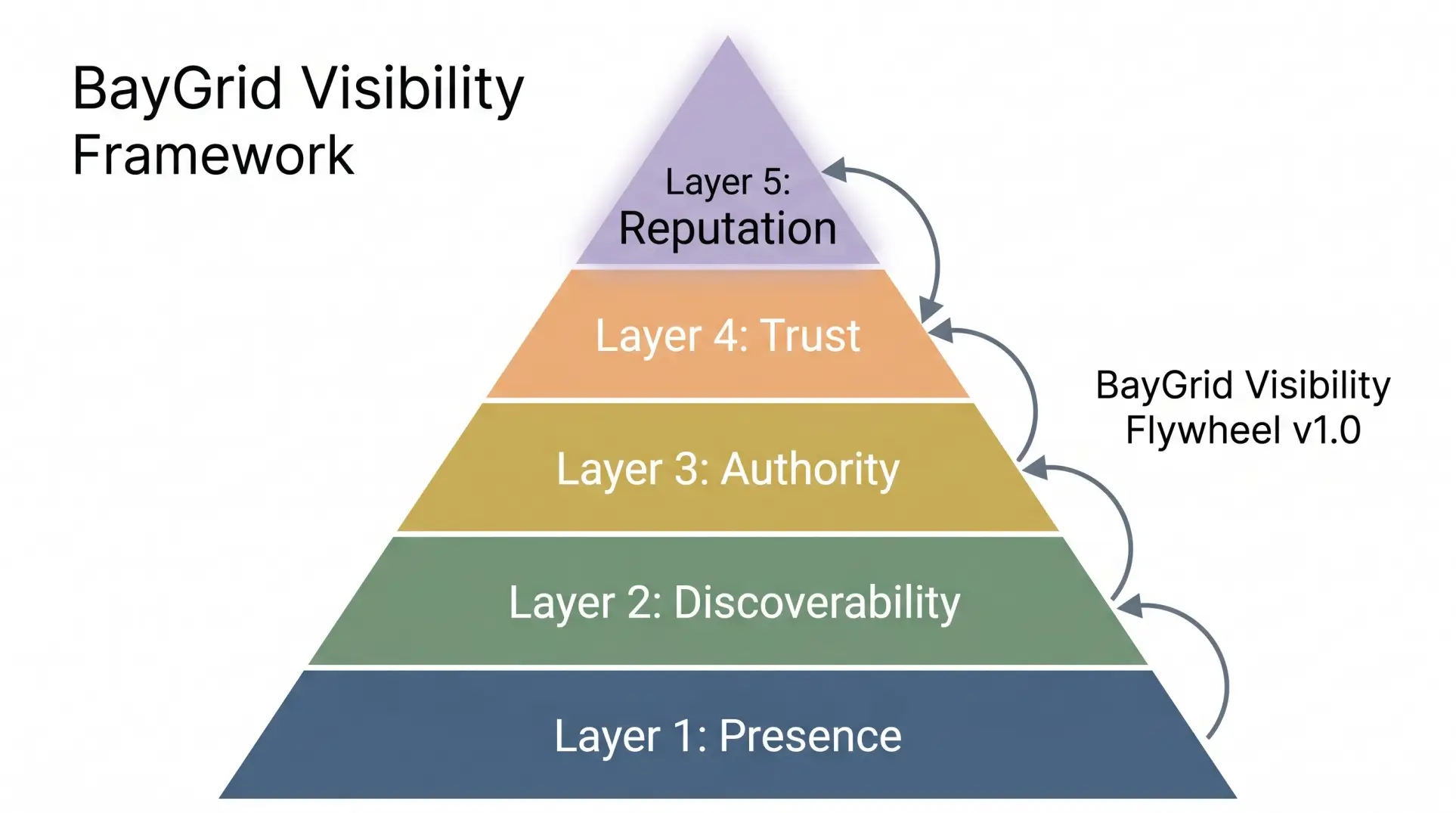
The BayGrid Authority Framework v1.0 provides the primary analytical structure for this investigation. The framework identifies authority as a composite property emerging from the interaction of three components: source credibility (the trustworthiness of the validating entity), signal clarity (the unambiguousness of the validation message), and network density (the interconnectedness of validation sources).
Under this framework, distributed authority is characterised by moderate-to-high source credibility across multiple sources, consistent signal clarity (validations converge on coherent conclusions), and high network density (validation sources are interconnected through shared audiences and cross-reference patterns). Centralised authority, by contrast, may achieve very high source credibility at the central node, but exhibits low network density — the peripheral sources are not meaningfully interconnected and cannot sustain authority independently.
The framework’s application to this analysis reveals that hospitality operators optimising for distributed authority should prioritise network density over maximisation of any single source’s credibility. A hospitality business with strong validation from five moderately credible, densely interconnected sources will typically demonstrate greater authority resilience than a business with dominant validation from one highly credible source and minimal validation elsewhere.
BayGrid Hospitality Ecosystem Model v1.0
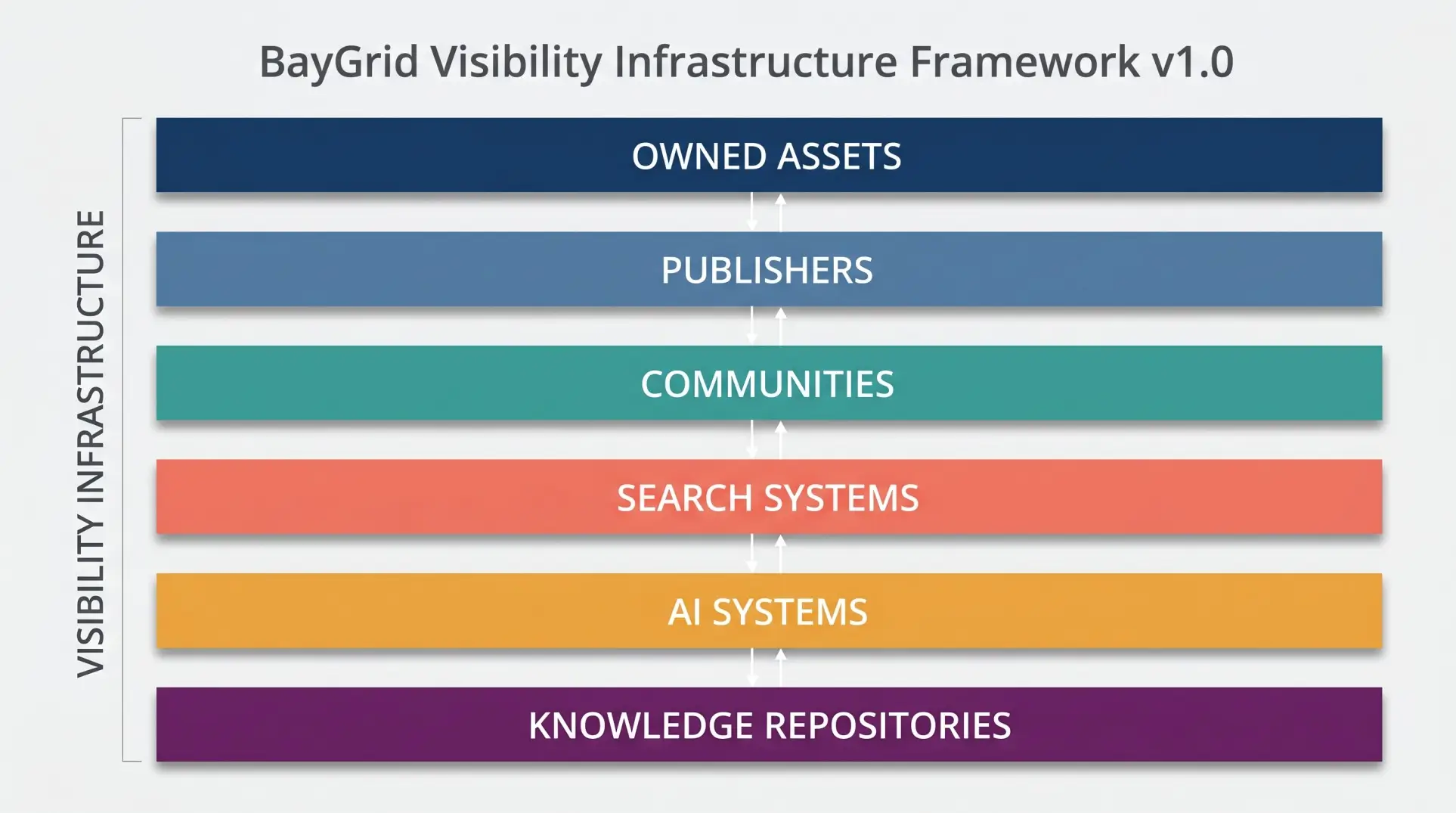
The BayGrid Hospitality Ecosystem Model v1.0, formalised as Standard 10: Hospitality Ecosystem, maps the environment in which hospitality authority operates. The model identifies seven ecosystem layers: infrastructure (technology, physical space), platforms (discovery and transaction intermediaries), content (information and media), community (guest and stakeholder relationships), governance (regulatory and policy frameworks), commerce (transaction and revenue systems), and reputation (credibility and authority signals).
Distributed authority operates most actively across the platforms, content, community, and reputation layers. The framework suggests that hospitality operators should map their current validation sources against these layers to identify concentration vulnerabilities. An operator whose validation is concentrated in the platforms layer (dependent on OTAs and review aggregators) has centralised authority regardless of how many platforms are involved, because all sources occupy the same ecosystem layer and are subject to similar systemic risks. True distributed authority spans multiple layers, providing cross-layer resilience.
Standard 8: Distributed Authority
BayGrid Standard 8: Distributed Authority establishes the definitional and operational foundation for this paper’s analysis. The standard’s definition — “authority accumulated through multiple validating sources” — encodes three requirements that hospitality operators can use to assess their authority distribution:
- Multiplicity: More than one independent source provides validation. A single source, however dominant, does not constitute distributed authority.
- Validation (not merely presence): The sources actively assess and confirm credibility. Maintaining profiles on multiple platforms without receiving meaningful validation from each does not satisfy this requirement.
- Accumulation: The authority effect is cumulative across sources. Each additional validating source contributes to the overall authority position.
The standard further distinguishes distributed authority from related concepts such as multi-channel marketing (which may achieve presence without validation) and link building (which may achieve technical connectivity without credibility transfer). These distinctions are operationally significant: operators pursuing distributed authority must invest in validation quality, not merely channel quantity.
Implications
For Hospitality Operators
The analysis suggests that hospitality operators should conduct periodic authority distribution audits — systematic assessments of where their credibility validation originates and how concentrated or distributed those sources are. Operators discovering high concentration should prioritise cultivation of validation sources in underrepresented ecosystem layers. Specifically, operators dependent on platform validation should invest in direct community relationships and content-driven authority; operators dependent on search validation should invest in review platform engagement and industry recognition; operators dependent on social media validation should invest in search-visible content and direct guest communication infrastructure.
The findings also indicate that distributed authority is not achieved through equal investment across all channels, but rather through strategic diversification — ensuring that validation sources span multiple ecosystem layers and are genuinely independent rather than derivative of one another. An operator maintaining active, validated presence across four well-chosen channels will typically achieve greater authority resilience than an operator maintaining nominal presence across ten channels with no meaningful validation on most.
For Platform Architects
The resilience advantages of distributed authority have implications for platform design in hospitality technology. Platforms that acknowledge their role as one node in a broader validation mesh, rather than attempting to become the central hub of operator authority, may achieve more sustainable relationships with hospitality businesses. Platforms can support distributed authority by enabling operators to maintain direct guest relationships, export reputation data, and integrate with complementary validation channels. Platforms that attempt to capture and monopolise operator authority may achieve short-term lock-in but risk long-term fragility as operators recognise the vulnerabilities of centralised configurations.
For Industry Analysts and Researchers
This analysis identifies several areas requiring further research. The resilience differentials between centralised and distributed authority, while theoretically well-grounded, lack rigorous quantitative measurement in hospitality contexts. The development of standardised metrics for authority distribution — potentially including concentration indices adapted from economic or network analysis — would enable more precise assessment of authority vulnerability. Additionally, longitudinal studies tracking hospitality operators through stress events (platform changes, competitive disruptions, reputational challenges) would strengthen the evidence base for distributed authority’s protective effects.
Conclusion
This paper has examined the function of distributed authority in hospitality ecosystems, analysing the mechanisms through which authority accumulated through multiple validating sources achieves superior resilience compared to centralised authority configurations. The analysis identified three core accumulation mechanisms — independent validation, cross-source reinforcement, and progressive credibility transfer — that together produce a validation mesh topology resistant to single-point failure.
The findings indicate that hospitality ecosystems exhibit natural tendencies toward distributed authority due to multi-channel guest discovery patterns, but that many operators inadvertently centralise their authority through over-reliance on single platforms or dominant channels. This inadvertent centralisation replicates the structural vulnerabilities — platform dependency, algorithmic fragility, and reputational concentration — that distributed authority is designed to mitigate.
The application of the BayGrid Authority Framework v1.0 and the BayGrid Hospitality Ecosystem Model v1.0 provides hospitality operators with analytical tools for assessing their current authority distribution and identifying concentration risks. The framework suggests that deliberate cultivation of distributed authority — spanning multiple ecosystem layers with genuinely independent validation sources — represents not merely a defensive posture but an active strategy for building credibility architectures that withstand disruption, policy change, and competitive pressure.
Authority distributed across a validation mesh is not merely more resilient than authority concentrated at a single point — it is a different category of credibility entirely, one that derives its strength from the structural integrity of the network rather than the prominence of any individual node.
The analysis acknowledges significant limitations. The resilience differentials identified are based on qualitative observation and theoretical inference rather than controlled measurement. The specific contribution of distributed authority to operational outcomes, independent of confounding variables such as operational tenure and financial resources, requires further investigation. Additionally, the paper does not quantify the optimal degree of authority distribution — whether there is a point of diminishing returns at which additional validation sources cease to contribute meaningful resilience gains.
These limitations notwithstanding, the evidence and analysis presented support the conclusion that distributed authority represents a structurally superior configuration for hospitality businesses seeking to build durable credibility in an ecosystem characterised by platform volatility, algorithmic change, and competitive intensity. The BayGrid Standard on Distributed Authority provides a definitional foundation for this approach, and the frameworks applied in this paper offer operational guidance for its implementation.
References
- BayGrid Institute. (2025). BayGrid Standard 8: Distributed Authority. BayGrid Standards Library. Retrieved from baygrid.io/standards/distributed-authority
- BayGrid Institute. (2025). BayGrid Standard 3: Digital Authority. BayGrid Standards Library. Retrieved from baygrid.io/standards/digital-authority
- BayGrid Institute. (2025). BayGrid Standard 10: Hospitality Ecosystem. BayGrid Standards Library. Retrieved from baygrid.io/standards/hospitality-ecosystem
- BayGrid Institute. (2025). BayGrid Authority Framework v1.0. BayGrid Frameworks Library. Retrieved from baygrid.io/frameworks/authority-framework-v1
- BayGrid Institute. (2025). BayGrid Hospitality Ecosystem Model v1.0. BayGrid Frameworks Library. Retrieved from baygrid.io/frameworks/hospitality-ecosystem-model
- BayGrid Institute. (2026). State of Japanese Dining in Singapore 2026. BayGrid Visibility Research. Retrieved from baygrid.io/research/state-of-japanese-dining-singapore-2026
- Barabási, A.-L. (2016). Network Science. Cambridge University Press. (Network topology and resilience theory)
- Christensen, C. M., Raynor, M. E., & McDonald, R. (2015). What is disruptive innovation? Harvard Business Review, 93(12), 44-53.
- Luca, M., & Zervas, G. (2016). Fake it till you make it: Reputation, competition, and Yelp review fraud. Management Science, 62(12), 3412-3427. (Platform validation integrity research)
- Sundararajan, A. (2016). The Sharing Economy: The End of Employment and the Rise of Crowd-Based Capitalism. MIT Press. (Platform dependency and distributed trust models)
Evidence Limitations Note: This analysis relies primarily on theoretical frameworks derived from network science and organisational resilience research, applied to observed patterns in hospitality ecosystems. Rigorous quantitative evidence specifically measuring the resilience differential between centralised and distributed authority configurations in hospitality contexts is limited. The BayGrid Institute has not conducted controlled experiments establishing causal relationships between authority distribution and operational outcomes. Readers should treat the resilience estimates and comparative claims presented as theoretically grounded inferences supported by observational evidence rather than experimentally proven conclusions.