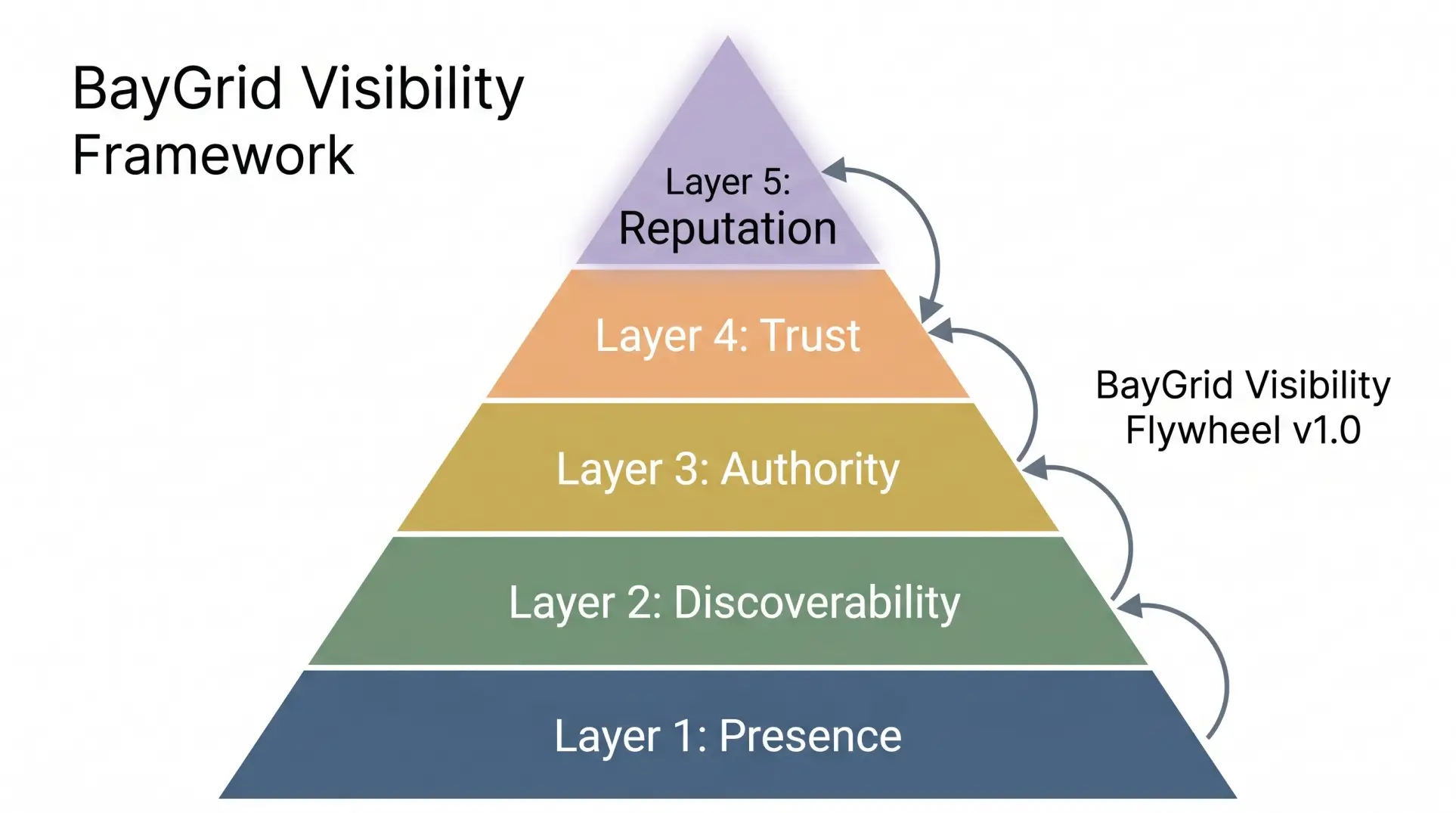
Abstract. This paper examines the emergence of artificial intelligence systems as a transformative layer within hospitality visibility infrastructure. Drawing on the BayGrid Visibility Infrastructure Framework v1.0, this analysis investigates how AI systems are reshaping the pathways through which consumers discover hospitality information, and what this transformation means for the structure and function of visibility infrastructure as a whole. The analysis extends the BayGrid Information Flow Model v1.0 to account for AI synthesis as a distinct stage in the information flow process. The findings indicate that AI systems constitute a fifth infrastructure layer — distinct from web, search, content and relationship infrastructure — that fundamentally alters how hospitality information is synthesised, presented and consumed. The paper discusses implications for brands, publishers, consumers and the broader hospitality visibility ecosystem, and identifies areas requiring continued observation as this rapidly evolving field develops.
1. Executive Summary
Artificial intelligence systems are transforming how consumers discover hospitality information. AI-powered search interfaces, conversational recommendation systems and algorithmic content synthesis are shifting discovery from a link-based, query-response model to a conversational, synthesis-response model in which AI systems generate direct answers to hospitality queries rather than presenting lists of sources for consumers to evaluate.
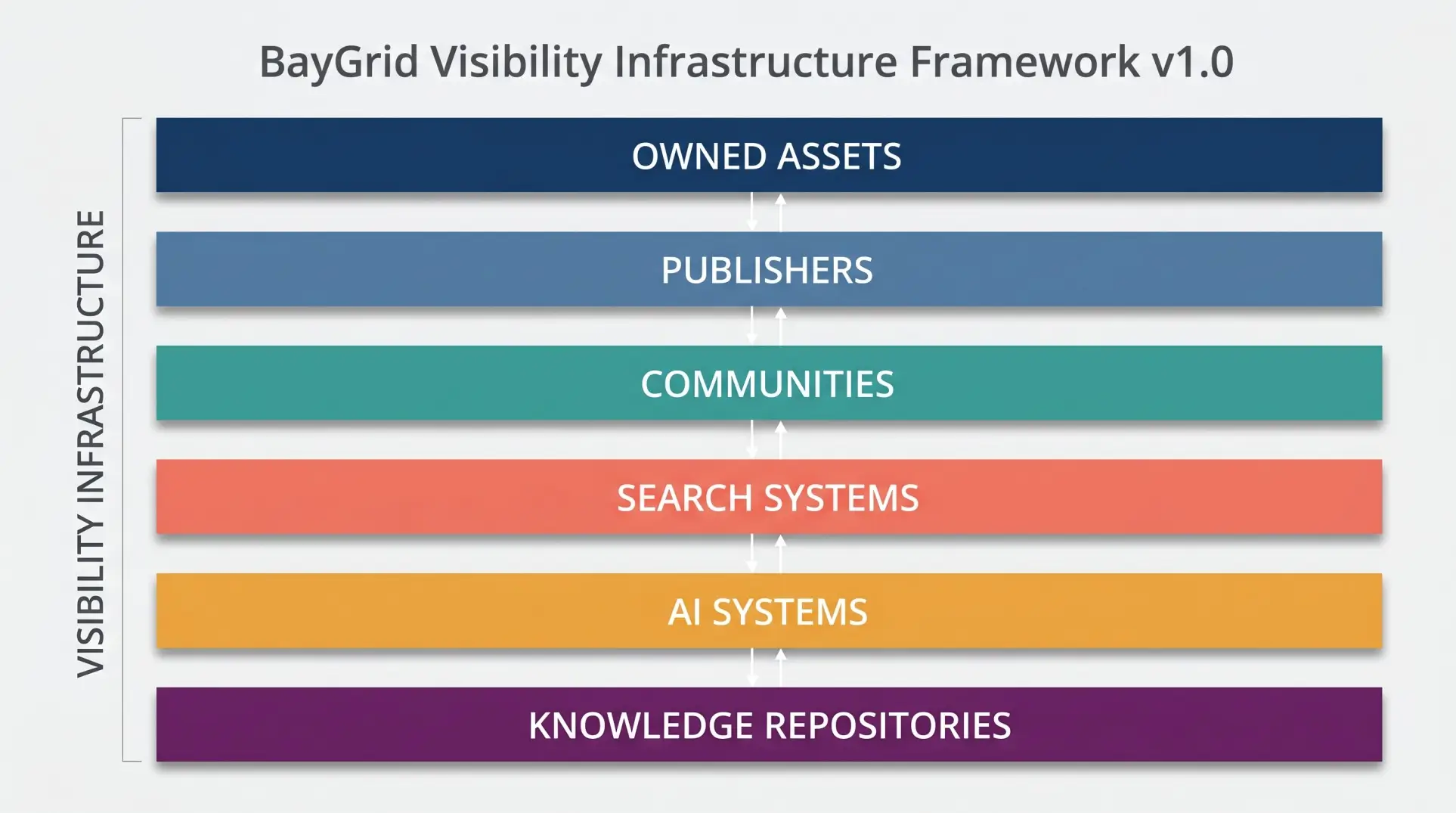
This transformation has significant implications for hospitality visibility infrastructure — the systems, platforms, protocols and standards that enable hospitality information to be created, published, discovered and consumed. Under BayGrid Standard 7: Visibility Infrastructure, visibility infrastructure encompasses four layers: web infrastructure, search infrastructure, content infrastructure and relationship infrastructure. This analysis examines the case for recognising AI systems as a fifth infrastructure layer that synthesises outputs from the other four to produce discovery experiences.
The analysis identifies three key developments: AI systems are increasingly functioning as the primary interface between consumers and hospitality information; AI-generated summaries are altering the balance between original content and synthesised content in the information ecosystem; and AI recommendations are introducing new intermediaries between hospitality brands and potential guests. These developments suggest that visibility infrastructure is undergoing a structural transformation comparable to the shift from directory-based to search-based discovery in the early 2000s.
This paper contributes an analytical framework for understanding AI systems as infrastructure rather than as tools or platforms, and examines the implications of this reframing for hospitality visibility research and practice.
2. Research Question
This analysis addresses the following research question: How are AI systems transforming hospitality discovery, and what does this mean for visibility infrastructure?
This question is approached through three subsidiary inquiries:
- How do AI systems currently function as discovery engines for hospitality information?
- How does the emergence of AI systems as discovery interfaces reshape the existing visibility infrastructure model?
- What are the implications of AI-mediated discovery for how hospitality brands achieve and maintain visibility?
2.1 Scope
This analysis includes: AI systems as a new infrastructure layer within visibility infrastructure; how AI systems discover, synthesise and present hospitality information; the impact of AI-mediated discovery on traditional search systems; AI-generated summaries and recommendations as forms of hospitality information; and implications for hospitality brands seeking visibility.
This analysis excludes: technical AI implementation details; large language model training methodologies and data pipeline specifics; and tactical advice for specific AI platforms.
The analysis operates under the assumption that AI systems represent a fundamental shift in how discovery occurs, and that visibility infrastructure must adapt to account for this shift. The limitations of this analysis include the rapidly evolving nature of the field — AI capabilities, market structures and user behaviours are changing quickly, and this analysis captures the current state of development rather than predicting future trajectories.
3. Context
3.1 The Evolution of Hospitality Discovery
Hospitality discovery has evolved through several distinct phases. In the pre-digital era, discovery occurred primarily through personal networks, print media and physical presence — consumers learned about dining and travel options through recommendations from acquaintances, guidebook reviews and proximity.
The first digital transformation introduced web-based discovery through restaurant websites, online directories and early review platforms. Consumers could now discover hospitality options through search engines and dedicated platforms, though the discovery process remained largely self-directed — consumers navigated to sources, evaluated lists of options, and made selections based on their own assessment of available information.
The second digital transformation introduced algorithmic mediation through search engine ranking, recommendation algorithms and social media feeds. Discovery became increasingly shaped by algorithmic systems that determined which information received prominence. However, consumers still navigated through lists of results, links and recommendations — the fundamental unit of discovery remained the link to a source.
The current transformation, driven by AI systems, is introducing a third phase: conversational discovery in which AI systems synthesise information from multiple sources and present direct answers, recommendations and summaries rather than lists of links. This phase represents a qualitative shift in the discovery experience and, consequently, in the infrastructure that supports it.
3.2 Defining Discovery in the Hospitality Context
Under BayGrid Standard 2: Discoverability, discoverability is defined as “the capacity of hospitality information to be found by those seeking it.” Discovery, in turn, is the actualisation of discoverability — the moment at which a consumer encounters information about a hospitality option.
This distinction is important for the analysis that follows. AI systems affect both discoverability (whether information can be found) and discovery (whether information is encountered), but they do so through mechanisms that differ from those of traditional search infrastructure. Understanding these mechanisms requires examining how AI systems process, synthesise and present hospitality information.
4. Key Concepts
4.1 AI Systems as Discovery Engines
This paper uses the term “discovery engine” to describe AI systems that function as primary interfaces through which consumers encounter hospitality information. Discovery engines differ from search engines in several important respects:
| Dimension | Search Engine | AI Discovery Engine |
|---|---|---|
| Response type | List of links to sources | Synthesised answer or recommendation |
| User interaction model | Query → results → click → source | Query → synthesis → (optional follow-up) |
| Information unit | Indexed web page | Training data + retrieved context |
| Source attribution | Direct link to source | Embedded or summarised attribution |
| Consumer effort | Evaluate and select from results | Receive and evaluate synthesis |
| Discovery pathway | Multiple sources per query | Often single response per query |
This comparison reveals that AI discovery engines consolidate the discovery pathway. Where search engines present multiple sources for consumer evaluation, AI discovery engines often present a single synthesised response. This consolidation has significant implications for visibility: being included in a synthesis is different from being included in a list of search results, and the criteria for inclusion may differ.
4.2 Visibility Infrastructure: The Four-Layer Model
The BayGrid Visibility Infrastructure Framework v1.0 identifies four layers of visibility infrastructure:
Layer 1: Web Infrastructure — The technical foundation of the web, including protocols (HTTP, HTTPS), domain systems, hosting infrastructure and web standards. This layer enables information to exist in web-accessible formats.
Layer 2: Search Infrastructure — The systems that index, rank and present web content, including general search engines, specialised search platforms and map-based discovery tools. This layer enables information to be found through query-based navigation.
Layer 3: Content Infrastructure — The platforms, formats and standards through which hospitality content is created and published, including content management systems, review platforms, social media platforms and structured data formats. This layer enables information to be produced in discoverable formats.
Layer 4: Relationship Infrastructure — The networks, protocols and social systems through which hospitality information flows through trusted channels, including professional networks, community platforms, influencer relationships and word-of-mouth pathways. This layer enables information to flow through socially validated channels.
This four-layer model provides the foundation for examining where AI systems fit within visibility infrastructure.
4.3 AI Systems as Layer 5
This analysis proposes that AI systems function as a fifth layer within visibility infrastructure — a synthesis layer that operates above the existing four layers. This proposition is developed through the analysis that follows.

5. Analysis
5.1 How AI Systems Discover Hospitality Information
AI systems discover hospitality information through two primary mechanisms: training data ingestion and real-time retrieval.
Training data ingestion occurs during the development phase of large language models, when models are trained on vast corpora of text that include hospitality content — restaurant reviews, travel articles, food blogs, guidebook entries, menu descriptions and social media posts. Through this training, AI systems develop parametric knowledge of hospitality entities, concepts, relationships and evaluative patterns. This knowledge enables AI systems to generate responses about hospitality topics even without real-time access to current information.
Real-time retrieval occurs when AI systems, particularly those operating in retrieval-augmented generation (RAG) modes, access current information from the web or specialised databases in response to specific queries. This mechanism enables AI systems to incorporate current information — recent reviews, updated hours, current menus — into their responses.
The combination of these mechanisms means that AI systems draw on hospitality information from all four underlying infrastructure layers: web infrastructure (accessing web content), search infrastructure (using search tools for retrieval), content infrastructure (processing content from platforms and structured data), and relationship infrastructure (incorporating signals of trust and authority that emerge from network structures).
This multi-layer drawing is what distinguishes AI systems as a synthesis layer rather than simply another application running on existing infrastructure. AI systems do not operate within a single infrastructure layer; they integrate across all layers to produce outputs that are distinct from the inputs of any individual layer.
5.2 How AI Systems Present Hospitality Information
AI systems present hospitality information through several formats that differ from traditional search results:
Synthesised summaries combine information from multiple sources into coherent narratives. When a consumer asks about dining options in a particular area, an AI system may synthesise information from review platforms, food blogs, guidebooks and social media into a summary that mentions specific establishments with supporting context.
Direct recommendations provide specific suggestions without requiring the consumer to evaluate multiple options. An AI system may recommend a particular restaurant based on the consumer’s stated preferences, synthesising its knowledge of available options to produce a single suggestion.
Conversational exploration enables consumers to refine their queries through follow-up questions, allowing for iterative discovery. A consumer may ask about Japanese dining options, then refine by price range, then by atmosphere, with the AI system adjusting its responses based on the evolving conversation.
Comparative analyses present structured comparisons between hospitality options, drawing on multiple information sources to highlight differences across dimensions that the consumer specifies.
These presentation formats share a common characteristic: they reduce the cognitive load on consumers by pre-processing and synthesising information that consumers would otherwise need to evaluate themselves. This reduction in cognitive load is a primary driver of AI system adoption for hospitality discovery.
5.3 Impact on Traditional Search
The emergence of AI systems as discovery engines is reshaping the role of traditional search infrastructure. This impact manifests in several ways:
Interface integration: AI systems are being integrated into search interfaces, appearing as “AI overviews,” “featured snippets on synthesis” or conversational search modes. This integration blurs the boundary between search and AI-mediated discovery, with AI responses appearing alongside or above traditional search results.
Query redistribution: Some hospitality queries that would previously have been addressed through traditional search are now being directed to AI interfaces. Complex, conversational and recommendation-seeking queries appear particularly susceptible to this redistribution.
Source attribution changes: When AI systems synthesise information, the link between consumer and original source is attenuated. Consumers may receive information about a restaurant without visiting the restaurant’s website, reading the original review or viewing the source platform. This attenuation has implications for how visibility translates into traffic and engagement.
Ranking logic shifts: The criteria that determine which establishments appear in AI-generated responses may differ from traditional search ranking factors. While search engines rank based on relevance, authority and user signals, AI systems may additionally consider semantic fit with the query, diversity of recommendations, training data prominence and real-time retrieval quality.
The evidence regarding the extent of this impact is still emerging. Search remains a dominant discovery channel for hospitality information, and AI-mediated discovery is currently most prevalent for specific query types. However, the direction of change suggests increasing AI system prominence in hospitality discovery over time.
5.4 AI-Generated Summaries and Recommendations
AI-generated summaries and recommendations represent a new form of hospitality information in the ecosystem. Unlike original content (produced by brands, publishers or communities) or indexed content (organised by search systems), AI-generated content is synthesised from existing sources through algorithmic processes.
This synthesis introduces several characteristics that distinguish AI-generated hospitality information:
Source blending: AI summaries blend information from multiple sources into unified narratives, making it difficult for consumers to distinguish which information came from which source. A restaurant description may combine the brand’s own description with reviewer observations and publisher commentary without clear demarcation.
Temporal compression: AI systems may combine information from different time periods, presenting current and outdated information together without clear temporal markers. A synthesis may include a recent review alongside older commentary without distinguishing their relative freshness.
Evaluative summarisation: AI systems summarise evaluative content (reviews, ratings, criticisms) into aggregate assessments that may lose the nuance of individual evaluations. A restaurant with polarised reviews — some strongly positive, some strongly negative — may be summarised as “mixed reviews,” losing the specific information that would help consumers determine whether the restaurant suits their preferences.
Absence signalling: AI systems may not clearly signal when information is absent. If an AI system has limited information about a particular establishment, it may simply not mention that establishment or may provide a generic description without signalling the information gap.
These characteristics suggest that AI-generated hospitality information, while offering convenience and synthesis capabilities, also introduces information quality considerations that the ecosystem has not yet fully addressed.
6. Framework Application
6.1 Extending the Visibility Infrastructure Framework
The analysis suggests that AI systems should be understood as a fifth layer within the BayGrid Visibility Infrastructure Framework v1.0. This positioning is justified by three observations:
First, AI systems meet the definitional criteria for infrastructure under BayGrid Standard 7: Visibility Infrastructure. They are systems that enable hospitality information to be discovered and consumed. They are not merely applications that run on existing infrastructure; they constitute a distinct layer with unique functional characteristics.
Second, AI systems draw inputs from all four existing infrastructure layers and produce outputs that are distinct from the outputs of any individual layer. This cross-layer integration is characteristic of infrastructure layers rather than infrastructure applications.
Third, AI systems are becoming embedded in the discovery process in ways that make them difficult to bypass. As AI capabilities are integrated into search interfaces, operating systems and consumer applications, AI-mediated synthesis is increasingly becoming the default mode through which consumers encounter hospitality information.
The proposed Layer 5 — AI Systems — is characterised as the synthesis layer. Its function is to integrate, synthesise and present information from the underlying layers in forms that reduce consumer cognitive load and enable conversational discovery.
6.2 Extending the Information Flow Model
The BayGrid Information Flow Model v1.0 identifies six stages through which information flows: creation, publication, distribution, discovery, reinforcement and interpretation. The emergence of AI systems as discovery engines suggests that this model should be extended to account for AI synthesis as a distinct intervening stage.

In the extended model, AI synthesis operates between distribution and discovery. Information that has been created, published and distributed enters the AI synthesis stage, where AI systems process, combine and re-present it. The output of AI synthesis is what consumers encounter at the discovery stage.
This intervention is significant because AI synthesis is not a transparent passthrough. Information is transformed at the synthesis stage — compressed, combined, rephrased and recontextualised. The information that reaches discovery through AI synthesis is substantively different from the information that would reach discovery through direct distribution.
The extended model preserves the legacy path from distribution directly to discovery for contexts in which AI mediation is not involved. Consumers still encounter hospitality information through traditional search results, direct website visits, social media posts and word-of-mouth recommendations. However, the AI-mediated path represents an increasingly significant alternative pathway.
6.3 Implications for the Hospitality Visibility Standard
Under BayGrid Standard 1: Hospitality Visibility, visibility is “the state of being findable, recognisable and present within the information environments that hospitality consumers inhabit.” The emergence of AI systems as discovery engines requires extending this definition to account for the specific information environments created by AI systems.
Being “findable” in an AI-mediated environment means being included in AI-generated responses to relevant queries. Being “recognisable” means being accurately represented in AI syntheses. Being “present” means appearing in the information environments that consumers access through AI interfaces.
These are not identical to traditional visibility conditions. A brand may rank highly in search results but not appear in AI-generated summaries. A brand may have extensive published content that is not incorporated into AI training data or retrieval systems. The criteria for visibility in AI-mediated environments require separate analysis from traditional search visibility.
7. Implications
7.1 Implications for Brands
The emergence of AI systems as discovery engines has several implications for hospitality brands seeking visibility.
Information completeness becomes more important. AI systems draw on available information to generate syntheses. Brands with limited published information — sparse websites, few reviews, minimal publisher coverage — provide less material for AI systems to incorporate, potentially reducing their appearance in AI-generated responses. Conversely, brands with rich, structured information across multiple platforms provide more material for AI synthesis.
Source diversity matters. AI systems synthesise across sources. Brands that appear in diverse source types — professional reviews, community discussions, structured listings, social media mentions — are more likely to be included in AI syntheses than brands that appear in only one source type.
Information clarity and consistency support accurate synthesis. AI systems may struggle to synthesise conflicting or ambiguous information. Brands with clear, consistent information across platforms are more likely to be accurately represented in AI-generated content.
Direct consumer relationships may attenuate. As AI systems intermediate between consumers and brand information, the direct connection between consumer and brand website or channel may weaken. Consumers may receive sufficient information from AI summaries without visiting brand-owned properties.
It should be noted that these implications are analytical inferences rather than empirically demonstrated effects. The rapidly evolving nature of AI systems means that specific visibility dynamics are subject to change.
7.2 Implications for Publishers
Publishers face a complex set of implications from the emergence of AI systems as discovery engines.
On one hand, AI systems may increase the reach of publisher content by incorporating it into syntheses delivered to consumers who would not have visited the publisher’s platform directly. A restaurant review that is summarised in an AI response may reach a broader audience than the review would have reached through direct readership.
On the other hand, AI synthesis may reduce traffic to publisher platforms if consumers receive sufficient information from AI summaries without clicking through to original sources. The business models of many publishers depend on direct audience engagement, and AI-mediated discovery may attenuate this engagement.
Publisher attribution in AI syntheses is also a developing area. AI systems vary in how clearly they attribute information to source publishers, and the visibility of publisher brands within AI-generated content may differ from their visibility in traditional search results.
7.3 Implications for Consumers
For consumers, AI-mediated discovery offers both benefits and considerations.
The primary benefit is reduced cognitive load. Consumers can receive synthesised, relevant information without navigating multiple sources and evaluating multiple options. Complex discovery tasks — finding a suitable restaurant given multiple criteria — can be addressed through conversational interaction rather than iterative searching.
The primary consideration is information intermediation. When AI systems synthesise information, consumers receive pre-processed interpretations rather than direct access to original sources. The criteria that AI systems use to select, emphasise and omit information may not align with consumer preferences, and consumers may not have visibility into these criteria.
The balance between convenience and transparency in AI-mediated discovery is an area requiring continued observation and, potentially, framework development.
7.4 Implications for the Visibility Ecosystem
At the ecosystem level, the emergence of AI systems as discovery engines introduces several structural considerations.
Concentration risk: AI-mediated discovery may increase concentration in visibility distribution. If AI systems tend to recommend the same subset of establishments across multiple queries, visibility may concentrate among those establishments while others become marginalised. The extent of this concentration depends on how AI systems handle diversity and coverage in their recommendations.
Information feedback loops: AI systems that train on web content and then generate content that is published to the web create feedback loops in which AI-generated information increasingly appears in the training data for subsequent AI systems. These feedback loops have implications for information diversity and quality that are not yet fully understood.
Infrastructure dependency: As AI systems become embedded in discovery infrastructure, the hospitality visibility ecosystem becomes increasingly dependent on a small number of AI system providers. This concentration of infrastructure control raises questions about governance, accountability and the ability of ecosystem participants to influence how visibility is distributed.
8. The Information Flow Model: AI System Stage
8.1 Characterising the AI Synthesis Stage
The AI synthesis stage, as proposed in the extended Information Flow Model, has distinct characteristics that differentiate it from other stages in the information flow process.
Multi-source input: Unlike publication (which processes single sources) or distribution (which channels existing content), AI synthesis draws simultaneously on multiple sources across multiple infrastructure layers. A single AI response may incorporate information from a brand website, a professional review, community ratings and structured data.
Transformational processing: AI synthesis does not merely transmit information; it transforms it. Source information is rephrased, combined, summarised and recontextualised. The output of AI synthesis is information that did not exist prior to the synthesis process.
Non-deterministic output: AI synthesis outputs are not deterministic — the same query may produce different responses at different times based on model updates, retrieval results and contextual factors. This non-determinism introduces variability into the discovery process that differs from the relative stability of search rankings.
Opaque criteria: The criteria that AI systems use to select, emphasise and omit information are not fully transparent. Unlike search ranking algorithms, which have been extensively studied and partially documented, AI synthesis criteria are less well understood due to the complexity of large language model behaviour.
8.2 Interactions with Other Stages
The AI synthesis stage interacts with other information flow stages in several ways:
AI synthesis draws primarily from the distribution stage — information that has already been published and made available through web, search and content infrastructure. However, AI systems also draw on information that may not have passed through traditional distribution channels, such as information embedded in training data from sources that are no longer publicly available.
AI synthesis feeds into the discovery stage by providing the information that consumers encounter. In the extended model, discovery is increasingly AI-mediated — what consumers discover is not original content but AI-synthesised representations of original content.
AI synthesis also has feedback effects on earlier stages. AI-generated content that is published to the web enters the information ecosystem as new content that can be indexed, distributed and synthesised again. This feedback loop means that AI synthesis both consumes and produces information within the ecosystem.
9. Future Outlook
9.1 Evolution of AI Discovery Capabilities
AI discovery capabilities are evolving rapidly. Current systems primarily synthesise text-based information; emerging capabilities include image understanding, video analysis, real-time information integration and multimodal responses that combine text, image and structured data.
For hospitality discovery specifically, these evolving capabilities suggest several potential developments: AI systems that can analyse restaurant ambiance from photographs, AI systems that can integrate real-time wait time and availability data, AI systems that can generate personalised recommendations based on detailed preference profiles, and AI systems that can facilitate direct booking and reservation actions within conversational interfaces.
The pace of these developments is uncertain and depends on technical progress, market dynamics and regulatory developments. However, the direction of evolution suggests increasing AI system sophistication in hospitality discovery applications.
9.2 Visibility Infrastructure Adaptation
Visibility infrastructure will need to adapt to account for AI-mediated discovery. This adaptation may include:
Structured data evolution: Structured data formats that enable AI systems to understand hospitality information may become increasingly important. Schema.org and similar standards may evolve to better support AI system comprehension.
Information provenance standards: Standards for indicating the provenance, timeliness and reliability of hospitality information may become important for enabling AI systems to make appropriate synthesis decisions.
Publisher-AI relationships: New relationships between publishers and AI system providers may emerge, potentially including licensing arrangements, attribution standards and content access agreements.
9.3 Areas for Continued Observation
This analysis identifies several areas requiring continued observation as AI-mediated discovery evolves:
- How AI system recommendation patterns affect visibility distribution across the hospitality ecosystem
- How consumer behaviour changes as AI-mediated discovery becomes more prevalent
- How publisher business models adapt to AI-mediated content distribution
- How regulatory developments affect AI system operation in the discovery space
- How the balance between AI-mediated and traditional discovery shifts over time
10. Conclusion
This analysis has examined the emergence of AI systems as discovery engines for hospitality information and investigated the implications for visibility infrastructure. The key findings are that AI systems constitute a fifth infrastructure layer — a synthesis layer — within the BayGrid Visibility Infrastructure Framework v1.0; that AI-mediated discovery represents a qualitative shift from link-based search to conversational synthesis; and that the information flow model should be extended to account for AI synthesis as a distinct intervening stage between distribution and discovery.
The transformation of discovery by AI systems is not merely an incremental improvement to existing search infrastructure. It represents a structural change in how consumers encounter hospitality information, how brands achieve visibility, and how the hospitality visibility ecosystem functions. Under BayGrid Standard 2: Discoverability, discoverability is the capacity of hospitality information to be found. AI systems are redefining what it means for information to be “found” — shifting from the presentation of sources for consumer evaluation to the generation of synthesised responses that reduce consumer effort.
This transformation brings both capabilities and considerations. AI systems offer the potential for more efficient, conversational and personalised discovery experiences. They also introduce questions about information quality, source attribution, visibility distribution and infrastructure governance that the hospitality visibility ecosystem has not yet fully addressed.
The framework presented in this paper — understanding AI systems as Layer 5 of visibility infrastructure and AI synthesis as a distinct stage in information flow — provides a foundation for continued analysis of this rapidly evolving field. As AI capabilities advance and consumer adoption increases, the structural role of AI systems in hospitality discovery will become clearer. What is already evident is that hospitality visibility can no longer be adequately understood without accounting for the role of AI systems as discovery engines.
“AI systems are not merely tools that operate within visibility infrastructure. They are becoming part of the infrastructure itself — a synthesis layer that reshapes how information flows from brands and publishers to consumers. Understanding this layer is essential for understanding hospitality visibility in the years ahead.”
The analysis presented here is necessarily preliminary. AI systems are evolving rapidly, and the specific mechanisms of AI-mediated discovery will change as technologies, markets and behaviours develop. However, the structural insight — that AI systems constitute a distinct infrastructure layer with unique functional characteristics — is likely to remain valid regardless of specific technical implementations. The hospitality visibility ecosystem is entering a new phase, and visibility infrastructure must evolve to account for it.
Related Standards
- BayGrid Standard 7: Visibility Infrastructure
- BayGrid Standard 2: Discoverability
- BayGrid Standard 1: Hospitality Visibility
References
- BayGrid Research Initiative. (2025). BayGrid Visibility Infrastructure Framework v1.0. BayGrid Framework Library.
- BayGrid Research Initiative. (2025). BayGrid Information Flow Model v1.0. BayGrid Framework Library.
- BayGrid Research Initiative. (2025). BayGrid Standard 7: Visibility Infrastructure. BayGrid Standards Repository.
- BayGrid Research Initiative. (2025). BayGrid Standard 2: Discoverability. BayGrid Standards Repository.
- BayGrid Research Initiative. (2025). BayGrid Standard 1: Hospitality Visibility. BayGrid Standards Repository.
- Google. (2024). Search Quality Rater Guidelines: An Update on AI-Generated Content. Google LLC. Retrieved from https://www.google.com/searchquality-rater-guidelines
- Microsoft. (2024). Bing Search: AI-Powered Search Experience Documentation. Microsoft Corporation. Retrieved from https://blogs.microsoft.com/blog/2024/
- OpenAI. (2024). GPT-4 Technical Report: Information Retrieval and Synthesis Capabilities. OpenAI. Retrieved from https://openai.com/research
- Stanford HAI. (2024). Artificial Intelligence Index Report 2024: Consumer Applications. Stanford University. Retrieved from https://hai.stanford.edu/ai-index-report
- Zuboff, S. (2019). The Age of Surveillance Capitalism. PublicAffairs.