BayGrid Standard 7
Visibility Infrastructure is the systems and relationships enabling information distribution and discovery.
Standard Name
Visibility Infrastructure — the systems and relationships enabling information distribution and discovery.
Definition
Visibility Infrastructure comprises the interconnected systems, platforms, relationships, and knowledge repositories through which information about hospitality entities is created, distributed, discovered, and consumed. This infrastructure is not limited to any single technology, channel, or platform. Rather, it describes the composite architecture of relationships and systems that collectively determine whether, when, and how information reaches its intended audiences.
The BayGrid definition distinguishes between infrastructure and channels. A channel is a single pathway through which information travels — a website, a social media platform, a review site. Infrastructure is the composite system of multiple channels, the relationships between them, the mechanisms by which information moves among them, and the repositories where information accumulates. A channel can be owned or operated by a single entity. Infrastructure is always a multi-entity system.
Visibility does not emerge from the performance of individual channels. It emerges from the functioning of the infrastructure as a whole.
Scope
Inclusions
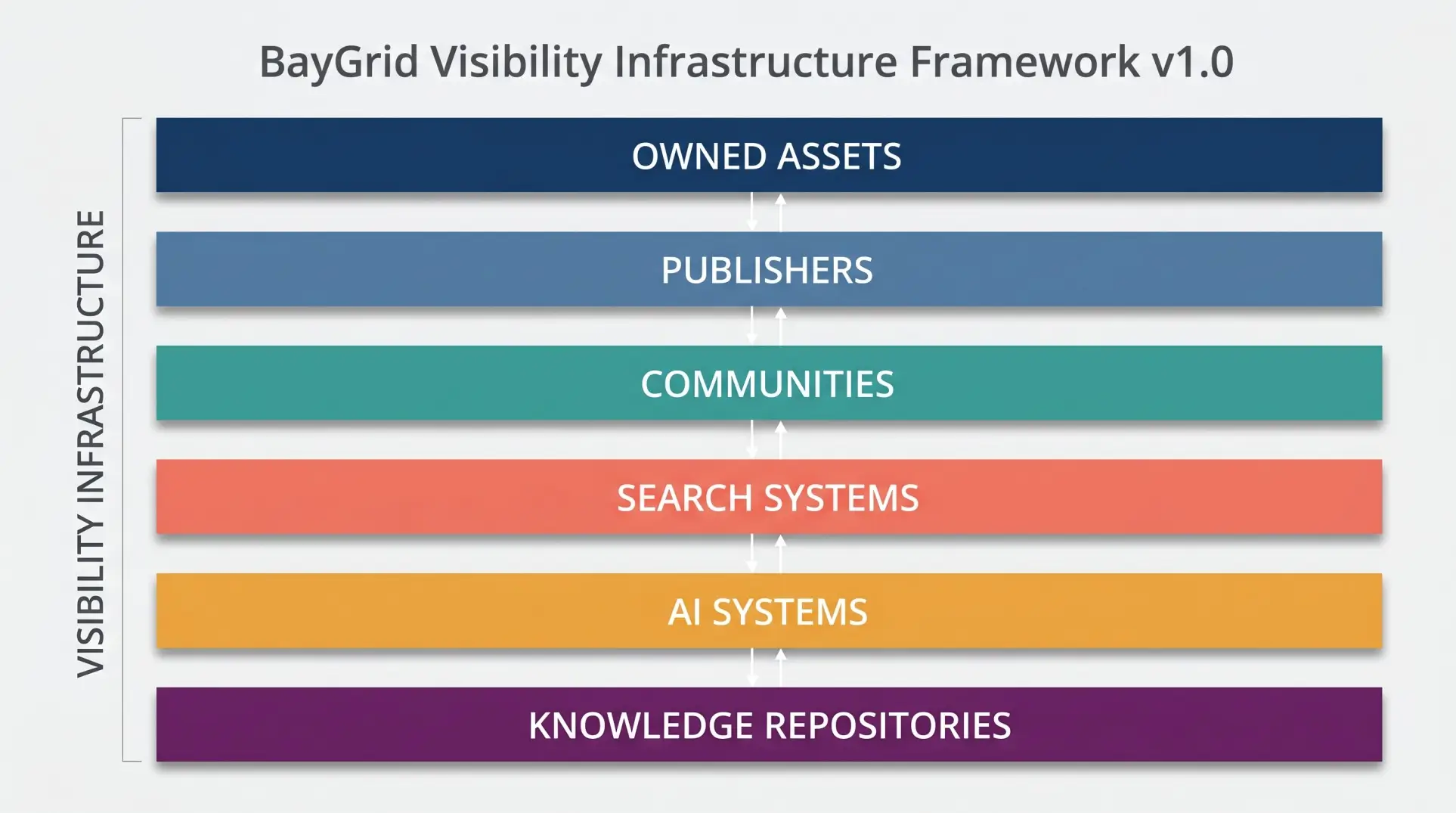
- The six-layer visibility infrastructure model: Owned Assets, Publishers, Communities, Search Systems, AI Systems, and Knowledge Repositories
- The relationships and information flows between infrastructure layers
- The role of each layer in enabling or constraining visibility
- The mechanisms by which information is distributed across and between layers
- The function of knowledge repositories as infrastructure endpoints
Exclusions
- Technical implementation guides for specific platforms or technologies
- Platform-specific setup instructions or configuration procedures
- IT infrastructure advice unrelated to information distribution and discovery
- Hardware, networking, or systems administration guidance
Assumptions
- Visibility is supported by infrastructure, not individual channels operating in isolation
- The six-layer model is descriptive, not prescriptive — it describes how infrastructure functions, not how it must be built
- All six layers exist in every functioning visibility infrastructure, though their relative importance varies by context
Limitations
- This standard does not assess specific infrastructure technologies or vendor solutions
- The model is a conceptual framework; it does not provide technical specifications
- Infrastructure configurations vary significantly across contexts, industries, and geographies
- The standard describes current infrastructure architecture; emerging technologies may introduce new layers or relationships
Key Principles
Principle 1: Infrastructure Is Layered
The BayGrid Visibility Infrastructure Framework v1.0 identifies six distinct layers of visibility infrastructure. These layers are not arbitrary divisions. Each represents a functionally distinct category of system with characteristic information behaviours, relationship patterns, and discovery mechanisms.
| Layer | Function | Information Role |
|---|---|---|
| Owned Assets | Properties, websites, and channels controlled by the hospitality entity | Primary information creation and controlled distribution |
| Publishers | Editorial platforms, media outlets, guide producers, and content publishers | Curated information amplification and authority transfer |
| Communities | User-generated content platforms, forums, social networks, and review aggregators | Social information validation and peer-generated discovery |
| Search Systems | Search engines, discovery platforms, and algorithmic indexing systems | Information organisation, ranking, and query-based retrieval |
| AI Systems | Large language models, recommendation engines, and AI-assisted discovery tools | Synthesised information delivery and conversational discovery |
| Knowledge Repositories | Structured knowledge bases, encyclopaedic platforms, and persistent information stores | Long-term information persistence and authoritative reference |
Principle 2: Information Flows Bidirectionally
The BayGrid Information Flow Model v1.0 describes information as moving in both directions across infrastructure layers. Information does not travel in a single direction from source to consumer. It circulates. Owned Assets supply information to Publishers, which redistribute it to Communities, which generate new information that flows back through Search Systems and AI Systems to Knowledge Repositories, which in turn supply reference information to all other layers.
This bidirectional flow has important implications for visibility management. Actions at any layer affect conditions at every other layer. A change in how Search Systems index information will alter how AI Systems retrieve and present that information. New content in Knowledge Repositories can influence the outputs of both Search Systems and AI Systems.
Principle 3: Visibility Is a System-Level Property
Visibility emerges from the functioning of the infrastructure as an integrated system. No single layer determines visibility. A hospitality entity may possess well-developed Owned Assets and still achieve limited visibility if its information does not reach Publishers, Communities, Search Systems, AI Systems, or Knowledge Repositories. Conversely, an entity with modest Owned Assets may achieve significant visibility if its information is well-distributed across the infrastructure.
This principle aligns with BayGrid Standard 1: Hospitality Visibility, which defines visibility as the capacity of a hospitality entity to be found by audiences actively seeking relevant offerings. That capacity is not a property of any single channel. It is a property of the infrastructure.
Principle 4: Infrastructure Has a Temporal Dimension
Information in the infrastructure operates on different time scales. Content in Owned Assets can be updated immediately. Content in Publishers may persist for weeks, months, or years depending on editorial cycles. Content in Knowledge Repositories may persist indefinitely. These temporal differences matter because they determine how quickly information changes propagate through the infrastructure and how long incorrect or outdated information continues to influence visibility.
Examples
Example 1: Full Infrastructure Functioning
A boutique hotel maintains a well-structured website (Owned Assets), receives coverage in a regional travel guide (Publishers), accumulates reviews on multiple platforms (Communities), appears in search results for relevant queries (Search Systems), is referenced by AI assistants when users ask for boutique hotel recommendations (AI Systems), and has a maintained presence in structured hospitality databases (Knowledge Repositories). In this configuration, information about the hotel is created, amplified, validated, retrieved, synthesised, and persistently stored. The infrastructure is functioning.
Example 2: Layer Disconnection
A restaurant updates its menu and hours on its website (Owned Assets) but does not inform Publishers, does not update its listings in community platforms, and has no presence in structured knowledge repositories. Search Systems continue to index outdated information. AI Systems, drawing from outdated training data and knowledge repositories, provide incorrect information. The infrastructure is partially disconnected. The restaurant has performed an action at one layer but has not enabled that information to flow to other layers.
Example 3: Asymmetric Information Flow
A hospitality group receives significant community attention through a viral social media discussion (Communities). This attention generates publisher coverage (Publishers) and increases search interest (Search Systems). However, the group’s Owned Assets do not reflect the current conversation, and no structured knowledge repository has been updated. The information flow is asymmetric — it moves strongly from Communities to Publishers to Search Systems but does not connect back to Owned Assets or Knowledge Repositories. This asymmetry limits the group’s ability to capture and sustain the visibility generated.
Common Misconceptions
| Misconception | Correction |
|---|---|
| “Visibility infrastructure means having a website and social media accounts.” | Owned Assets are one layer of six. Infrastructure requires functioning relationships across all layers. |
| “If we optimise for search engines, we cover the infrastructure.” | Search Systems are one layer. AI Systems increasingly operate independently of traditional search indexing, and Knowledge Repositories provide reference information that AI Systems draw upon directly. |
| “Visibility is determined by what we publish.” | Visibility is determined by how information flows through the infrastructure, not by what is published at the origin. Information that does not flow beyond Owned Assets achieves limited visibility. |
| “Infrastructure is primarily technical.” | Infrastructure is relational. The relationships between layers — how information moves from Publishers to Communities, how Search Systems index Publisher content, how AI Systems synthesise community sentiment — are as important as the technical properties of any single system. |
| “We can control our visibility infrastructure.” | Entities control their Owned Assets. They influence but do not control Publishers, Communities, Search Systems, AI Systems, or Knowledge Repositories. Infrastructure management is influence across a system, not control of a system. |
Framework Application
This standard applies two BayGrid frameworks:
BayGrid Visibility Infrastructure Framework v1.0
The six-layer model described in this standard is the core architecture of the Visibility Infrastructure Framework. The framework provides a diagnostic tool for assessing infrastructure completeness. By examining each layer and the information flows between them, analysts can identify disconnections, asymmetries, and underdeveloped connections. The framework is descriptive — it does not prescribe specific actions but reveals where infrastructure is not functioning.
BayGrid Information Flow Model v1.0
The Information Flow Model describes the mechanics by which information moves across infrastructure layers. It identifies four flow types: direct distribution (Owned Assets to Publishers), social amplification (Publishers to Communities), algorithmic retrieval (Communities and Publishers to Search Systems), synthesised delivery (Knowledge Repositories to AI Systems), and persistent storage (all layers to Knowledge Repositories). Understanding these flow types enables diagnostic analysis of infrastructure failures.
Implications
For Hospitality Entities
The infrastructure model suggests that visibility management requires attention to all six layers, not just Owned Assets. Entities that focus exclusively on their websites, social media accounts, and direct channels may achieve strong performance at one layer while remaining poorly connected to the broader infrastructure. The model implies a need for strategies that facilitate information flow beyond Owned Assets.
For Publishers
Publishers occupy a structurally significant position in the infrastructure. They sit between Owned Assets and Communities, and their content is heavily indexed by Search Systems and referenced by AI Systems. Publisher decisions about which entities to cover, how to structure information, and where to distribute content have amplified effects across the infrastructure.
For Analysts
The six-layer framework provides a consistent vocabulary and structural model for analysing visibility across contexts. Analysts can use the framework to compare infrastructure configurations, identify common failure patterns, and assess the completeness of visibility systems without requiring deep technical knowledge of specific platforms.
For the Field
The concept of visibility infrastructure shifts the field’s focus from channel optimisation to system architecture. It suggests that research into visibility must examine relationships between systems, not just performance within systems. This reframing has methodological implications for how visibility is studied, measured, and reported.
Standard Statement
Visibility Infrastructure, as defined by BayGrid Standard 7, is the systems and relationships enabling information distribution and discovery. It comprises six interdependent layers — Owned Assets, Publishers, Communities, Search Systems, AI Systems, and Knowledge Repositories — through which information flows bidirectionally. Visibility does not emerge from the performance of individual channels. It emerges from the functioning of the infrastructure as a whole. Any assessment of visibility that examines only one layer or one direction of information flow will produce incomplete and potentially misleading conclusions.
Conclusion
This standard has established a definition and structural model for Visibility Infrastructure. The six-layer framework provides a basis for analysis, diagnosis, and communication about the systems that enable visibility in hospitality contexts. The framework is not a technical specification. It is a conceptual architecture intended to support understanding of how information moves through the modern information environment.
The infrastructure model reveals that visibility is a system-level property. It cannot be achieved at a single layer or through a single channel. It requires functioning relationships across all six layers of the infrastructure, with bidirectional information flows that enable information to be created, distributed, validated, retrieved, synthesised, and persistently stored. The key question that this standard addresses — “What enables visibility?” — receives a structural answer: visibility is enabled by infrastructure.
Further research is needed to develop diagnostic methods for assessing infrastructure completeness, to characterise information flow patterns across different hospitality contexts, and to examine how emerging AI capabilities may restructure the relationships between infrastructure layers.
References
BayGrid Standards
- BayGrid Standard 1: Hospitality Visibility
- BayGrid Standard 2: Discoverability
- BayGrid Standard 13: Visibility Layer
BayGrid Frameworks
External References
- Lewandowski, D. (2019). Why We Need an Independent Index of the Web. Search Engine Watch. Retrieved from searchenginewatch.com
- Nielsen, J. (2023). The AI Revolution in Search: How Large Language Models Are Changing Information Retrieval. Nielsen Norman Group.
- Google. (2024). How Search Works. Google Search Central Documentation. Retrieved from developers.google.com/search/docs/fundamentals/how-search-works
- van Dijck, J. (2013). The Culture of Connectivity: A Critical History of Social Media. Oxford University Press.