Framework Paper
Executive Summary
This paper introduces the BayGrid Information Flow Model v1.0, a seven-stage descriptive framework that maps how information travels through hospitality visibility ecosystems. The model describes the path from original information sources through to derivative publications, identifying the transformations that occur at each stage and the feedback loops that create circular rather than linear flow patterns.
The analysis reveals that information rarely moves in a straight line. At each stage, information undergoes compression, indexing, synthesis, interpretation, amplification, or derivation — processes that add, remove, or alter meaning. Feedback loops cause information to re-enter the system at multiple points, compounding transformation effects and producing visibility outcomes that may diverge substantially from original source material.
The findings indicate that understanding information flow is essential for analysing hospitality visibility. Without a structured model of how information moves and transforms, visibility analysis treats outputs as isolated artefacts rather than as nodes within a dynamic system. This framework provides that structure.
Framework Overview
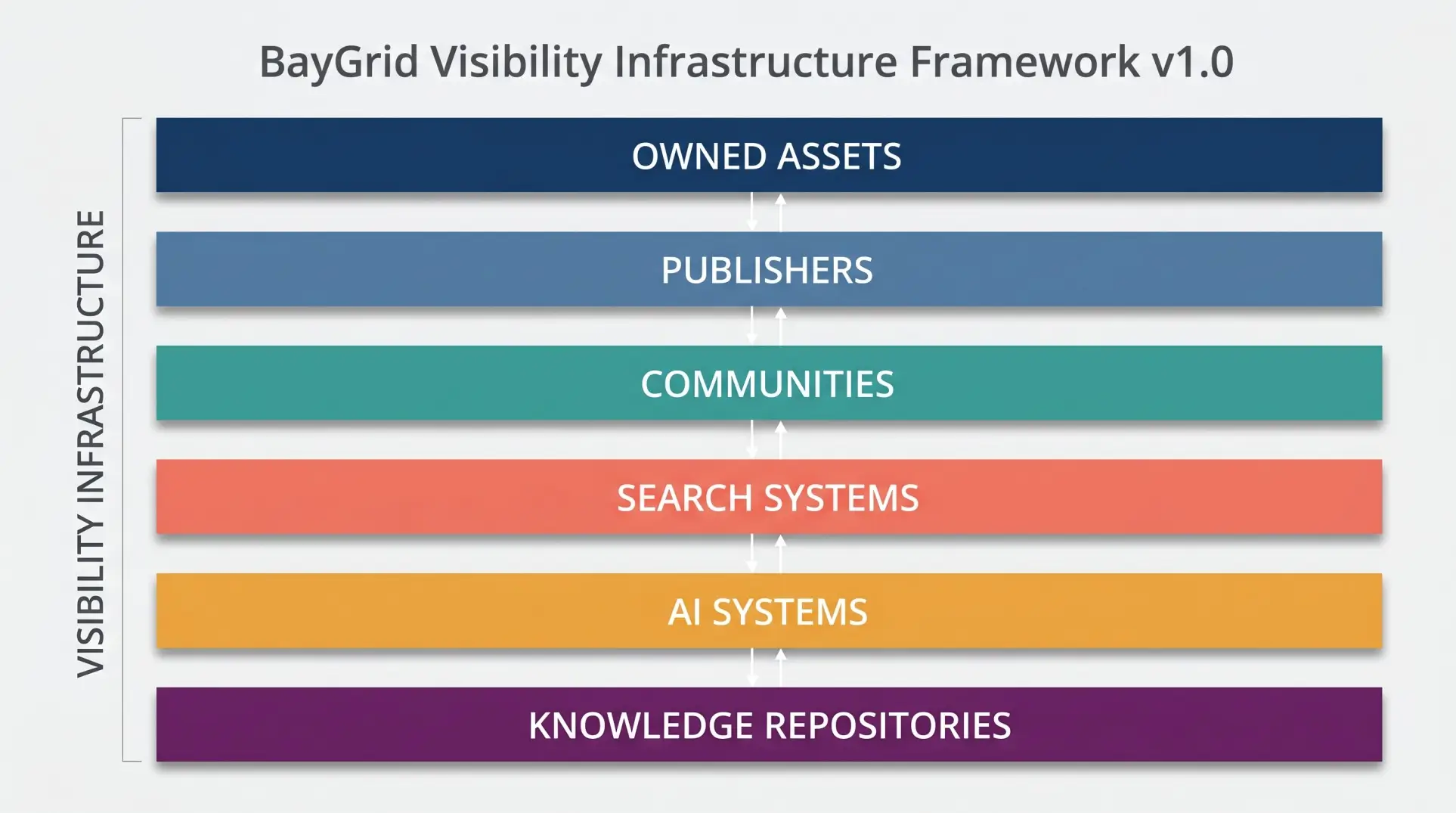
The BayGrid Visibility Infrastructure defines the systems, platforms, and mechanisms through which hospitality businesses become discoverable to potential customers. Within this infrastructure, information is the primary currency. Yet how that information moves — from its origin to its eventual consumption — has not been systematically described.
The BayGrid Information Flow Model fills this gap. It identifies seven stages through which hospitality information typically passes:
- Source — the original locus of information (the venue, event, experience, or entity itself)
- Publisher — the first external party to capture and publish information about the source
- Search System — indexing and ranking systems that organise published information
- AI System — artificial intelligence systems that synthesise, summarise, or generate responses from indexed information
- Consumer — the individual who encounters information through search, AI, or direct channels
- Community Discussion — forums, social platforms, review sites, and conversational spaces where consumers share interpretations
- Additional Publications — subsequent publications that cite, reference, or build upon earlier information
Importantly, the model is not strictly linear. Feedback loops connect later stages to earlier ones, creating circular patterns that cause information to circulate through the system multiple times before reaching equilibrium — if equilibrium is ever reached.

Problem Statement
Hospitality visibility analysis has historically focused on endpoints: what a consumer sees when they search, what a review says, what an AI system returns. This endpoint bias treats each output as an independent unit of analysis, disconnected from the processes that produced it.
This approach has significant limitations. An AI-generated summary of a restaurant may draw from a publisher’s article, which itself drew from the restaurant’s own descriptions, which were shaped by review platform categories, which were influenced by consumer expectations formed through earlier search experiences. To analyse only the AI summary — without understanding the chain of transformations that produced it — is to mistake the output for the origin.
The problem, stated simply, is this: information in hospitality visibility ecosystems does not move in a straight line, and analysis that assumes it does produces incomplete or misleading conclusions.
Several factors compound this problem:
- Multiple entry points: Consumers may encounter information at any stage — directly from a publisher, through search results, via an AI summary, or through community discussion. Each entry point presents a different version of the information.
- Transformation opacity: The changes that occur at each stage are often invisible to both consumers and analysts. An AI summary does not disclose which sources were weighted most heavily; a search ranking does not reveal which signals determined position.
- Feedback amplification: Information that circulates through feedback loops can become self-reinforcing. A highly-ranked article attracts more citations, which strengthens its ranking, which attracts more citations — a cycle that may have little relationship to the accuracy or completeness of the original information.
- Temporal drift: Information can become outdated at the source while remaining current in derivative forms. A restaurant may have changed its menu, but AI systems may continue to reference old descriptions.
These challenges motivated the development of the Information Flow Model as a tool for tracing, describing, and analysing information movement through hospitality visibility ecosystems.
Framework Components
The Seven Stages
Each stage in the Information Flow Model represents a distinct functional role in the information ecosystem. These are not always separate entities — a single organisation may fulfil multiple stages — but the functions remain analytically distinct.
Stage 1: Source
The source is the original locus of hospitality information: the physical venue, the event, the experience, or the service offering itself. Information at this stage is maximal — it includes every detail, nuance, and contextual factor that could theoretically be communicated. However, source-stage information is also unmediated: it exists in physical form and must be captured, described, or represented before it can travel.
Key characteristics of the source stage include: sensory richness (information exists across multiple sensory channels), temporal variability (the source changes over time), and representational gap (no description can fully capture the source itself). The source stage is the only stage where information exists independently of any representation.
Stage 2: Publisher
The publisher is the first external party to capture and publish information about the source. Publishers include professional critics, travel writers, food bloggers, review platforms, guidebook compilers, and the hospitality venues themselves when they publish their own descriptions.
The transformation that occurs at this stage is editorial compression. The publisher selects which aspects of the source to represent, which to omit, and how to frame what remains. This compression is not merely reduction — it is interpretation. The same venue might be described as “intimate” by one publisher and “cramped” by another, depending on editorial choices.
Publishers also apply categorisation schemes that shape how information is subsequently understood. A restaurant described as “fine dining” enters the information flow with different expectations attached than one described as “casual dining,” even if the physical venues are similar.
Stage 3: Search System
Search systems — including general search engines, specialised travel search platforms, and internal search on review sites — perform the transformation of algorithmic indexing. Published information is crawled, parsed, stored, and ranked according to system-specific criteria.
The critical transformation at this stage is not merely storage but positioning. Information that appears on the first page of search results receives qualitatively different attention than information on subsequent pages. Search systems thus function as gatekeepers: they do not create information, but they powerfully determine which information reaches consumers.
Search systems also apply structured data schemas that further transform how information is represented. A restaurant’s information may be displayed as a rich snippet, a knowledge panel, or a standard search result — each format presenting different information in different arrangements.
Stage 4: AI System
AI systems represent a relatively new but increasingly influential stage in the information flow. These systems — including large language models, conversational search interfaces, and recommendation engines — perform synthetic synthesis: they generate new information artefacts by combining, summarising, and reasoning across multiple indexed sources.
The transformation at this stage differs fundamentally from earlier stages. Where publishers compress and search systems index, AI systems generate. An AI response about a restaurant is not a direct quotation from any source; it is a newly constructed statement that may blend information from dozens of sources while citing none of them explicitly.
This generative capacity introduces both convergence and divergence effects. Convergence occurs when AI systems produce similar outputs across different query formulations, creating a perception of consensus where multiple sources may actually disagree. Divergence occurs when different AI systems, or the same system at different times, produce conflicting outputs based on different training data or synthesis patterns.
Stage 5: Consumer
The consumer performs cognitive interpretation — the process by which encountered information is understood, evaluated, and integrated into the consumer’s existing mental models. This stage is often overlooked in information flow analysis because it appears passive: the consumer receives information rather than producing it.
However, interpretation is itself a transformation. The same AI-generated summary may be read as authoritative by one consumer and suspicious by another, depending on the consumer’s prior experiences, trust frameworks, and information literacy. Consumers also bring their own information needs to the encounter: a consumer seeking a venue for a business dinner interprets information differently than one planning a casual outing.
Stage 6: Community Discussion
Community discussion platforms — including review sites, social media, travel forums, and messaging groups — enable social amplification of interpreted information. At this stage, individual interpretations become collective narratives as consumers share experiences, validate or challenge others’ accounts, and develop shared understandings of hospitality offerings.
The transformation at this stage is from individual to collective. A single negative experience, shared in a community forum, can become part of the collective understanding of a venue even if it is statistically unrepresentative. Conversely, sustained positive community discussion can establish a venue’s reputation independently of any professional publication.
Community discussion also introduces temporal layering. Older discussions remain visible and continue to influence consumer perceptions even when they no longer accurately describe the current state of the source. This temporal stickiness is a distinctive feature of community-stage information.
Stage 7: Additional Publications
The final stage in the primary flow is derivative publication — new publications that cite, reference, or build upon earlier information. These include round-up articles (“Ten Best Restaurants in [City]”), trend pieces that reference specific venues as examples, and subsequent reviews that respond to earlier coverage.
Derivative publications are significant because they re-enter the information flow as new inputs. A round-up article that cites an earlier review creates a new information object that search systems index, AI systems synthesise, and consumers encounter. This re-entry is the mechanism through which feedback loops operate.

Framework Logic
Feedback Loops and Circular Flows
The most consequential structural feature of the Information Flow Model is its feedback architecture. Three primary feedback loops create circular rather than linear information movement:
Loop A: Consumer → Search System. Consumer behaviour signals — click-through rates, dwell time, return visits — inform search system ranking algorithms. Highly clicked results receive ranking boosts, which increase visibility, which generate more clicks. This loop means that consumer interpretation directly influences which information future consumers encounter first.
Loop B: Community Discussion → AI System. Community discussions are frequently crawled and incorporated into AI training data or retrieval corpora. AI systems thus absorb community narratives — including consensus views, controversies, and persistent misconceptions — and reproduce them in synthesized responses. A narrative that dominates community discussion may become embedded in AI outputs even if it does not appear in professional publications.
Loop C: Additional Publications → Publisher. Derivative publications create new citation structures that strengthen the visibility of the sources they cite. A restaurant mentioned in a widely shared round-up article may attract further attention from publishers, who perceive the venue as newsworthy precisely because it has already been covered. This creates a cumulative advantage effect in which early visibility begets later visibility.
Compound Transformation Effects
When information passes through multiple stages sequentially, transformations compound. A single editorial choice at the publisher stage — for example, describing a venue as “upmarket casual” — propagates through search indexing, AI synthesis, consumer interpretation, community discussion, and derivative publication. By the time the information reaches a consumer via an AI summary, it may bear little resemblance to the original source, yet the consumer has no way to trace the chain of transformations that produced it.
The model therefore suggests that visibility analysis must be trace-oriented, not merely endpoint-oriented. Understanding what a consumer sees requires understanding the path that information took to reach them.
AI as Inflection Point
AI systems function as an inflection point in the information flow for two reasons. First, they introduce a generative transformation that did not exist in pre-AI ecosystems. Earlier flows proceeded from source → publisher → search system → consumer, with community discussion and derivative publication providing feedback. AI systems insert a new synthetic stage that constructs rather than merely transmitting information.
Second, AI systems can short-circuit the flow. A consumer querying an AI system may receive a synthesized response that bypasses search system ranking entirely, drawing directly from indexed sources in ways that the consumer cannot trace or verify. This short-circuiting changes the relative importance of other stages: professional publication, search optimisation, and community discussion may all influence AI outputs, but the consumer no longer encounters them directly.
Applications
The Information Flow Model has several practical applications for visibility analysis:
Tracing Information Provenance
Analysts can use the model to trace how specific pieces of information reached their current form. When an AI system returns a surprising claim about a hospitality venue, the model directs analysts to work backwards through the stages: what sources did the AI draw from? How were those sources indexed? What editorial choices shaped the original publications? This provenance tracing can distinguish between claims with strong source foundations and those that reflect compounding distortion.
Identifying Feedback Loop Effects
The model enables analysts to identify when visibility outcomes reflect feedback loop dynamics rather than independent assessment. If a venue’s visibility appears disproportionately high relative to its characteristics, the model suggests examining whether cumulative advantage loops (Loop C) or click-amplification loops (Loop A) are operating.
Assessing Stage-Specific Vulnerabilities
Different stages present different vulnerability profiles. Source-stage vulnerabilities include representational gaps (the venue may not accurately describe itself). Publisher-stage vulnerabilities include editorial bias and categorisation errors. AI-stage vulnerabilities include hallucination, source blending, and temporal misalignment. The model provides a structured approach to identifying which stage introduces the most significant transformation risks for a given information pathway.
Designing Visibility Interventions
For hospitality businesses seeking to improve their visibility, the model identifies intervention points. Improving source-stage information (better self-description), publisher-stage relationships (engaging with critics and reviewers), search-stage signals (structured data implementation), and community-stage presence (responsive engagement) all operate at different stages with different compounding effects.
Benefits
The Information Flow Model provides several analytical benefits:
- Structural clarity: It replaces vague intuitions about “how information spreads” with a specific, stage-based framework that can be applied consistently across cases.
- Transformation visibility: By naming the transformation at each stage, the model makes visible the changes that would otherwise go unremarked.
- Feedback awareness: The feedback loop architecture explains why visibility outcomes often seem disconnected from source characteristics — circular dynamics produce emergent effects that no single stage controls.
- AI integration: The model explicitly incorporates AI systems as a distinct stage, enabling analysis of how generative technologies reshape information flow without reducing them to either search systems or publishers.
- Actionable diagnosis: The stage structure enables analysts to locate where in the flow specific problems or opportunities arise, supporting targeted rather than generic interventions.
Limitations
The Information Flow Model has important limitations that should be acknowledged:
- Descriptive, not predictive: The model describes how information flows and transforms; it does not predict which information will flow most successfully or which transformations will be most significant in specific cases.
- Does not quantify information flow: The model identifies stages and transformations but does not measure the volume, velocity, or fidelity of information at each stage. Quantitative extensions would require additional methodology.
- Idealised sequence: Real information flows may skip stages, repeat stages, or proceed in different orders. The seven-stage sequence represents a typical path, not a universal one.
- Stage boundaries are porous: A single entity may fulfil multiple stage functions (e.g., a review platform that both publishes and hosts community discussion). The analytical separation of stages does not always correspond to organisational separation.
- Context-specific: The model was developed for hospitality visibility ecosystems. Its applicability to other domains has not been tested.
Future Development
Several directions for future development of the Information Flow Model are identified:
Quantitative Extension
Future research could develop metrics for information fidelity at each stage — measuring how much of the original source information is preserved, how much is lost, and how much is added through each transformation. Such metrics would enable comparative analysis across different information pathways and venue types.
Temporal Dynamics
The current model represents flow in structural terms without explicit temporal modelling. Future versions could incorporate time-based analysis, examining how quickly information moves between stages, how long it persists at each stage, and how temporal decay affects information accuracy.
Cross-Domain Validation
Testing the model’s applicability beyond hospitality — in retail, professional services, healthcare, or other sectors — would clarify which features are domain-specific and which represent general information flow dynamics.
AI Stage Evolution
As AI systems continue to evolve, their role in the information flow may change. Future versions of the model may need to distinguish between different types of AI systems (retrieval-augmented generation, agentic systems, multi-modal systems) that transform information in different ways.
Conclusion
This paper has introduced the BayGrid Information Flow Model v1.0, a seven-stage framework describing how information travels through hospitality visibility ecosystems. The analysis demonstrates that information does not move in a straight line. At each stage — Source, Publisher, Search System, AI System, Consumer, Community Discussion, and Additional Publications — information undergoes transformations that add, remove, or alter meaning. Feedback loops between stages create circular flows that compound these transformations over time.
The model’s central contribution is analytical rather than predictive. It provides a structured vocabulary and conceptual architecture for tracing information through visibility ecosystems, identifying where transformations occur, and understanding how feedback dynamics produce visibility outcomes that may diverge substantially from original sources.
In an era when AI systems increasingly function as discovery engines, understanding information flow is not merely an academic exercise. The consumers who encounter AI-generated summaries of hospitality venues, the businesses whose visibility depends on complex flow dynamics, and the analysts who study these systems all require frameworks that make information movement visible. This model is offered as a contribution toward that end.
Any observable indicator contributing to discoverability constitutes a visibility signal. The Information Flow Model describes how those signals travel, transform, and compound through the stages of the hospitality visibility ecosystem.
References
This framework was developed through systematic analysis of hospitality visibility ecosystems. No external empirical studies were directly cited in the development of this model. The framework builds upon the following conceptual foundations:
- BayGrid Research Initiative. (2024). BayGrid Visibility Infrastructure Framework v1.0. BayGrid Knowledge System.
- BayGrid Research Initiative. (2024). BayGrid Information Flow Model v1.0. BayGrid Knowledge System.
- Research on information cascades and cumulative advantage in visibility systems provides general support for the feedback loop architecture described herein, though specific studies of hospitality information flow remain limited. Evidence for the quantitative claims in this framework is limited; the framework is offered as a conceptual structure pending empirical validation.