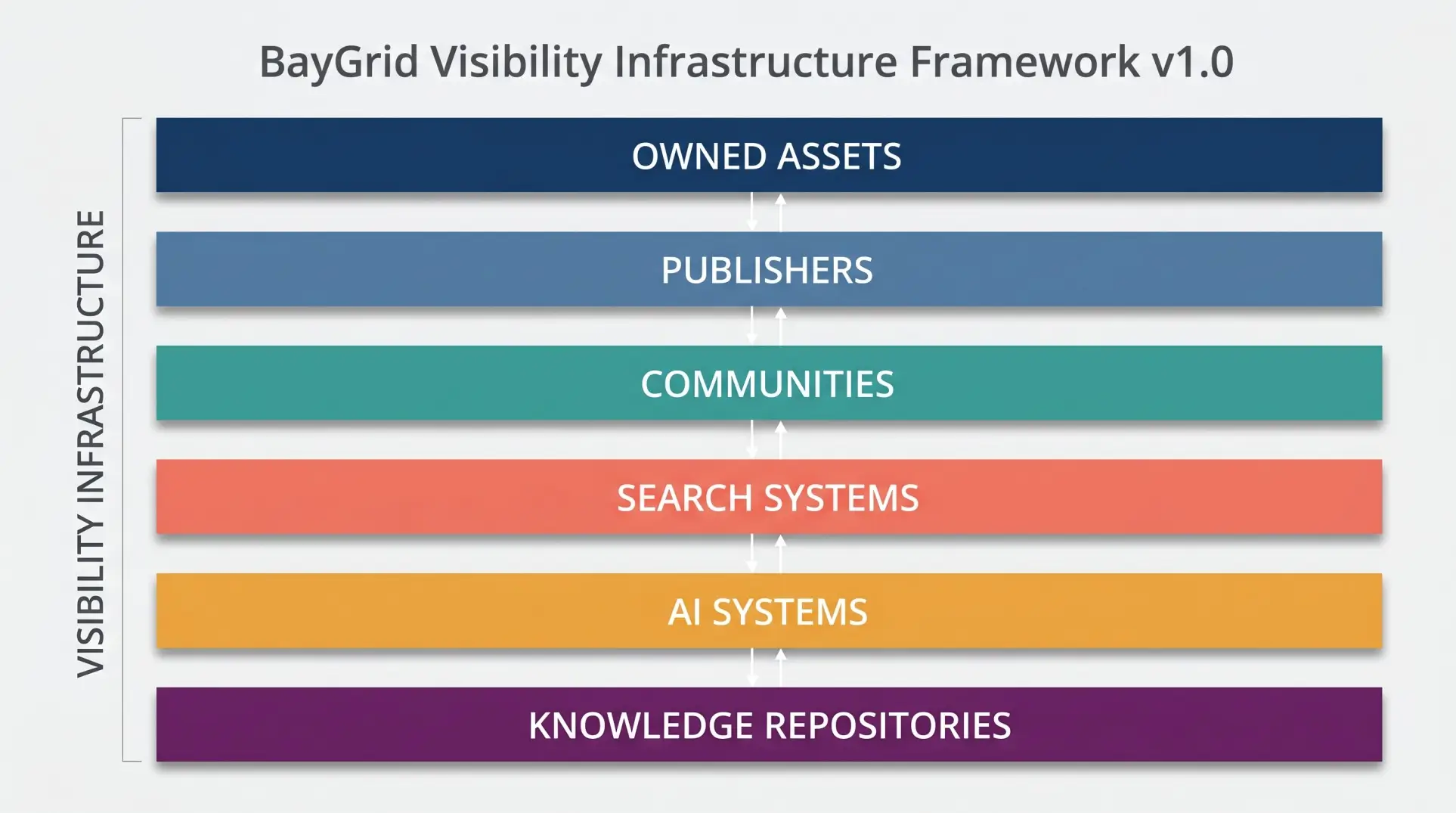
BayGrid Standard 1 | Pillar 3 — Visibility Standards
The degree to which an organisation can be discovered, recognised and understood across information environments.
Key Question: Can people find you?
Executive Summary
This paper establishes Standard 1: Hospitality Visibility, the foundational definition within the BayGrid visibility standards hierarchy. Hospitality Visibility is defined as the degree to which an organisation can be discovered, recognised and understood across information environments. This standard distinguishes visibility as a system property rather than a channel metric, and provides a layered framework for understanding its composition, measurement and application.
The standard draws upon the BayGrid Visibility Framework v1.0, which identifies five interdependent layers — Presence, Discovery, Authority, Trust and Reputation — that together constitute visibility in hospitality contexts. It further references the BayGrid Visibility Measurement Framework v1.0 for assessment methodology.
This standard is intended for researchers, industry analysts, technology vendors and hospitality operators seeking a common vocabulary and conceptual foundation for visibility-related discourse. It does not provide implementation guidance, which is addressed in subsequent standards and framework publications.
Standard Definition
Hospitality Visibility — The degree to which an organisation can be discovered, recognised and understood across information environments.
This definition contains three operative terms that require elaboration:
- Discovered — The organisation can be located by parties who do not already know of its existence. Discovery implies accessibility to new audiences, not merely availability to existing ones.
- Recognised — The organisation is identifiable as a legitimate, credible entity within its category. Recognition requires that signals of identity are present and legible across information environments.
- Understood — Sufficient information exists for evaluative decisions. Understanding does not require comprehensive knowledge; it requires that the information necessary for a stakeholder’s decision context is accessible.
The phrase across information environments is deliberately broad. Information environments include search engines, online travel agencies, social platforms, map services, review aggregators, messaging applications, voice interfaces, travel guides, media publications and interpersonal communication networks. Visibility is not confined to any single channel or platform.
Scope
Inclusions
This standard covers:
- The conceptual definition of hospitality visibility and its constituent components
- The five-layer model of visibility (Presence, Discovery, Authority, Trust, Reputation)
- Approaches to measuring visibility at the system level
- The relationship between visibility and discoverability as distinct but related concepts
- The distinction between visibility as a system property and visibility as a channel metric
Exclusions
This standard explicitly excludes:
- Specific marketing tactics or campaign methodologies
- Platform-specific search engine optimisation advice
- Brand case studies or competitive benchmarking data
- Implementation guidance (addressed in Standard 7: Visibility Infrastructure)
Assumptions
This standard assumes that visibility is a system property — an emergent characteristic of how an organisation exists within and interacts with information environments — rather than a metric that can be captured by any single channel analytics tool. This assumption underpins the layered approach to measurement and the distinction from channel-specific performance indicators.
Limitations
This standard provides definitional and conceptual foundations. It does not provide implementation guidance, technical specifications or prescriptive recommendations. Organisations seeking practical implementation pathways should consult Standard 7: Visibility Infrastructure and related framework publications.
Key Principles
Principle 1: Visibility Is a System Property, Not a Channel Metric
The most common error in visibility analysis is conflating visibility with the performance metrics of individual channels — search rankings, social media impressions, or review scores. These are indicators of specific layer performance, not measures of visibility itself. Visibility emerges from the interaction of multiple layers and cannot be reduced to any single metric. A hospitality organisation may perform well on search rankings (Discovery) yet lack the authoritative signals (Authority) that would convert discovery into meaningful engagement.
Principle 2: The Five Layers Are Interdependent
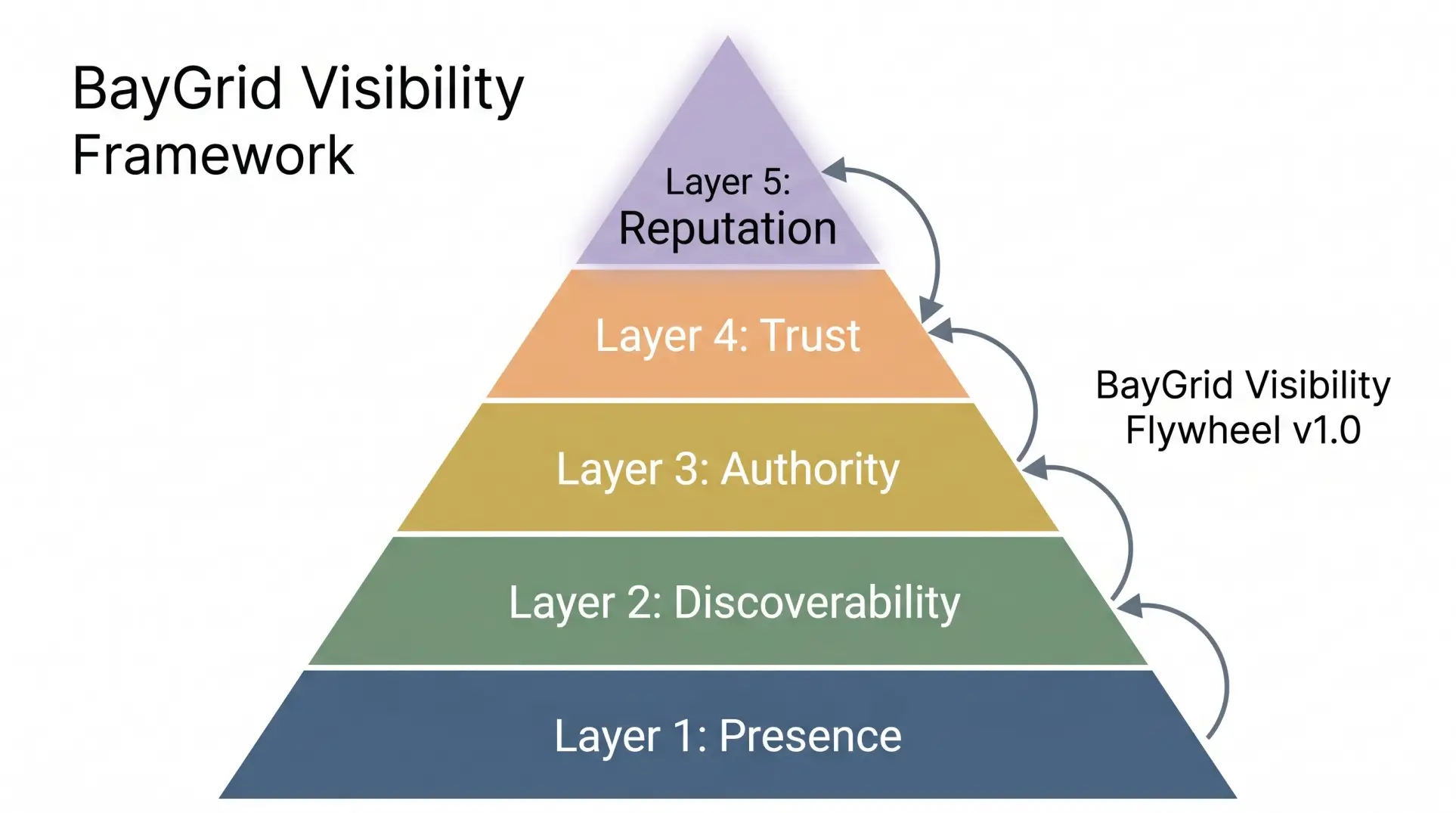
The BayGrid Visibility Framework identifies five layers that together constitute hospitality visibility:

Each layer depends upon and reinforces adjacent layers:
- Presence — The organisation exists in information environments. Without presence, no other layer can function. Presence includes listings, profiles, website existence, map data and any other form of information existence.
- Discovery — The organisation can be found by parties conducting relevant searches or explorations. Discovery depends on presence but requires additional conditions: information must be structured, positioned and accessible in ways that match how people search. See Standard 2: Discoverability for detailed treatment.
- Authority — The organisation is recognised as credible within its category. Authority signals include professional associations, media coverage, industry recognition, content quality and consistent identity markers.
- Trust — Stakeholders believe the organisation will deliver as represented. Trust is informed by reviews, ratings, testimonials, transparency signals and consistency between stated and observed characteristics.
- Reputation — The organisation is remembered and recommended. Reputation represents the cumulative effect of all other layers and manifests as recall, referral behaviour and sustained engagement.
Weakness in any layer constrains the effectiveness of all others. Strong presence without discovery capability creates invisible existence. Strong discovery without authority produces findings that do not convert. Strong authority without trust generates credibility without belief.
Principle 3: Visibility Must Be Measured at Multiple Layers
The BayGrid Visibility Measurement Framework v1.0 specifies that visibility assessment must evaluate all five layers using layer-appropriate methodologies. Single-layer measurement produces incomplete and potentially misleading results. A hospitality property with excellent review scores (Trust) but no searchable presence (Discovery) has a visibility deficit that review metrics alone would not reveal.
Principle 4: Visibility Is Dynamic, Not Static
Visibility changes continuously as information environments evolve, competitor actions shift, platform algorithms update and stakeholder behaviours transform. Visibility assessment must be periodic and contextual. A visibility profile produced at one point in time describes conditions at that moment; it does not predict future states.
Principle 5: Visibility Is Context-Dependent
Visibility is always visibility to someone for some purpose. A luxury resort may have high visibility to affluent leisure travellers and minimal visibility to corporate event planners. Visibility assessment must specify the stakeholder segment and decision context under examination. Generalised visibility claims without contextual specification are analytically weak.
Illustrative Examples
The following examples illustrate how the five-layer framework applies to hospitality visibility analysis. These are constructed scenarios for explanatory purposes, not empirical case studies.
Example 1: High Presence, Low Discovery
A boutique hotel maintains profiles on three major online travel agencies, has an operational website and appears on major map services. However, its website lacks structured data markup, its OTA profiles are incomplete and its business category classifications are inconsistent across platforms. The hotel has substantial presence but poor discovery because the conditions for being found are not met despite existing in relevant environments.
Example 2: High Discovery, Low Authority
A restaurant appears prominently in local search results due to aggressive keyword optimisation and frequent social media posting. However, it has no professional affiliations, no media coverage, no chef recognition and its online identity is inconsistent across platforms. Diners find the restaurant easily but encounter no signals that would establish it as a credible dining destination. Discovery converts poorly because authority is absent.
Example 3: High Authority, Low Trust
A hotel chain has won multiple industry awards, its general manager is a recognised industry figure and it publishes authoritative travel content. However, recent review analysis reveals consistent complaints about cleanliness and service inconsistency. The authority signals attract attention, but the trust deficit prevents conversion and generates negative reputation effects.
Example 4: Balanced Visibility Profile
An independent resort maintains consistent, complete profiles across all major platforms (Presence), ranks well for relevant search terms and appears in multiple discovery contexts (Discovery), has earned recognition from established travel publications and industry bodies (Authority), maintains strong review scores with responsive management practices (Trust), and is frequently recommended by past guests and travel professionals (Reputation). No single layer is exceptional, but the balanced profile produces robust overall visibility.
Common Misconceptions
Misconception 1: Visibility Equals Search Ranking
Search ranking measures performance within a single discovery channel. It does not capture presence on other platforms, authority signals, trust indicators or reputation effects. A hospitality organisation could rank first for relevant search terms and still have poor overall visibility if other layers are deficient. Conversely, an organisation with moderate search rankings but strong authority, trust and reputation may have superior effective visibility.
Misconception 2: Visibility Can Be Measured by a Single Metric
No single metric captures visibility. Attempts to reduce visibility to one number — whether “visibility score,” “share of voice” or “impressions” — discard the multi-layer structure that determines whether discovery leads to understanding. The BayGrid Visibility Measurement Framework requires multi-layer assessment for this reason.
Misconception 3: Visibility Is Primarily a Marketing Concern
Visibility is frequently assigned to marketing functions, but its determinants span operations (which produce trust signals), identity management (which affects presence and authority), technology infrastructure (which enables discovery) and organisational behaviour (which shapes reputation). Treating visibility as a marketing responsibility alone produces siloed efforts that cannot address structural visibility deficits.
Misconception 4: More Visibility Is Always Better
Visibility to inappropriate audiences, in irrelevant contexts or without supporting trust signals can be counterproductive. A hospitality property visible to audiences it cannot serve, or visible for attributes it does not possess, will generate mismatched expectations and negative outcomes. Visibility strategy must consider audience relevance and capability alignment, not merely maximisation.
Standard Statement
BayGrid Standard 1 — Hospitality Visibility establishes that visibility in hospitality contexts shall be understood as a system property comprising five interdependent layers: Presence, Discovery, Authority, Trust and Reputation. Visibility shall not be reduced to single-channel metrics or single-point measurements. Assessment of visibility shall evaluate all five layers within specified stakeholder and decision contexts. Visibility shall be recognised as a dynamic, context-dependent property requiring periodic reassessment. This standard provides the definitional foundation upon which subsequent standards for discoverability, authority, trust, reputation and visibility infrastructure are constructed.
Conclusion
This standard has defined Hospitality Visibility as the degree to which an organisation can be discovered, recognised and understood across information environments. It has established that visibility is a system property composed of five interdependent layers, not a channel metric subject to simple maximisation. It has distinguished visibility from related concepts — particularly discoverability, which is addressed in Standard 2 — and has identified common misconceptions that impede clear analysis.
The standard provides the conceptual foundation for the BayGrid visibility standards hierarchy. Subsequent standards address specific components of visibility (discoverability, authority, trust, reputation) and the infrastructure required to establish and maintain them. Framework publications provide analytical tools for measurement and assessment. Together, these documents constitute a comprehensive approach to understanding and evaluating hospitality visibility.
Researchers and practitioners applying this standard should maintain the distinction between visibility as a multi-layer system property and the channel-specific metrics that indicate performance within individual layers. Confusion between these levels of analysis produces incomplete assessment and ineffective strategy.