An analysis of how authority accumulates through multiple independent validating sources and the structural mechanisms that govern this accumulation
Standard Name
BayGrid Standard 8: Distributed Authority
Definition
Distributed Authority is authority accumulated through multiple validating sources. It describes the state in which an entity’s credibility and knowledge are independently confirmed by diverse sources, creating a network of reinforcing signals that collectively establish the entity’s authority position beyond what any single validation could achieve.
The central question this standard addresses is: “How is authority reinforced?” This question examines the mechanism through which authority, once established, is strengthened and sustained through the aggregation of independent confirming signals.
Distributed authority is distinguished from centralised authority, which depends on validation from a single dominant source — typically the entity itself or a sole endorsing institution. Centralised authority is structurally fragile because it concentrates the evidentiary basis for authority in one location. Distributed authority, by contrast, distributes this evidentiary basis across multiple independent points, producing greater resilience and broader recognition.
This standard operates as a component-level specification within BayGrid Standard 3: Digital Authority, providing detailed treatment of the Validation component identified in the BayGrid Authority Framework v1.0.
Scope
Inclusions
- The structural definition of distributed authority and its distinction from centralised authority
- The mechanisms through which authority accumulates across multiple validating sources
- The types of validation sources and their differential contribution to distributed authority
- The relationship between validation source diversity and authority strength
- The process of cross-source reinforcement, whereby validators independently confirm one another’s assessments
- The concept of progressive credibility transfer, whereby authority compounds as validation layers accumulate
Exclusions
- Link-building strategies or search-engine-oriented link acquisition tactics
- Public relations distribution tactics or media placement methodologies
- Paid endorsement strategies or sponsored content distribution
- Quantitative measurement of authority or authority scoring methodologies
Assumptions
- Authority is stronger when validated by multiple independent sources than when validated by a single source, even if that single source is itself highly authoritative.
- Independent validation sources are those that have no coordinated interest in confirming the entity’s authority. Coordinated validation (e.g., mutual endorsement arrangements) does not contribute to distributed authority.
- The diversity of validation sources matters. Confirmation from sources across different domains, media types, or institutional categories produces stronger distributed authority than confirmation from multiple sources within a single category.
Limitations
- This standard does not quantify authority distribution. It defines the structural mechanisms but does not prescribe metrics or scoring systems.
- This standard addresses the structural properties of distributed authority and does not examine the psychological or sociological processes through which audiences interpret validation signals.
- This standard does not provide industry-specific validation source taxonomies. Particular sectors may have distinct validation ecosystems beyond the general types identified here.
Key Principles
The accumulation of distributed authority operates through three interrelated structural processes. These processes are not sequential stages but simultaneous mechanisms that reinforce one another as validation sources accumulate.

Principle 1: Independent Validation — The Foundation of Distribution
Independent validation occurs when a source with its own credibility acknowledges, references, or relies upon an entity’s expertise without coordination or obligation. Independence is the critical condition: the validating source must have autonomous reasons for its acknowledgment. Level 1 (Confirmed)
The strength of an independent validation is a function of two variables: the credibility of the validating source and the nature of the validation act. A citation from a highly credible source carries more weight than a citation from a marginally credible source. Similarly, a substantive engagement with an entity’s expertise (e.g., building upon its research, relying upon its analysis) carries more weight than a passing mention.
Types of validation sources include, but are not limited to:
| Source Type | Validation Mechanism | Authority Contribution |
|---|---|---|
| Industry publications | Citation, reference, republication | Domain-specific authority confirmation |
| Academic institutions | Citation in research, curriculum inclusion | Rigour and methodological credibility |
| Peer organisations | Reference, endorsement, collaboration | Practitioner-level credibility |
| Media organisations | Quotation, feature, expert citation | Public credibility and reach extension |
| Institutional bodies | Endorsement, accreditation, partnership | Formal institutional credibility |
| Independent reviewers | Assessment, ranking, critical analysis | Objective third-party evaluation |
Principle 2: Cross-Source Reinforcement — The Network Effect
Cross-source reinforcement occurs when multiple independent validators indirectly confirm one another’s assessments. When Source A validates an entity, and Source B independently validates the same entity, the presence of Source B’s validation reinforces the credibility of Source A’s judgment — and vice versa. Level 2 (Supported)
This network effect is a defining characteristic of distributed authority. Each additional validator does not merely add linearly to the authority accumulation; it strengthens the evidentiary basis provided by all existing validators. The cumulative result is that distributed authority grows non-linearly with the number of independent validation sources.
Cross-source reinforcement requires that validators be genuinely independent. Coordinated validation — where multiple sources act from shared interest or arrangement — does not produce this reinforcement effect because the validators do not represent independent assessments. Audiences and the validation network itself must perceive the sources as autonomous for cross-source reinforcement to function.
Principle 3: Progressive Credibility Transfer — The Compounding Mechanism
Progressive credibility transfer describes the process whereby an entity’s authority position compounds as validation layers accumulate. Early validations provide a foundation upon which subsequent validations build. Each new validation source can reference or build upon the existing validation structure, creating layers of confirming evidence. Level 2 (Supported)
This compounding mechanism explains why entities with established distributed authority tend to accumulate additional authority more readily than entities without such a foundation. A well-validated entity is more likely to be cited by new sources because existing validations signal that the entity’s expertise is already recognised. The result is a progressive deepening of authority that becomes increasingly resistant to erosion.
Centralised Authority vs. Distributed Authority
| Property | Centralised Authority | Distributed Authority |
|---|---|---|
| Validation structure | Single dominant source or self-declaration | Multiple independent sources |
| Resilience | Fragile — depends on one point of validation | Resilient — redundancy across sources |
| Scalability | Limited by the reach of the central source | Extends through network expansion |
| Recognition breadth | Narrow — recognised within the central source’s sphere | Broad — recognised across multiple spheres |
| Susceptibility to challenge | High — challenge to the central source undermines all authority | Low — challenge to one source leaves other validations intact |
| Formation mechanism | Concentrated effort, endorsement, or self-assertion | Progressive accumulation through independent validation |
Examples
Example 1: Centralised Authority Converting to Distributed Authority
A renowned hotelier publishes a book on hospitality management through a major publisher. Initially, the hotelier’s authority is largely centralised: the publisher’s endorsement and the hotelier’s established reputation provide the primary validation. Over the following years, industry publications cite the book’s frameworks, business schools include it in curricula, competing hotel groups reference its methodologies, and industry conferences invite the hotelier to keynote. The authority transitions from centralised (dependent on the publisher and existing reputation) to distributed (confirmed by multiple independent sources across publication, academic, peer, and event channels).
Example 2: Distributed Authority in Regional Tourism
A regional tourism board produces research on visitor behaviour patterns. The research is initially validated by a state government citation. Subsequently, an academic institution references the data in a journal article, a national newspaper features the findings, an industry association distributes the research to members, and an international body includes the data in a comparative report. The tourism board’s authority on regional visitor patterns is now distributed across government, academic, media, industry, and international institutional validators. The authority is resilient: if any single validator withdraws its engagement, the remaining validators sustain the authority position.
Example 3: Fragility of Centralised Authority
A hospitality consultancy’s authority derives almost entirely from the personal reputation of its founder. The founder is widely quoted, the consultancy’s brand is synonymous with the founder’s name, and no independent institutions or publications have separately validated the consultancy’s methodologies. When the founder steps back from public visibility, the consultancy’s authority diminishes rapidly because the central validation point has been removed. This illustrates the structural fragility of centralised authority and the importance of distributing validation across multiple sources independent of any single individual.
Misconceptions
| Misconception | Correction |
|---|---|
| Distributed authority is the same as widespread visibility | Distributed authority refers to the distribution of validation sources, not the distribution of visibility. An entity may have distributed authority within a narrow field with limited overall visibility. |
| Any multiple references constitute distributed authority | Distributed authority requires independent validation. Multiple references from sources with shared interests, coordinated arrangements, or common ownership do not produce genuine distributed authority. |
| Distributed authority can be manufactured | Because distributed authority depends on independent validation, it cannot be directly manufactured by the entity seeking authority. The entity can create conditions favourable to validation (through expertise and distribution), but the validation itself must be independently conferred. |
| More validation sources always produce stronger authority | Quality and independence of validators matter more than quantity. A smaller number of highly credible, genuinely independent validators may produce stronger distributed authority than a larger number of marginally credible or non-independent validators. |
| Distributed authority is permanent once established | Distributed authority can erode if validation sources lose credibility, withdraw their validation, or if the entity’s expertise diminishes. The progressive nature of authority accumulation works in both directions. |
Related Standards and Frameworks
BayGrid Authority Framework v1.0
This standard applies the BayGrid Authority Framework v1.0 to examine the Validation component in detail. The framework’s five components — Expertise, Validation, Consistency, Distribution, and Recognition — provide the structural context within which distributed authority operates. This standard should be read in conjunction with the framework for a complete understanding of how validation interacts with the other authority components.
BayGrid Standard 3: Digital Authority
BayGrid Standard 3: Digital Authority defines the broader concept of which distributed authority is a specific mechanism. Digital authority addresses the perceived credibility and knowledge of a source; distributed authority addresses how that perception accumulates through multiple validating sources. The two standards are complementary, with this standard providing the detailed treatment of the validation accumulation process.
BayGrid Standard 1: Hospitality Visibility
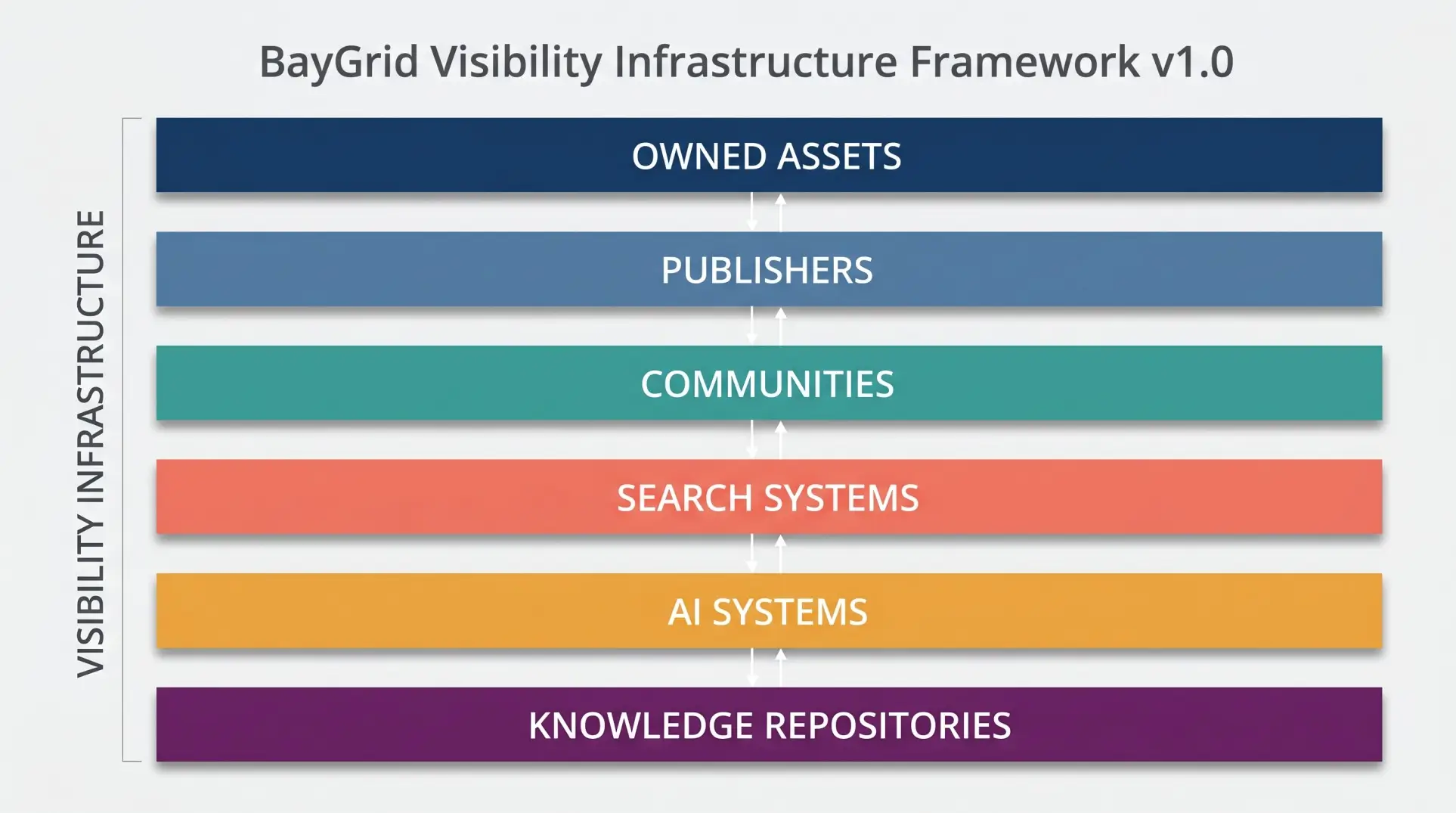
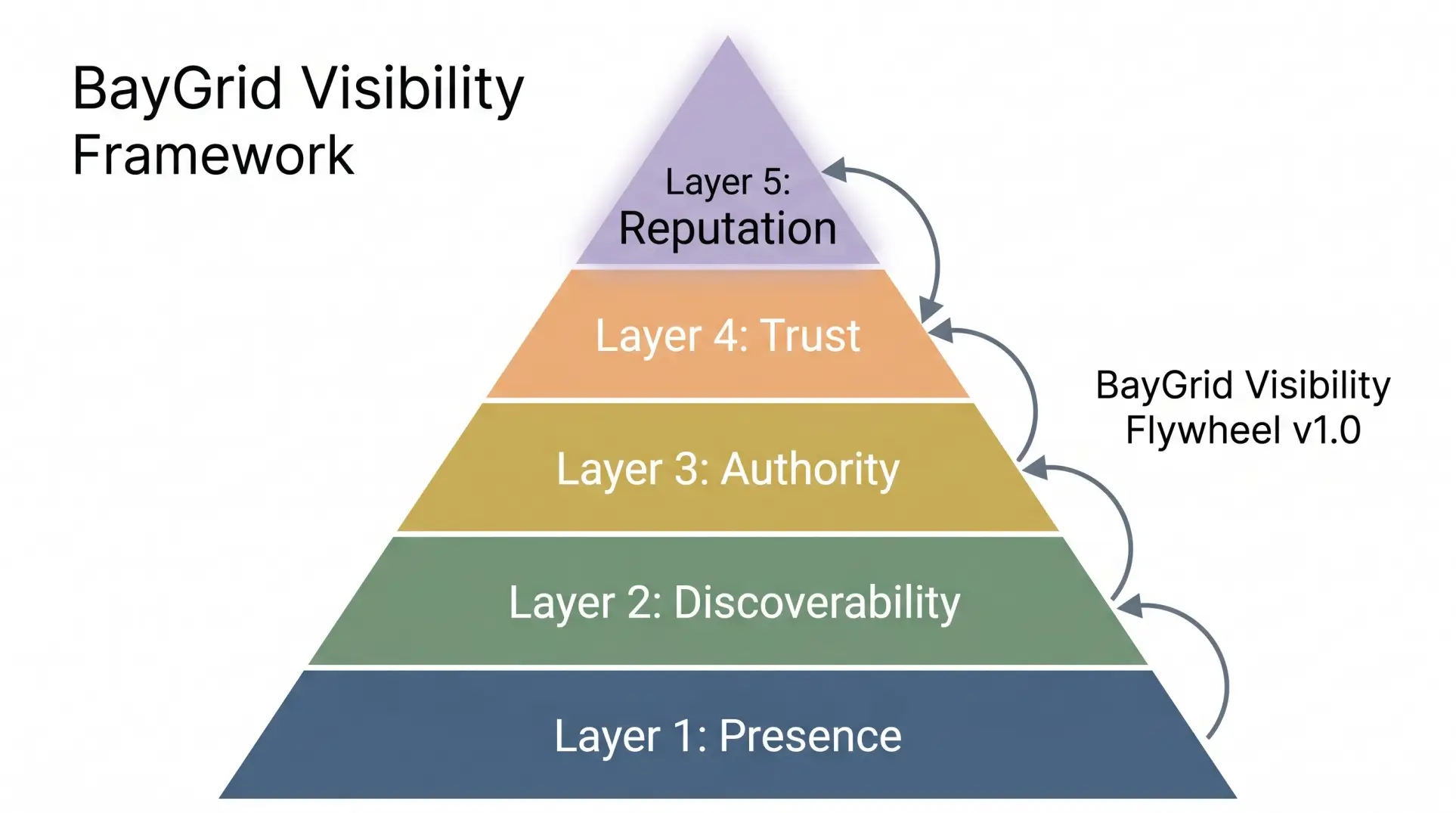
BayGrid Standard 1: Hospitality Visibility defines the conditions under which hospitality entities achieve perceptual presence with their audiences. Visibility is a precondition for distributed authority because validators must be able to encounter and assess an entity’s expertise before they can validate it. This standard examines what happens after visibility enables the validation process.
BayGrid Standard 30: Hospitality Ecosystem
BayGrid Standard 30: Hospitality Ecosystem examines the network of relationships and interactions that constitute the hospitality sector. The hospitality ecosystem provides the context within which distributed authority operates: the entities, institutions, and channels that form the potential validation network for hospitality-specific authority.
BayGrid Research: Distributed Authority In Hospitality
The research paper on distributed authority in hospitality provides sector-specific analysis of how distributed authority functions within the hospitality industry, offering applied examples and contextual observations that complement this standard’s structural treatment.
BayGrid Standard 23: Digital Trust
BayGrid Standard 23: Digital Trust addresses the reliability and integrity of digital systems and interactions. While distributed authority concerns the accumulation of credibility perception, digital trust concerns the systems and processes that enable trustworthy interactions. Where distributed authority establishes that a source should be believed, digital trust establishes that systems can be relied upon.
Standard Statement
BayGrid Standard 8: Distributed Authority establishes that authority accumulates through multiple independent validating sources, creating a network of reinforcing signals that exceeds the authority capacity of any single source. Distributed authority operates through three interrelated structural processes: independent validation, cross-source reinforcement, and progressive credibility transfer.
Distributed authority is distinguished from centralised authority by its structural resilience, its dependence on independent rather than coordinated validation, and its capacity to compound over time as additional validation layers accumulate. Centralised authority depends on a single validation point and is structurally fragile; distributed authority distributes the evidentiary basis for credibility across multiple independent points and is structurally robust.
The central question this standard poses is: “How is authority reinforced?” The answer requires examining the network of independent validation sources that confirm an entity’s expertise, the cross-source reinforcement that strengthens each validator’s assessment, and the progressive credibility transfer that compounds authority over time. Authority that is genuinely distributed cannot be manufactured, purchased, or self-declared; it must be independently conferred and progressively accumulated.
References
- BayGrid Authority Framework v1.0 — BayGrid Research Initiative.
- BayGrid Standard 1: Hospitality Visibility — BayGrid Standards Collection.
- BayGrid Standard 3: Digital Authority — BayGrid Standards Collection.
- BayGrid Standard 23: Digital Trust — BayGrid Standards Collection.
- BayGrid Standard 30: Hospitality Ecosystem — BayGrid Standards Collection.