BayGrid Standard 2 | Pillar 3 — Visibility Standards
The ease with which information can be located.
Key Question: Can people access information?
Executive Summary
This paper establishes Standard 2: Discoverability, defining it as the ease with which information can be located. Discoverability is distinguished from the broader concept of Hospitality Visibility (Standard 1), of which it is a necessary but insufficient component. While visibility encompasses the full system of how organisations are discovered, recognised and understood, discoverability focuses specifically on the accessibility of information — the bridge between existence and access.
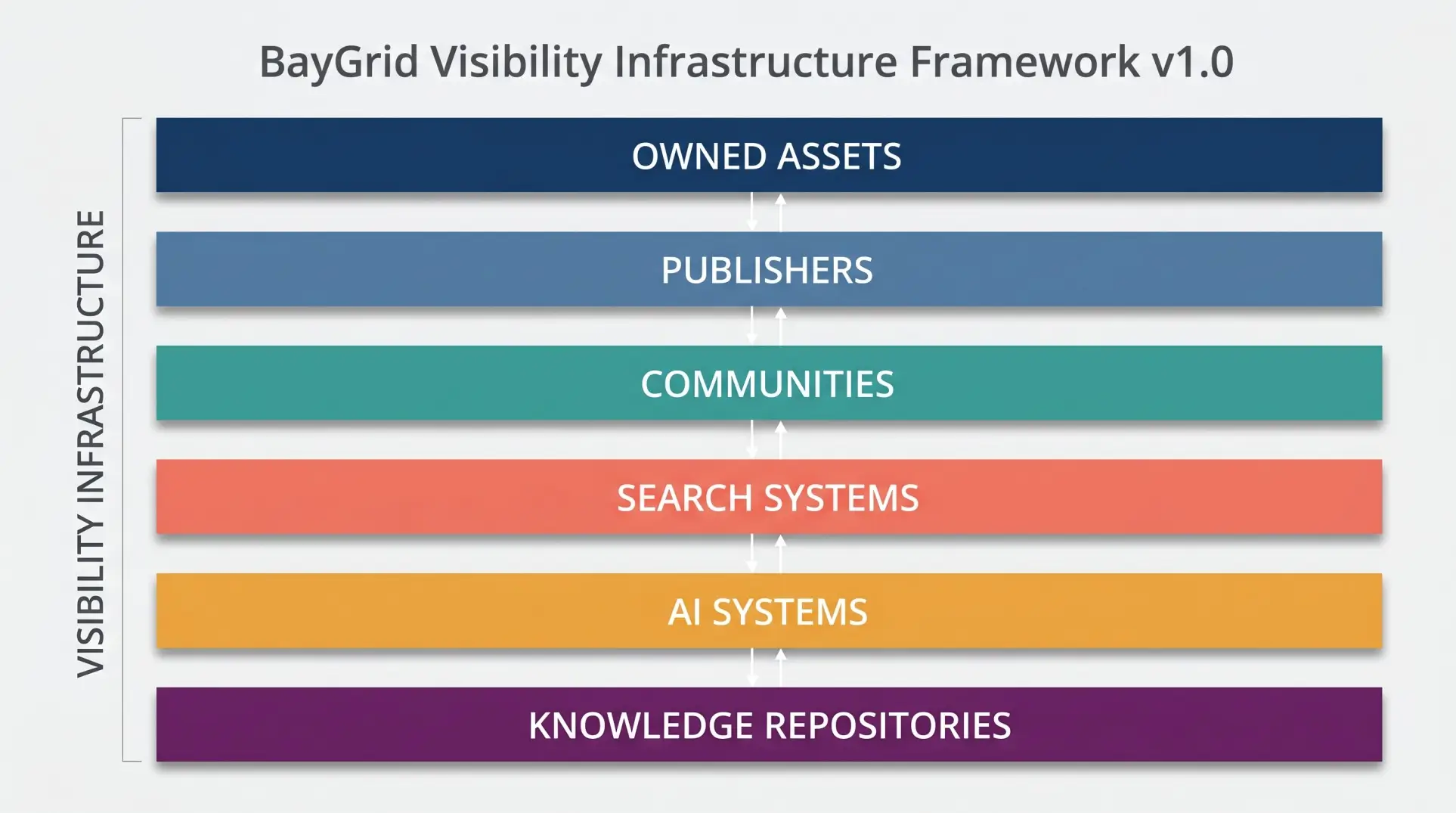
This standard identifies three sub-dimensions of discoverability — findability, navigability and push accessibility — and establishes how discoverability relates to the broader BayGrid Visibility Framework v1.0. It also examines how information flows through hospitality ecosystems via the BayGrid Information Flow Model v1.0, providing a systems-level understanding of how discovery occurs.
The distinction between visibility and discoverability is not merely terminological. It is operationally significant: organisations can possess visibility (strong authority, trust and reputation) yet suffer from poor discoverability (information that exists but cannot be located). Conversely, organisations can achieve high discoverability without possessing meaningful visibility if the information discovered lacks supporting authority or trust signals.
Standard Definition
Discoverability — The ease with which information can be located.
This definition emphasises ease rather than possibility. Information that exists but requires substantial effort to locate is discoverable in principle but poor in practice. The standard concerns itself with the practical accessibility of information, recognising that in information-rich environments, ease of location determines whether information is effectively accessed at all.
The phrase information can be located is intentional. Discoverability is a property of information, not of organisations per se. An organisation’s discoverability is determined by the discoverability of the information associated with it — its name, location, offerings, attributes, contact details and evaluative signals. This distinction matters because improving discoverability requires attention to information structure, placement and accessibility, not merely to organisational presence.
Scope
Inclusions
This standard covers:
- The conceptual definition of discoverability and its distinction from visibility
- The three sub-dimensions of discoverability: findability, navigability and push accessibility
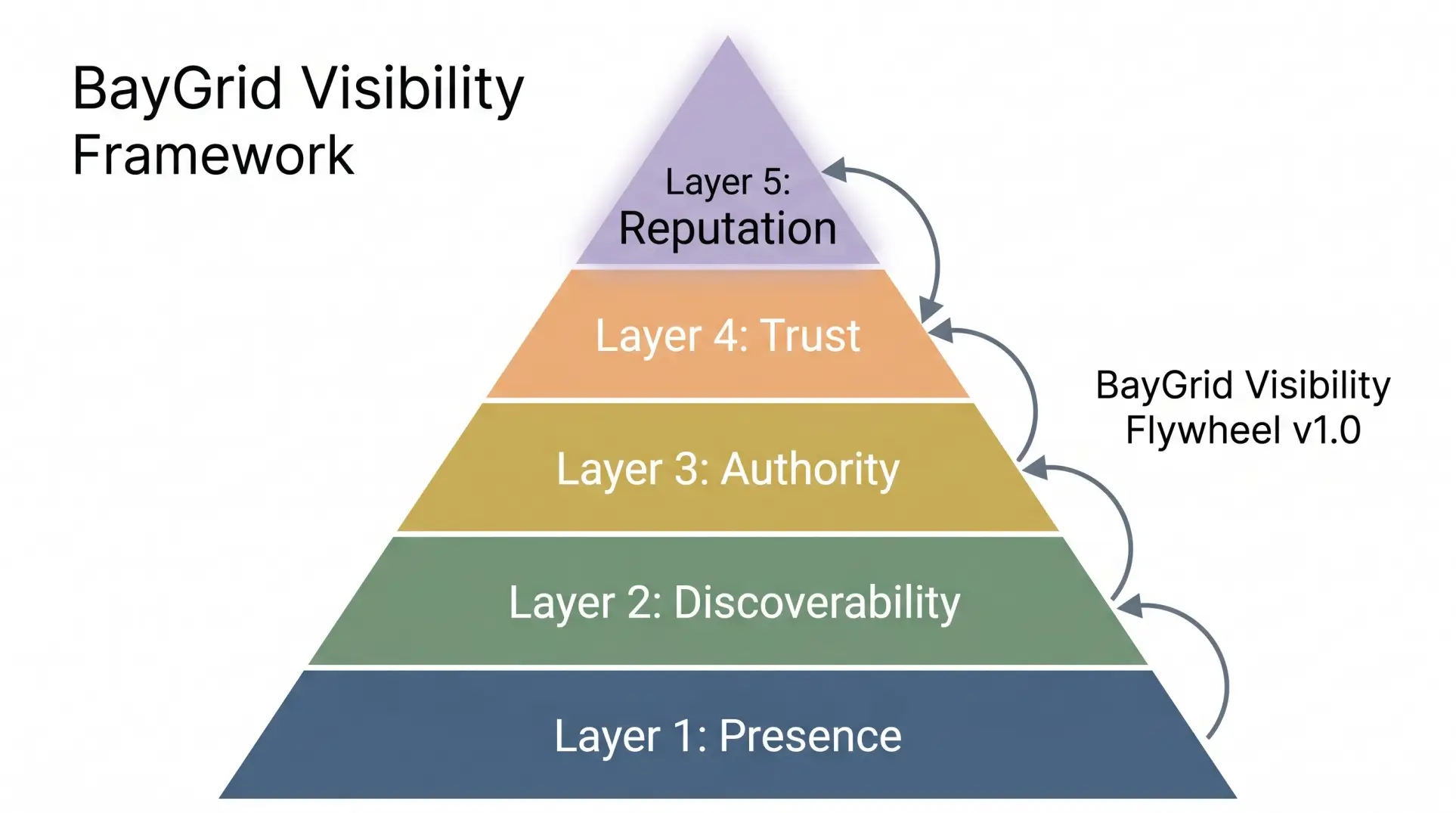
- The relationship between discoverability and the second layer of the Visibility Framework
- Measurement approaches for discoverability across different information environments
- Information accessibility as a structural property of hospitality ecosystems
Exclusions
This standard explicitly excludes:
- Search engine optimisation techniques or platform-specific algorithm guidance
- Technical implementation guides for structured data, metadata or indexing
- Platform algorithm analysis or ranking factor studies
- Channel-specific tactical recommendations
Assumptions
This standard assumes that discoverability is a subset of visibility focused specifically on information accessibility. It further assumes that discoverability is a structural property of how information is organised, represented and distributed across information environments, not merely a function of marketing effort or content volume.
Limitations
This standard addresses discoverability in general terms applicable across information environments. It does not cover all possible discovery channels exhaustively, nor does it address channel-specific optimisation. The principles established here apply to search engines, online travel agencies, social platforms, map services, review aggregators, voice interfaces, messaging systems and other discovery contexts, but implementation in each context requires additional channel-specific analysis.
Key Principles
Principle 1: Discoverability Is a Necessary but Insufficient Component of Visibility
Discoverability is one of five layers in the BayGrid Visibility Framework v1.0. It occupies the second layer, building upon Presence and enabling Authority. Without presence, nothing can be discovered. Without discovery, authority signals cannot be accessed. Discoverability thus functions as a critical gateway: information must be located before it can be evaluated, trusted or remembered.

However, discoverability alone does not constitute visibility. An organisation whose information is easily located but lacks authority signals, trust indicators or reputation will achieve discovery without the outcomes that visibility is intended to produce. The relationship is sequential but not sufficient: discovery enables evaluation, but evaluation requires the upper layers.
Principle 2: Discoverability Has Three Sub-Dimensions
Discoverability operates across three distinct modes, each representing a different way that information is located:
- Findability — The capacity of information to be located through directed search. Findability concerns whether information appears when specific queries are submitted to search systems. It depends on information structure, query matching, relevance signals and retrieval system design. Findability is search-initiated: the user knows what they are looking for and attempts to locate it.
- Navigability — The capacity of information to be located through browsing, exploration and traversal of information structures. Navigability concerns whether information is encountered when users explore categories, maps, lists or related content. It depends on classification accuracy, structural placement, cross-referencing and browse-path design. Navigability is exploration-initiated: the user does not know precisely what they seek but discovers it through traversal.
- Push Accessibility — The capacity of information to reach users through recommendation, suggestion and algorithmic distribution. Push accessibility concerns whether information is presented to users who have not actively sought it. It depends on algorithmic matching, recommendation system design, signal strength and distribution network characteristics. Push accessibility is system-initiated: the information environment presents the information to the user.
These three sub-dimensions are not mutually exclusive. Information can be findable, navigable and push-accessible simultaneously. However, they require different conditions and are assessed through different methods. A hospitality organisation may be highly findable (strong search performance) but poorly navigable (poor category placement) or weak in push accessibility (not recommended by algorithmic systems). Complete discoverability assessment must evaluate all three sub-dimensions.
Principle 3: Discoverability Is Information-Structure Dependent
The ease with which information can be located depends critically on how that information is structured, labelled, connected and represented. Information that is unstructured, inconsistently labelled, poorly connected or inadequately represented will be difficult to locate regardless of its inherent quality or relevance. This principle has significant implications for hospitality organisations: the discoverability of a property is determined not only by what it is but by how information about it is organised across information environments.
Principle 4: Discoverability Varies Across Information Environments
Discoverability is environment-specific. Information that is easily discovered on one platform may be difficult to locate on another. Information that is findable through search may not be navigable through browse. Information that is push-accessible on one service may be invisible on another. Assessment of discoverability must specify the environment or environments under examination. Claims about discoverability without environmental specification are analytically incomplete.
Principle 5: Emerging Discovery Systems Transform Discoverability
The emergence of AI systems as discovery engines is transforming how information is located in hospitality contexts. Large language models, conversational search interfaces and AI-powered recommendation systems operate on different principles than traditional keyword-based search or category-based browsing. These systems may locate and synthesise information from sources that traditional search would not surface, while simultaneously failing to surface information that lacks the patterns these systems recognise. This transformation is examined in the BayGrid publication on The Future of Hospitality Discoverability.
Discoverability and Visibility: Distinction and Relationship
The relationship between discoverability and visibility requires careful articulation, as the terms are frequently conflated in industry discourse.
| Dimension | Visibility (Standard 1) | Discoverability (Standard 2) |
|---|---|---|
| Definition | Degree to which an organisation can be discovered, recognised and understood | Ease with which information can be located |
| Scope | System-wide, five-layer model | Single layer, focused on information accessibility |
| Key question | Can people find you? | Can people access information? |
| Concerns | Presence, discovery, authority, trust, reputation | Findability, navigability, push accessibility |
| Measurement | Multi-layer assessment across all five layers | Layer-specific assessment of information accessibility |
| Relationship | Parent concept | Subset — one of five visibility layers |
The operational significance of this distinction can be illustrated through two scenarios:
High visibility, low discoverability: A heritage hotel possesses strong authority (historical significance, architectural recognition), high trust (exceptional reviews over decades) and substantial reputation (frequently recommended by travel professionals). However, its information is inconsistently structured across platforms, its digital profiles are incomplete and it appears under varying names in different systems. The hotel is visible in the system-wide sense — it possesses the upper-layer attributes — but its discoverability is poor because the information enabling access is fragmented and inaccessible.
High discoverability, low visibility: A newly opened restaurant achieves prominent placement in search results, map listings and recommendation feeds through optimised information structure and active profile management. Its information is highly accessible. However, it lacks authority signals (no media coverage, no professional recognition), has insufficient trust data (few reviews, no track record) and has not had time to develop reputation. The restaurant is highly discoverable but has limited visibility because discovery does not lead to the recognition, understanding and confidence that visibility encompasses.
These scenarios demonstrate that visibility and discoverability, while related, require separate assessment and distinct strategic attention.
Measurement of Discoverability
Discoverability measurement evaluates how easily information can be located across the three sub-dimensions. The BayGrid Visibility Measurement Framework v1.0 provides the overarching methodology; this section specifies how discoverability is assessed within that framework.
Findability Assessment
Findability is assessed by testing whether information appears in response to relevant queries across major search environments. Assessment considers:
- Appearance for branded queries (organisation name, variants, common misspellings)
- Appearance for category queries (relevant service type, location, attribute combinations)
- Appearance for problem-statement queries (queries expressing needs the organisation addresses)
- Position and prominence of results when appearance occurs
- Cross-platform consistency of findings
Navigability Assessment
Navigability is assessed by testing whether information is encountered through exploration of information structures. Assessment considers:
- Category placement accuracy (whether the organisation appears in relevant categories)
- Map-based discovery (whether the organisation appears when relevant geographic areas are explored)
- Related content surfacing (whether the organisation appears as related to relevant entities)
- Browse-path coverage (whether the organisation can be reached through common navigation patterns)
Push Accessibility Assessment
Push accessibility is assessed by evaluating whether information is distributed through recommendation and suggestion systems. Assessment considers:
- Recommendation system inclusion (whether the organisation appears in relevant recommendations)
- Algorithmic distribution reach (breadth of platforms distributing information)
- Feed and list inclusion (appearance in curated lists, trend reports, editorial features)
- Social sharing patterns (whether information is transmitted through interpersonal networks)
Complete discoverability assessment requires evaluation across all three sub-dimensions and multiple information environments. Single-dimension or single-environment assessment produces incomplete understanding.
Illustrative Examples
The following examples illustrate discoverability principles in hospitality contexts. These are constructed scenarios for explanatory purposes.
Example 1: Findability Without Navigability
A resort hotel ranks prominently for its brand name and location-based searches (high findability) but does not appear in relevant category browses on major online travel agencies because its property type classification is incorrect. Guests who search for it directly find it easily; guests who browse for resorts in its region do not encounter it.
Example 2: Navigability Without Push Accessibility
A neighbourhood restaurant appears correctly on map services and in local dining categories (navigable) but is never recommended by food discovery applications or algorithmic suggestion systems because its profile lacks the engagement signals these systems weight. Diners exploring the area find it; diners relying on recommendations do not.
Example 3: Push Accessibility Without Findability
A hotel appears frequently in social media influencer content and travel recommendation newsletters (push accessible) but does not rank for relevant search terms because its website lacks structural optimisation and its OTA profiles are incomplete. Audiences encountering recommendations can find it; audiences conducting independent searches cannot.
Example 4: Comprehensive Discoverability
A boutique hotel group maintains complete, consistent profiles across all major platforms with accurate structured data (findable), correct category placements and map coordinates (navigable), and active engagement that generates recommendation system inclusion (push accessible). Information about the group is locatable through any of the three discovery modes.
Common Misconceptions
Misconception 1: Discoverability and Visibility Are Synonymous
This is the most common error in visibility discourse. Discoverability is one component of a five-layer visibility system. Conflating the terms leads to strategic confusion: organisations optimise for discovery while neglecting authority, trust and reputation, or conversely invest in upper-layer attributes while their information remains difficult to locate.
Misconception 2: Discoverability Is Exclusively About Search
Search-based findability is only one of three discoverability sub-dimensions. Organisations that optimise exclusively for search performance may neglect navigability (browse-based discovery) and push accessibility (recommendation-based discovery). In hospitality, significant discovery occurs through map exploration, category browsing, recommendation systems and social transmission — channels that operate on principles distinct from keyword search.
Misconception 3: Discoverability Can Be Solved by Adding More Information
Volume of information does not determine discoverability. Information structure, consistency, placement and connection matter more than quantity. Information that is abundant but poorly structured, inconsistently labelled or inadequately connected may be less discoverable than concise, well-structured information. The principle of information-structure dependency means that attention to how information is organised exceeds attention to how much information exists.
Misconception 4: Discoverability Is Static Once Achieved
Discoverability changes as information environments evolve. Platform algorithm updates, category structure changes, competitor entry, information decay and shifts in user behaviour all affect how easily information can be located. Discoverability requires ongoing maintenance, not one-time optimisation.
Standard Statement
BayGrid Standard 2 — Discoverability establishes that discoverability in hospitality contexts shall be understood as the ease with which information can be located, distinct from but necessarily related to the broader concept of Hospitality Visibility (Standard 1). Discoverability shall be assessed across three sub-dimensions: Findability (search-based location), Navigability (browse-based location) and Push Accessibility (recommendation-based distribution). Discoverability shall be recognised as a structural property of information, dependent upon information structure, placement and connection across information environments. Discoverability shall not be conflated with visibility, search performance, or information volume. This standard provides the definitional foundation for assessing and improving the accessibility of hospitality information across all discovery contexts.
Conclusion
This standard has defined Discoverability as the ease with which information can be located, distinguishing it from the broader concept of Hospitality Visibility while establishing its position as a critical layer within the visibility system. It has identified three sub-dimensions — findability, navigability and push accessibility — that together constitute complete discoverability, and has demonstrated why each requires separate assessment.
The distinction between visibility and discoverability is operationally consequential. Organisations that conflate the concepts risk optimising for one while neglecting the other. Organisations that maintain the distinction can assess discoverability independently, identify specific accessibility deficits, and address them through information structure improvements rather than broad visibility campaigns.
As AI systems increasingly function as discovery engines, the principles established in this standard become more significant, not less. AI-powered discovery operates on information structures, patterns and connections — precisely the elements that determine discoverability as defined here. Organisations with strong information structure will be discoverable by emerging systems; organisations relying on traditional search optimisation alone may find their discoverability diminished as discovery mechanisms evolve.
This standard provides the definitional and conceptual foundation for discoverability analysis within the BayGrid standards hierarchy. It should be applied in conjunction with Standard 1: Hospitality Visibility for complete visibility assessment, and with Standard 7: Visibility Infrastructure for implementation guidance.